Would it improve the final tooth?
The crown’s look, bite and cleaning access depend on implant position. Ask whether a guide is expected to make a meaningful difference to that crown in your case.


Not every implant needs a surgical guide, and not every guide earns its place. From Puslinch, weigh the question honestly: what guidance could add to your case, what records and steps it brings with it, how fit is verified, and when another method is just as sound.
Plenty of implants are placed without one. A surgical guide is a custom template, produced from 3D imaging and scans, that sits on teeth or tissue and helps steer certain steps toward a planned position. It can be valuable in some cases and add little in others. The useful question is not whether guides are modern, but what one would do for your particular site.
Answering that takes a proper assessment. The replacement tooth, the bone, any nearby nerve or sinus, the gum and the room available for instruments all come into it. Where those are straightforward, the case for a guide may be modest. Where they are tight or complex, it may be stronger. Either way, a guide never makes a doubtful site suitable, and it does not stand in for the surgeon’s clinical view.
Coming in from Puslinch, you can put the question to us directly. Ask what a guide would add, which steps it would cover, how its fit would be checked, and what the plan is if it cannot be used. A clear, case-specific answer is worth more than a general promise that technology improves every implant.
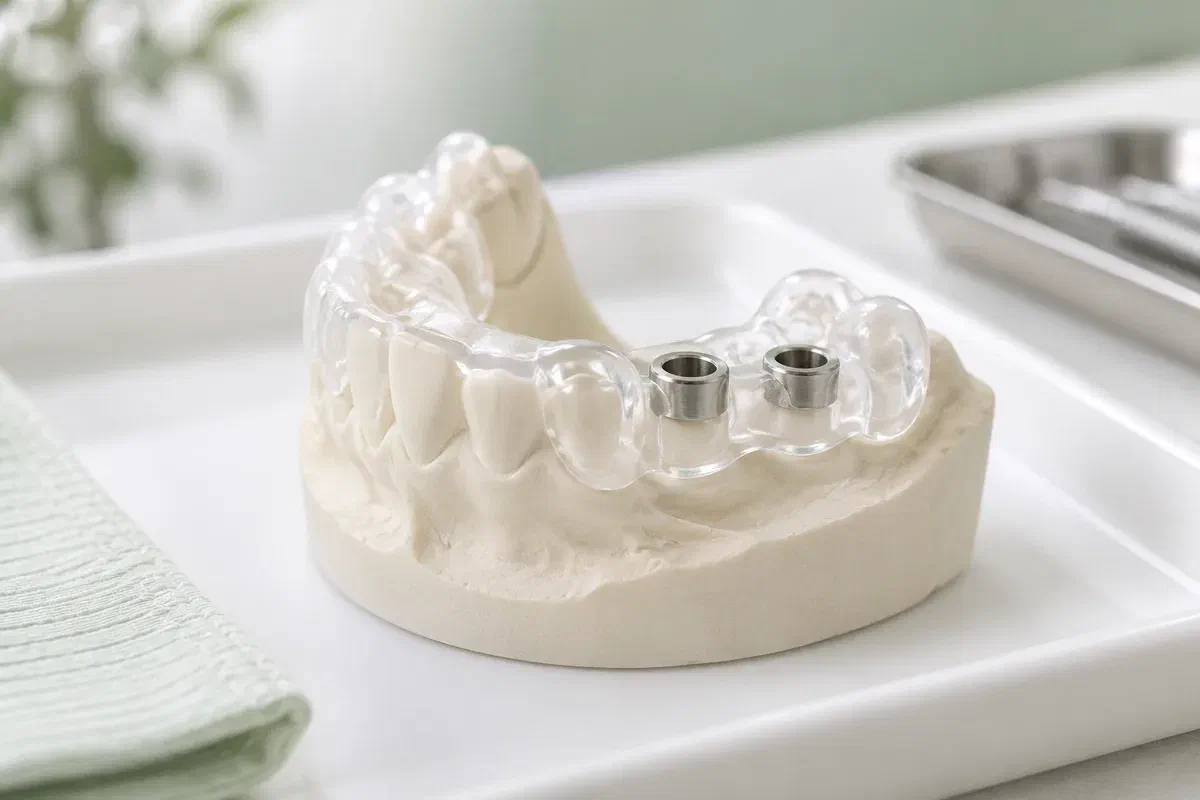
A guide earns its place within one specific plan. You should hear what it is meant to improve, what it needs in order to work, and what it adds in time and cost.
The crown’s look, bite and cleaning access depend on implant position. Ask whether a guide is expected to make a meaningful difference to that crown in your case.
Limited space or nearby structures can strengthen the case for guidance. Even so, a margin for uncertainty and a check of instrument access are still needed.
Guidance often means extra records, design time and manufacturing. Ask what it adds in cost and visits, and which steps still rely on other methods.
Choosing a guide is a decision about positioning. It does not by itself bring flapless surgery, a same-day tooth, freedom from discomfort or quicker healing.
In the right case, a guide offers a physical reference that relates the planned position to the actual site. The benefit depends on accurate records, sound design and manufacture, a stable seat and careful use. Weak links anywhere reduce it.
Judgement remains at the centre whichever method is chosen. Some difference between planned and final position is possible, and the surgeon must adapt to findings. It is reasonable to ask why guidance is, or is not, being recommended to you.
Patient information: International Team for Implantology — computer-guided implant surgery
Digital planning brings the future tooth and the implant into the same view, which can help in cases where small changes in position would affect appearance or cleaning.
A guide relies on reliable imaging and surface scans. Ask how they are matched and whether anything in your mouth might change before surgery and affect fit.
If the guide does not seat properly, it should not be used just because it was paid for. Ask how the surgeon would decide and what might change.
Whether a guide is used, the general sequence is similar. Ask who plans, who produces any guide, who places the implant and who completes the crown, particularly if care is shared.
This first question has nothing to do with technology. Your mouth, general health and the alternatives, such as a bridge or partial denture, are reviewed along with the risks. Only then does it make sense to plan an implant in detail.
Imaging and examination shape the planned position. At this point the team weighs whether a guide would genuinely add value, what it could rest on, how instruments would reach, what lies nearby, and whether bone work or a referral is needed.
When a guide is part of the plan, it is tried in and its seating confirmed before any guided step. Should it rock or sit wrongly, the surgeon switches to the method you already discussed together.
How long you wait for the crown, and how often you are seen, comes down to healing. Whichever method was used, the gum and implant are examined before the restoration is started.
What you need to do afterwards depends on what was performed, such as an extraction, a graft or a temporary tooth. Follow the written instructions, not assumptions about the method.
Ask how to clean near the site, what to eat and how to handle a temporary appliance. Feeling fine early on does not mean the site has healed.
Keep the instruction sheet and our number to hand. Get in touch about any symptom it lists, anything that moves, or trouble with a temporary tooth.
After the crown is in, daily cleaning and professional reviews help keep the gum and bone around the implant healthy for the long term. Ask which brushes or floss suit the shape of your crown, and how often you should come in for a check.
Every case is different, so treat these as general points and ask how they apply to the plan in front of you.
Visit our Bronte Street practice for an implant assessment. We will look at the site, explain whether a guide would add anything, and outline any records or specialist input that could help.
Bring any X-rays or treatment plans you already have and tell us what you are hoping to understand.
