Does the surgeon know the crown plan?
The implant position should support the tooth your dentist intends to make. Ask how the surgical and restorative sides agree on that position before anything is manufactured.


A guided implant can involve a planning team, a lab, a surgeon and the dentist who makes the crown. From Rockwood, learn who usually does what, how records and the surgical guide pass between them, how fit is confirmed, and who to call at each stage.
It surprises some people how many professionals can be involved in a single implant. Your dentist may plan the final tooth, a specialist may place the implant, and a laboratory may make the surgical guide and the crown. The guide itself is a custom template made from 3D imaging and scans. It seats on teeth or tissue and helps direct selected steps toward a position agreed in advance.
That agreement is the real work. Everyone needs to understand the planned tooth, the bone, any nearby nerve or sinus, the gum and whether instruments can reach. A guide passes those decisions from planning to surgery but does not make them. It cannot turn a poor site into a good one, and whoever performs the surgery remains responsible for judging what is appropriate.
If you are travelling from Rockwood, knowing who is responsible for each step saves confusion later. Ask who plans the position, who makes and checks the guide, which clinician performs the surgery, and who builds the crown. Ask, too, what happens if the guide cannot be used. Clear roles are worth more than any claim that a digital plan has removed uncertainty.
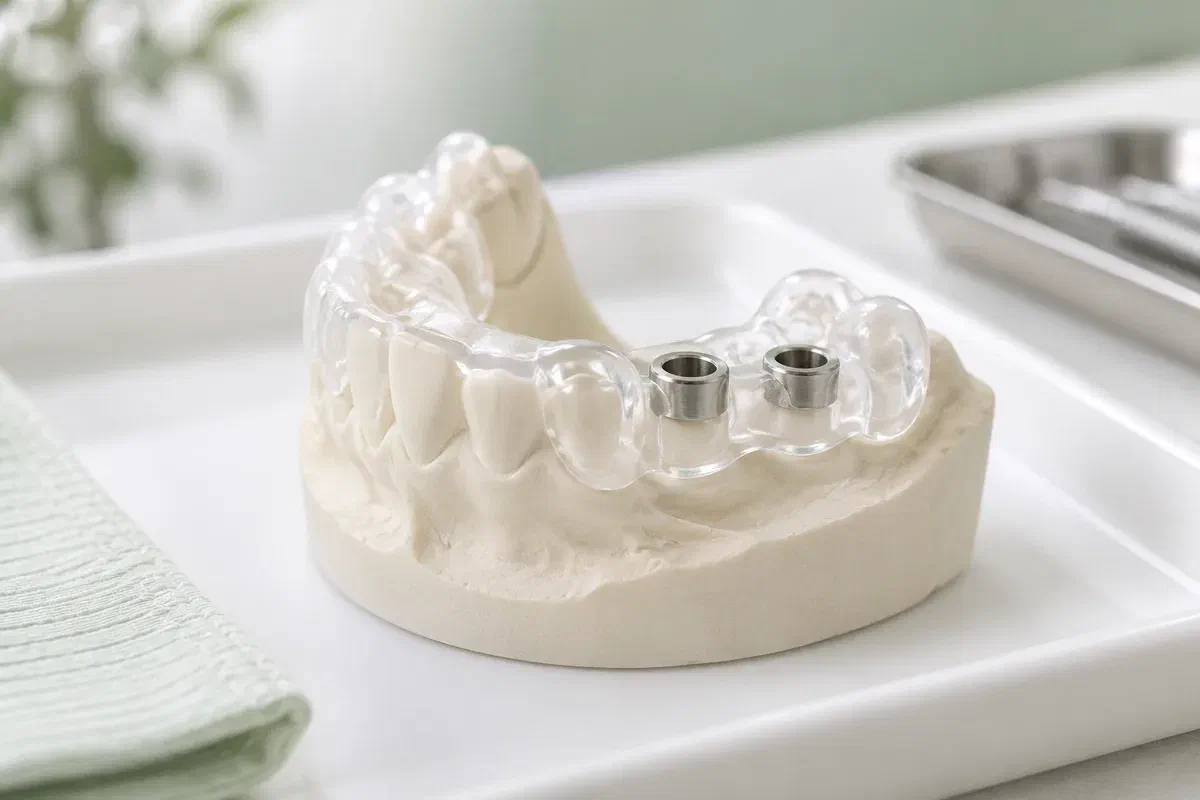
A guide serves one plan shared by everyone involved. The discussion should explain what it is meant to help with, what it depends on, and how information moves between clinicians.
The implant position should support the tooth your dentist intends to make. Ask how the surgical and restorative sides agree on that position before anything is manufactured.
Imaging reveals nearby structures and access limits. The person performing surgery should review it, and the plan still needs a margin for uncertainty in the mouth.
Ask which steps would be guided and which done otherwise, and who will explain the limitations, costs and any additional records or appointments involved.
Guided describes how the implant is positioned, whoever places it. It does not mean no incision, a tooth on the same day, no discomfort or shorter healing.
When several people work on one implant, a guide can act as a physical record of the agreed position. Its usefulness still depends on good imaging and scans, careful design and manufacture, a stable fit and correct use during surgery.
It does not replace communication or judgement. The achieved position can differ from the plan, and the surgeon must respond to findings. Ask why guidance is proposed and how each person involved accounts for its limitations.
Patient information: International Team for Implantology — computer-guided implant surgery
Digital planning lets the restoring dentist and the surgeon look at the future tooth and implant together, so position decisions reflect appearance, function and cleaning.
The guide depends on imaging and surface scans that may move between offices. Ask how they are checked and what happens if your mouth changes in the meantime.
If the guide does not seat, it should not be used regardless. Ask who decides on the alternative and how the rest of the team will be informed.
Every team and guide system works a little differently. Ask for the names or roles responsible for planning, guide production, surgery and the crown, so you always know who to contact.
The mouth, health history and replacement options are reviewed and the risks discussed. If an implant looks reasonable, records are arranged and a specialist may be brought in.
Imaging informs where the implant should go. Surgeon and restoring dentist consider the guide’s support, access, anatomy and any grafting, and the guide is then designed and made.
Before use, the guide is seated and checked. Should it fail that check, the surgeon falls back on an approach discussed in advance rather than relying on a template that does not sit properly.
After healing is reviewed, the crown stage begins. Ask who decides the implant is ready and how that information reaches the dentist making your tooth.
Recovery instructions come from the clinician who performed the surgery, and they reflect whatever else happened that day, such as a tooth removal, bone graft or temporary tooth. Keep that written sheet and follow it, even if advice you were given for another procedure was different.
Find out how to keep the area clean, what is sensible to eat for the first while, and how a temporary tooth or appliance should be worn and cleaned. Feeling settled on the first evening is encouraging, but bone and gum take longer than that.
Keep the surgeon’s instructions and contact details handy for the healing period, and know when questions should go to your regular dentist instead.
Once the crown is in, daily cleaning and regular reviews continue. Ask who will monitor the implant over the years and how any concern will be referred.
Arrangements differ between practices and cases. Use these answers as a guide and ask how your own team will share the work.
Visit our Bronte Street practice to review your starting point and how a guided approach might fit. We will explain what records are needed and whether a specialist should be part of your care.
Bring any referral letters, scans or plans you already have, and the names of any other clinicians involved.
