You would rather not leave with a gap
Treat the temporary tooth as its own discussion. Ask whether it would be fixed or removable, what it is meant to do in the meantime, and which foods or habits would be off limits while the site heals.


A tooth is coming out, and you have heard the implant might go in the same day. Here in Milton, we help you sort out what “immediate” would cover in your plan, which conditions it depends on, and what healing still asks of you.
Most people first hear the word immediate when an extraction is already on the calendar. In implant care it can mean two quite different things: putting the implant into the socket at the same visit the tooth is removed, or attaching a replacement tooth soon after the implant is placed. One can happen without the other.
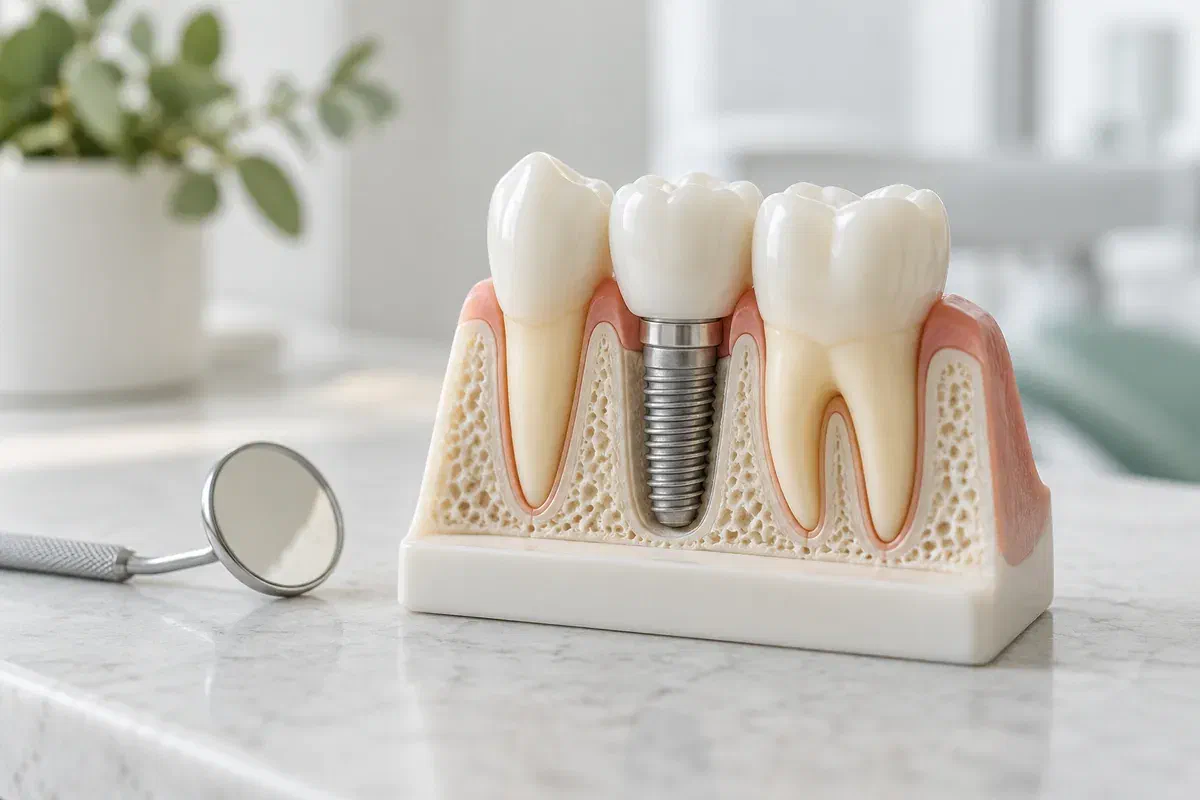
It helps to picture the parts separately. The implant sits in the jaw as a support. The tooth you see is a restoration connected to it through planned components. Placing that support, giving it time to heal, and asking it to carry chewing forces are distinct stages, and a temporary tooth often has a narrower job, with stricter rules, than the final one.
For anyone in Milton weighing this decision, our role is to make the proposed timing plain. Ask which step is being called immediate and what has to be true on the day for it to go ahead. A useful explanation covers the preferred route, the fallback if conditions differ, and the visits that still follow.
Two people can ask for an immediate implant and want different things. Let the clinician know whether you mostly want to avoid a visible gap, cut down on separate procedures, or know when the new tooth can actually be used.
Treat the temporary tooth as its own discussion. Ask whether it would be fixed or removable, what it is meant to do in the meantime, and which foods or habits would be off limits while the site heals.
Find out exactly what gets combined and what does not. A shorter start rarely removes healing checks, later impressions, fitting visits, or the work of finishing a permanent restoration.
Placement, restoration and loading are separate events. Asking for each proposal to be laid out in those terms makes it far easier to compare than a general promise of immediate implants.
Timing rests on assessment and what is found clinically. No plan should commit to an immediate final tooth before the site and the intended restoration have been properly evaluated.
For some sites, combining stages or fitting a suitable early tooth can be part of a well-planned approach. Any advantage should be explained for your particular site, along with the conditions it relies on and what you would need to avoid while things heal.
Risks and alternatives belong in the same conversation. Implant stability, the state of the gum and bone, the design of the restoration and your general health can all shape what is sensible. It is fair to ask what would point toward a slower sequence, and what findings would prompt a change to the original plan.
Patient information: International Team for Implantology — implant placement and loading protocols
A temporary tooth can fill a visible space without being able to handle normal biting. Keeping that difference in mind explains the restrictions and stops appearance from becoming the test of readiness.
Talk through time away from work, meals, travel and review visits against the actual sequence. Ask which dates are estimates and which depend on what is found during treatment or later healing.
If an immediate step turns out to be unsuitable, an agreed alternative shows how the space and site will be handled. That gives you firmer ground for consent than a plan built on every condition being ideal.
A good implant assessment sets out both the timing proposed and the conditions attached to it. If surgical and restorative care are handled by different clinicians, ask who does what and how the two will stay coordinated.
The clinician looks at the mouth, reviews your health history and takes suitable records. When a tooth is still present, its diagnosis and chance of being kept need weighing before removal and replacement are planned.
Set out the stages for extraction where it applies, implant placement, any temporary tooth and the final restoration. Ask when chewing on the area is allowed and what findings must support each step.
What the clinician sees during treatment can change whether an immediate step is suitable. The team should describe the alternative in advance and reassess, rather than pressing on just to keep the first timetable.
Follow-up visits decide when later stages can begin. Even with an early tooth in place, more records, fitting appointments or replacing the provisional may be needed before treatment is complete.
Your instructions will depend on the procedure and the restoration you received. Keep the written guidance handy and ask the team to clarify anything uncertain before you return to your usual routine.
Stick to the food and chewing advice you were given. Avoid testing whether the tooth can bite normally, and do not assume a fixed temporary tooth is doing the same job as the final one.
Ask how to look after the surgical area and any temporary appliance without disturbing healing. The routine usually changes as the site settles, so confirm when each new step should begin.
Come to follow-up visits even when everything feels fine. Get in touch about unexpected movement, symptoms that are getting worse, or anything your instructions flag, so the site and restoration can be checked.
These answers turn common timing terms into practical expectations. Your own plan should state which steps are proposed and what must be confirmed before each one goes ahead.
Book a consultation at our Bronte Street practice to go over implant timing and how the missing tooth could be replaced. We will listen to your concerns and explain the assessment needed to compare immediate and staged options.
If you already have a proposal or imaging from elsewhere, bring it along, and let us know whether the schedule, a visible gap or the temporary tooth worries you most.
