

Illustrative patient and dentist reviewing an existing implant crown
Restorative Dentistry

Implant Crown Replacement in Milton

Food that packs in beside an implant tooth every evening, a rough edge your tongue keeps finding, or a crown that has started to shift can all be looked at closely. Our Milton team checks the crown, its connection, the implant beneath and the gum around it before talking about renewal.

Implant teeth in Milton, looked at again

The floss keeps catching. Now what?

Trouble with an implant tooth often shows up at the sink, when floss shreds on one edge or dinner settles into the same gap every night. The crown is a separate piece fixed to the implant system, and it can wear, chip or lose its fit while the implant stays sound. Finding the responsible part comes before any talk of a new crown.

Those small annoyances are not all one problem. A rough margin, an opened contact, a slight rock and an awkward shape may each need a different response. Some respond to a limited repair or connection work; others make a remake sensible.

It helps to know how long the crown has been in, whether it was repaired or tightened before, and what changed when the issue began. A good plan spells out what would be replaced, what could stay and which limits apply to you.

Book a review of your implant crown
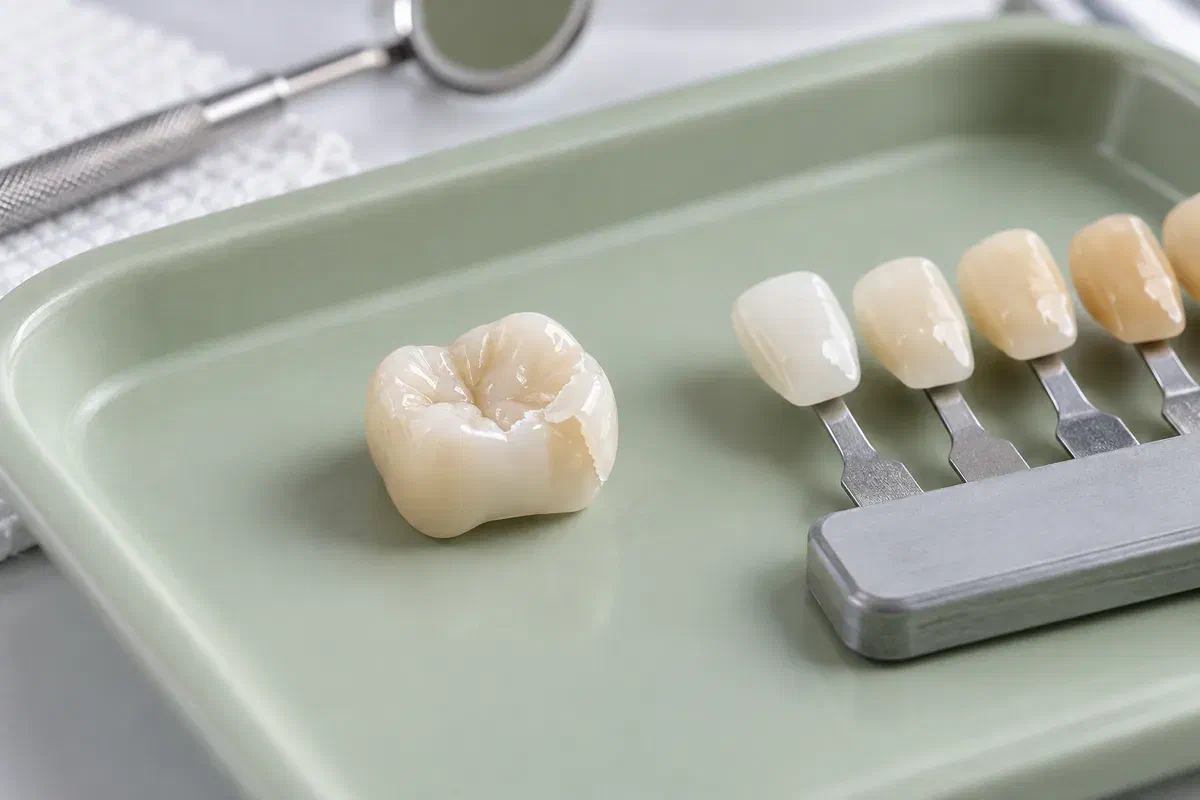
Ceramic implant crown with a small damaged edge beside a shade guide
Worth mentioning at your visit

Tell us how it started, not just how it looks.

How the crown has behaved over the years matters as much as what is visible today. If the implant or crown was placed at another office, any paperwork you have can save time and guesswork.

An edge has chipped or the surface has worn

Where the damage sits and how large it is help decide whether a repair makes sense. Let us know about earlier chips and any change in how your teeth meet, so we can look at why the material is breaking down.

The crown keeps working loose

Movement that returns after being dealt with points toward the connection and other parts of the assembly. A fresh crown on top will not necessarily stop it, and the implant itself may need to be checked as well.

Food traps, or the look no longer suits you

Describe exactly what bothers you, such as the contour, a glimpse of metal or a spot that always collects food. The position of the implant and the gum around it can limit what a new crown on its own can change.

If the crown moves or comes off, call the clinic before you keep chewing on it. Store any piece you recover safely in a small container, and please do not glue it back yourself.

Why the assessment comes first

A new crown should answer a clear question.

Where a remake is the right call, it can correct things the current crown simply cannot be adjusted to fix. Our conversation may cover the material, the overall shape, how it meets the teeth on either side, its colour and how it is held in place.

Covering a problem with a nicer surface does not solve it. The implant, the connection and the gum need to be in suitable condition for the planned work, and anything that keeps causing trouble should be identified. It is fair to ask which of your concerns a new crown should help and which will need care of their own.

Patient information: Cambridge University Hospitals — maintenance of implant restorations

Separate a damaged crown from a faulty connection

Knowing where the problem comes from sets the size of the job. Ask whether the crown itself has reached the end of its use or whether a component underneath should be dealt with first.

Use what you have noticed day to day

Your experience with food packing, how the bite feels, the appearance and cleaning all feed into the design. Mention what you liked about the old crown too, not only what you would change.

Think about upkeep before choosing the design

Different materials and ways of attaching a crown can affect cleaning access and future repairs. Ask how checks and any component work would be handled down the road, rather than choosing on looks alone.

How replacement is planned in Milton

From records to a finished tooth, in four stages

The way your existing crown is attached and the parts used in your implant system shape every step. You can ask about taking off the old crown, what fills the space meanwhile, which records help and any tests needed before the new one is made.

  1. Go over the history together

    Bring any implant information you have and tell us when the crown was placed, repaired or retightened. We talk through your symptoms, goals and recent changes in health or nearby dental work.

  2. Examine the crown and what holds it

    The dentist looks at the crown's surfaces, contacts and connection and at the surrounding gum. X-rays or further tests may be needed to tell a crown problem apart from one involving the implant or the tissue supporting it.

  3. Weigh a repair against a remake

    We explain what would change and what would stay. You can go over material and shade, fees, visits, how removal works and how the gap is handled meanwhile.

  4. Fit the new crown and check your bite

    The new crown is checked against the implant system, neighbouring teeth, gum and bite. You leave with care instructions, a follow-up plan and a clear idea of what to report if the issue returns.

Living with the new crown

Give it a few weeks of real meals, then tell us.

A replacement crown can feel unfamiliar even though the implant underneath has not changed. Follow the instructions from your fitting and notice how contacts and cleaning feel as you go back to everyday eating.

Speak up if it hits first or catches

A crown that feels tall or snags while chewing should be checked. It will not reliably wear into place, and adjusting it at home is not safe.

Learn the cleaning routine for its shape

A new contour can change how you reach the gumline and the spaces on each side. Ask us to show you which brushes or floss suit it, and point out any spot where food still collects or access is awkward.

Keep up with checks on the implant and gum

The implant and the tissue around it still need regular attention. Let us know soon about movement, chipping, bleeding that does not settle or any change that feels like the problem that led to the replacement.

How much work is really needed

Three possible paths, sized to the problem

Your assessment should set a small fix beside a full remake and any wider treatment the findings call for. You are entitled to ask why the recommended option fits the concern that brought you in.

If the current crown is still serviceable

A targeted repair or component fix

A small defect or a connection issue can sometimes be managed without making a new crown. The material involved, how far the damage goes and the condition of the parts that stay decide whether this is reasonable.

If the visible tooth is past its best

A fresh crown on the existing implant

A remake may make sense when the crown is no longer suitable but the implant and the relevant parts can stay. Ask what improvement to expect and which limits the existing site places on the result.

If the trouble sits below the crown

A deeper look at the implant or gum

Problems with the implant, the connection or the surrounding tissue may need further treatment or a referral to a specialist. Any new crown would then be planned around what that assessment shows.

Common questions in Milton

What people ask before replacing an implant crown

These answers cover the doubts that tend to come up about an implant tooth that is already in place. The right treatment depends on pinning down the problem, since not every concern means a new crown.

(905) 876-4488
Why does food keep getting stuck beside my implant crown?
An open contact, a shifted neighbour, a hard-to-clean contour or gum changes can all play a part. The dentist checks which applies before suggesting a repair, a new crown or a different cleaning approach.
Is the implant itself affected if the crown is remade?
Not necessarily. If the implant and its support are suitable, they may stay while the crown is replaced. The connection and gum still need assessing, so ask which parts the plan keeps.
My crown rocks a little when I chew. Should I wait and see?
It is better to call. Movement can come from different parts of the assembly, and continuing to chew on it may cause further damage. Do not try to tighten it or glue it yourself; the cause needs to be found first.
Can a chipped implant crown be smoothed instead of replaced?
Sometimes. A small chip away from the bite may be polished or repaired. Larger or recurring damage can make a remake more sensible, and the cause of the chipping matters too.
Do I need X-rays before an implant crown is replaced?
Imaging often helps show whether the concern lies with the crown or with the implant and bone. The dentist will explain what your case needs.
How will I know the new crown is working well?
It should feel comfortable, stay firm and let floss pass cleanly. A follow-up visit confirms those details, so mention anything that differs from fitting day.
Book in Milton

Bring the implant tooth that’s been bothering you.

Come to our Bronte Street practice for a look at a worn, chipped or troublesome implant crown. We will tell you plainly whether a small repair, a remake or a closer look underneath is the right next step.

If you have them, bring implant records and notes on past repairs, plus any part of the crown that came off.

Visit Milton Dental Clinic
Unit 1, 342 Bronte St. S, Milton, ON L9T 5B7
Get directions Clinic hours
Monday–Thursday
11am–7pm
Friday–Sunday
By appointment only

Areas we serve

  • Milton
  • Oakville
  • Mississauga
  • Georgetown
  • Halton Hills
  • Acton
  • Campbellville
  • Brampton
  • Burlington
  • Puslinch
  • Rockwood
  • Erin
  • Caledon
  • Etobicoke
  • Old Milton
  • Bronte Meadows
  • Timberlea
  • Dorset Park
  • Dempsey
  • Clarke
  • Beaty
  • Coates
  • Harrison
  • Scott
  • Willmott
  • Ford
  • Bowes
  • Cobden
  • Walker
  • Mountain View
  • Milton Heights
  • Hawthorne Village
  • Valley View
  • Fallingbrook
  • Nassagaweya
  • Trafalgar
  • Esquesing
  • Nelson
  • Brookville
  • Moffat
  • Glen Williams
  • Norval
  • Limehouse
  • Stewarttown
  • Ashgrove
  • Hornby
  • Silver Creek
  • Speyside
  • Scotch Block
  • North Oakville
  • River Oaks
  • Glen Abbey
  • West Oak Trails
  • Palermo
  • Bronte Creek
  • College Park
  • Joshua Creek
  • Uptown Core
  • Preserve
  • Iroquois Ridge
  • Lisgar
  • Meadowvale
  • Meadowvale Village
  • Churchill Meadows
  • Erin Mills
  • Central Erin Mills
  • Streetsville
  • East Credit
  • Creditview
  • Heartland
  • Sheridan
  • Mount Pleasant
  • Credit Valley
  • Huttonville
  • Churchville
  • Springbrook
  • Northwest Brampton
  • Bram West
  • Fletcher's Meadow
  • Fletcher's Creek South
  • Alton Village
  • Orchard
  • Millcroft
  • Headon Forest
  • Tansley
  • Brant Hills
  • Tyandaga
  • Kilbride
  • Lowville
  • Aberfoyle
  • Morriston
  • Arkell
  • Hillsburgh
  • Freelton
  • Carlisle
  • Waterdown
  • Flamborough
  • Mountsberg

How can we help?

Milton Dental Clinic

Have a question about your smile? Choose the option that works best for you.

For urgent dental concerns, please call.
Messages are reviewed during clinic hours.