It comes out with almost no effort
Much easier removal often leads the dentist to check the retentive parts. Mention whether the denture also lifts during meals or conversation, and whether one side releases sooner.


Your evening cleaning routine is often where you first sense an implant denture changing: it slips off its supports more easily, or a part looks worn. From Georgetown, we can review the attachments, fit and cleaning habits together, and explain whether a component change is the right response.
Each night you lift the denture out, brush it, and set it to soak. Over time you get a feel for how much effort removal takes, so when it suddenly comes away with barely a tug, you notice. That ease points to the attachment system: the inserts, clips or other gripping parts that link the appliance to its implants. They are maintenance items, distinct from the implants, and they do wear.
A quicker release is a prompt to investigate, not a conclusion. Worn retentive parts are one possibility. Others include a housing that has shifted in the acrylic, a base whose fit against the gums has changed, or tissue around a support that has become tender. The dentist assesses the complete appliance in your mouth before settling on a repair.
For your visit, pack the appliance, anything that has broken off, and the cleaning products you use, or a photo of their labels. Records naming the implant or attachment system are useful too. Tell us whether the change crept up gradually, followed a drop or hard bite, or appeared after recent treatment elsewhere.
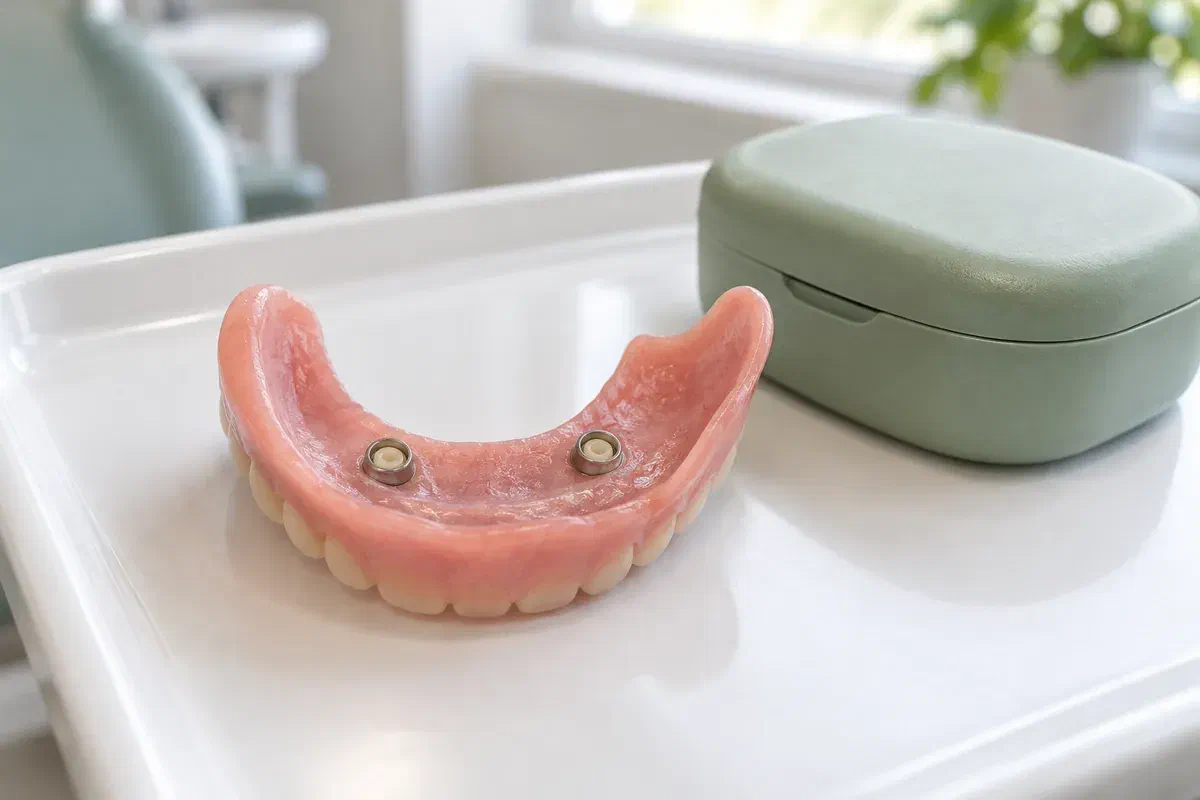
How the appliance behaves when you remove it and clean it is valuable information. Describe when it lifts during the day, whether both connections still engage, and what removal feels like now.
Much easier removal often leads the dentist to check the retentive parts. Mention whether the denture also lifts during meals or conversation, and whether one side releases sooner.
If the denture does not settle on both implants, the appliance and supports need examining. Avoid biting it into place or pressing harder; call for advice if it will not seat as usual.
Fish it out, keep it in a closed container, and bring it along. Please do not glue it back or choose a replacement by its look, because the part and system need to be identified.
Pain, swelling or bleeding around an implant, or a support that seems to move, should be mentioned when you call. Those concerns need assessment beyond a new insert.
If a replaceable part has worn and the base, housings and implants are still in suitable condition, renewing it may bring back dependable retention. Before any work, the dentist should explain the finding, the part concerned and what improvement is realistic.
Your daily routine depends on being able to remove the denture without a struggle. A very tight hold can make evening cleaning harder, particularly with stiff fingers or wrists. Tell the team about grip strength, discomfort, coordination or anyone who helps, so the retention suits how you care for it.
Patient information: Health Research Authority — maintenance of implant overdentures
Worn inserts are seldom a reason, on their own, for a new denture. Ask which elements of yours are suitable to keep and what would make the dentist reconsider.
Knowing whether the issue is in the insert or clip, the housing, or the implant helps you understand the repair, any ordering, and the estimate.
Before you leave, remove and reseat the denture yourself, much as you would at home. If it feels hard, mention it so fit and retention can be reviewed.
Every overdenture is a little different. A replaceable part may be all that is needed, or the examination may show that records, laboratory work, or care for the denture or gums should come first.
The dentist asks about the appliance’s age, earlier attachment changes, the brushes and soaks you use, and what you have noticed. Records help identify the system and past repairs.
The denture, the attachment sites, the gums around each implant and your bite are assessed together, to see whether worn parts account for the change or something else must be dealt with first.
You will talk through the proposed part, its compatibility, availability and cost. Work follows your system’s requirements; parts on order or laboratory support can mean another appointment.
After the work, seating, removal and comfort are checked, and your cleaning routine is reviewed. You should know what to monitor and when to come back if hold becomes uneven.
Cleaning advice should be written for your attachment system and the materials in your denture. Products recommended for a different appliance may not be suitable for yours.
Find the correct position, then use the pressure you were shown. If it starts seating differently, call rather than forcing it, biting it home or adjusting a part yourself.
Some products may not suit certain components. Confirm the recommended soaking solution and time, brush the denture and implants with suitable tools, and keep abrasive powders and household cleaners out of the routine.
If removal gets easier again, or you see rocking, sore spots or residue that is hard to clear, note when it started. Replacing parts again without reassessment may overlook a fit or support problem.
Your own records and examination settle the details. These questions can help you prepare to discuss cleaning, wear, compatibility, handling and follow-up.
Arrange a visit to our Bronte Street practice in Milton so the dentist can examine your removable overdenture, its attachments and the implants. We will explain what has changed and which maintenance and cleaning routine suits it.
Bring the appliance, any loose piece, your cleaning products and available implant records.
