

Illustrative consultation about the attachments of a removable implant denture
Restorative Dentistry

Implant Denture Attachment Replacement in Milton

When an implant-retained denture starts to rise during a meal or lift as you speak, the cause could be a worn insert, a change in fit, or something in the supporting tissues. Close to home in Milton, we can look at which one it is before any part is changed.

Milton attachment care

It held firmly at first. Now dinner feels different.

Many people first notice the change at the table. A bite of crusty bread or a firm piece of fruit pulls the denture upward, when a few months ago it stayed put. That moment points toward the attachment system: the inserts, clips or similar parts that hold the appliance onto its implants while still letting you take it out to clean. Those small parts are not the implants, and they are designed to be maintained or renewed over the life of the denture.

Even so, a looser feel at dinner is a symptom rather than a diagnosis. Worn retentive parts are one explanation. A cracked or shifted housing, a denture base that no longer meets the gums the way it did, or inflammation around a support would each need a different plan. Our job is to look at how the whole appliance sits and works, not to assume that a firmer clip is the answer.

For people across Milton, the first visit is mostly about gathering the story. Bring the denture itself, any piece that has come away, and whatever implant or attachment paperwork you still have. Let us know if the hold faded slowly, changed after a fall or a hard bite, or started soon after other dental work, because the timing shapes what we examine first.

Book a look at your attachments
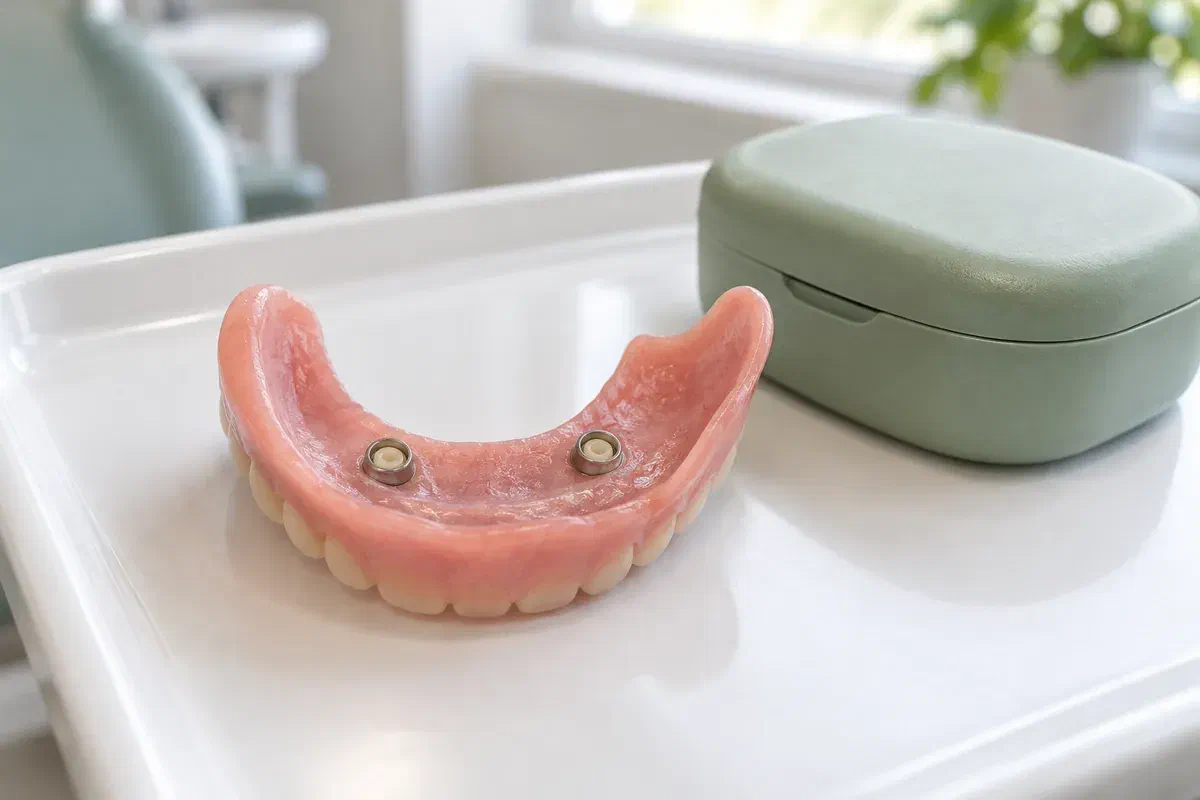
Illustrative fitting surface of a removable overdenture with two attachment housings
Signs worth mentioning

Tell us what happens, and when.

Looseness can show up in different ways. Describing which foods or movements trigger it, whether both sides click in, and how removal feels gives the dentist a clearer picture of whether retention, fit or tissue health is involved.

Chewing lifts the denture off its supports

A hold that weakens over months often leads to a check of the retentive parts. Note whether it happens with certain foods, when you talk, or as you take the appliance out, and whether one side gives way first.

Only one side seems to connect

When a single attachment no longer engages, the denture and its supports both need examining. Please do not keep biting down hard to push it into place; if it will not seat in the usual way, call us for advice.

A tiny part turned up in the sink

Put any piece that has come loose into a small closed container and bring it along. Avoid gluing it back in or ordering a replacement because it looks similar; the exact part has to be identified first.

If you have pain, swelling, bleeding, or a support in your mouth that seems to move, say so when you book. Those signs call for an assessment that goes beyond swapping an insert.

What a targeted repair offers

Better hold, without making the denture a struggle to remove.

Where wear in a replaceable component is the main finding and the rest of the system is still in good shape, renewing that part may improve how securely the appliance holds. You should hear what was found, which piece is involved, and what difference you can reasonably expect before any work begins.

A grip that is as tight as possible is not always the most useful outcome. You still have to lift the denture out and put it back every day for cleaning. Let us know about hand strength, joint pain, coordination, or anyone who helps you at home, so the retention chosen suits your real routine.

Patient information: Health Research Authority — maintenance of implant overdentures

Keep using a denture that still works

One worn part does not automatically mean starting over with a new appliance. Ask whether the base, teeth, housings and implants are suitable to keep, and which findings would change that advice.

Know which piece is being addressed

A good explanation separates the insert or clip from the housing that holds it and from the implant beneath. That clarity helps you follow the repair, any parts that need ordering, and the estimate attached.

Practise handling before you go

Ask to take the denture out and put it back in yourself while still in the chair. If the new hold feels hard to manage, mention it then, so the fit and retention can be reviewed on the spot.

How the visit runs

History, examination, agreed work, then a final test.

What you need depends on the attachment design and on what the examination shows. Some concerns come down to one replaceable part; others call for records, laboratory help, or treatment of the denture or gums first.

  1. Talk through the background

    Expect questions about how old the denture is, earlier attachment changes, which cleaners you use, and what you have noticed. Any records you bring help identify the system and past repairs that could affect today’s findings.

  2. Check hold and overall fit together

    The dentist looks at the denture, the attachment areas, the gums around the supports, and your bite as one picture. The goal is to see whether worn parts explain the problem or whether something else should be handled first.

  3. Settle on the right component work

    You will discuss the suggested part, whether it matches your system, availability and cost. If a change is appropriate, it is done to that system’s requirements; another appointment may be needed if parts or lab support must be arranged.

  4. Confirm seating, removal and comfort

    Once the work is finished, the denture is checked again. You should leave knowing how to handle it, what to keep an eye on, and when to come back if the hold feels uneven or removal becomes hard.

After new attachments

Gentle, consistent handling protects the connection.

Ask for care steps that suit your particular attachment system and denture materials. A routine that works for a friend’s or relative’s appliance may not be right for the parts in yours.

Line it up before you press

Find the correct position first, then use the pressure you were shown. If it stops clicking in the way it should, call us rather than forcing it, biting it into place, or filing at a part yourself.

Check which cleaners are safe

Clean both the denture and the supports as instructed, with suitable brushes and products. Ask directly about soaking solutions and how long to soak, and skip abrasive pastes or household chemicals nobody has approved for it.

Note it if the looseness returns

Keep a simple record of when the hold weakens again and whether rocking, sore spots or cleaning trouble come with it. Swapping parts repeatedly without looking for the cause can leave a fit or support problem untreated.

Which repair fits

The finding decides the fix.

Changing an attachment is only one way to respond to a loose implant denture. The examination should show whether the issue sits in the connection alone or involves the appliance and its supports as well.

When everything else is still suitable

Renewing a worn retentive part

A compatible insert, clip or similar component can be replaced once the system and its condition have been checked. Ask what exactly is changing and how the result will be judged.

When extra grip would not solve it

Work on the denture base or housing

A base that no longer fits well, a damaged housing, or another problem with the appliance may need a different repair or a laboratory step. The plan should deal with that, not lean on stronger retention.

When the problem is in the mouth itself

A closer look at the implant support

Pain, inflamed tissue or a support that moves needs its own diagnosis. Further implant assessment or a referral may have to come first, before the attachment itself can be dealt with properly.

Common questions

Straight answers about loose implant dentures.

Your own records and examination settle the details for your appliance. These questions are a starting point for talking about worn parts, compatibility, daily handling, and ongoing care.

(905) 876-4488
Is the implant itself the part that wears out when my denture loosens?
In most cases of gradual loosening, the worn piece is a replaceable part of the attachment system rather than the implant. The implant gives support within the jaw, while inserts and clips do the gripping. The dentist still checks the complete setup before agreeing that a small repair is enough.
Can I keep wearing the denture while it feels loose?
Often you can, with care, but it depends on why it is loose. If it rocks, rubs, or one side will not connect, mention that when booking so we can advise you. Pain, swelling or a moving support should be reported promptly rather than worn through.
Should I try denture adhesive to make up for the lost hold?
Ask before you do. Adhesive can hide a change in fit and leave residue around the attachment parts that makes cleaning harder. Describing the looseness to the team is more useful than masking it, because the cause needs to be found.
Do the inserts have a set replacement date?
No single timetable fits every appliance. The attachment design, the way the denture is handled, cleaning habits and the condition of the base all affect wear. Ask what signs to watch for and when to return for review instead of counting the months.
What paperwork helps if my implants were placed years ago?
Anything that names the implant or attachment system is helpful, such as a treatment summary, a product card, or a letter from the clinic that placed them. If nothing survives, the team can still examine the appliance, though identifying the parts may take longer.
Can a Milton appointment fit around a working day?
Our Bronte Street practice is open Monday to Thursday from 11am to 7pm, with Friday to Sunday by appointment. Mention when you book that the visit is about implant denture attachments, so the right amount of time is set aside.
Book in Milton

Bring the denture, and the story of what changed.

Arrange a visit to our Bronte Street clinic so we can examine your removable implant denture and its attachments. We will explain what is causing the change, talk through suitable maintenance, and outline what is needed for the next step.

Please bring the appliance, any loose parts, and whatever implant records you have.

Visit Milton Dental Clinic
Unit 1, 342 Bronte St. S, Milton, ON L9T 5B7
Get directions Clinic hours
Monday–Thursday
11am–7pm
Friday–Sunday
By appointment only

Areas we serve

  • Milton
  • Oakville
  • Mississauga
  • Georgetown
  • Halton Hills
  • Acton
  • Campbellville
  • Brampton
  • Burlington
  • Puslinch
  • Rockwood
  • Erin
  • Caledon
  • Etobicoke
  • Old Milton
  • Bronte Meadows
  • Timberlea
  • Dorset Park
  • Dempsey
  • Clarke
  • Beaty
  • Coates
  • Harrison
  • Scott
  • Willmott
  • Ford
  • Bowes
  • Cobden
  • Walker
  • Mountain View
  • Milton Heights
  • Hawthorne Village
  • Valley View
  • Fallingbrook
  • Nassagaweya
  • Trafalgar
  • Esquesing
  • Nelson
  • Brookville
  • Moffat
  • Glen Williams
  • Norval
  • Limehouse
  • Stewarttown
  • Ashgrove
  • Hornby
  • Silver Creek
  • Speyside
  • Scotch Block
  • North Oakville
  • River Oaks
  • Glen Abbey
  • West Oak Trails
  • Palermo
  • Bronte Creek
  • College Park
  • Joshua Creek
  • Uptown Core
  • Preserve
  • Iroquois Ridge
  • Lisgar
  • Meadowvale
  • Meadowvale Village
  • Churchill Meadows
  • Erin Mills
  • Central Erin Mills
  • Streetsville
  • East Credit
  • Creditview
  • Heartland
  • Sheridan
  • Mount Pleasant
  • Credit Valley
  • Huttonville
  • Churchville
  • Springbrook
  • Northwest Brampton
  • Bram West
  • Fletcher's Meadow
  • Fletcher's Creek South
  • Alton Village
  • Orchard
  • Millcroft
  • Headon Forest
  • Tansley
  • Brant Hills
  • Tyandaga
  • Kilbride
  • Lowville
  • Aberfoyle
  • Morriston
  • Arkell
  • Hillsburgh
  • Freelton
  • Carlisle
  • Waterdown
  • Flamborough
  • Mountsberg

How can we help?

Milton Dental Clinic

Have a question about your smile? Choose the option that works best for you.

For urgent dental concerns, please call.
Messages are reviewed during clinic hours.