

Illustrative consultation about maintaining gum health around a dental implant
Restorative Dentistry

Implant Gum-Care Maintenance in Burlington

Some implants have one awkward corner that no brush seems to reach. If you are travelling from Burlington, we can find that spot with you, check the gum tissue for inflammation, and work out whether the fix is a tool, a technique, or a closer look at the crown.

The spot the brush misses

Access is half of implant hygiene.

You brush carefully, you floss, and still one side of the implant feels rough or never quite clean. That is a common experience. The crown may flare outward near the gum, sit tight against a neighbour, or leave a small ledge where plaque collects. Effort alone cannot make up for a space the tools cannot get into.

Plaque left in that spot can inflame the gum. Inflammation that stays in the soft tissue is called peri-implant mucositis; when the supporting bone is also affected, it is peri-implantitis. How the area looks or feels will not reliably show which one is present. An examination, previous findings, and imaging where justified are what make the difference clear.

From Burlington, people often come to our Milton practice wanting practical answers about cleaning. Bring your usual brush or interdental aids if you like, and let us watch how you reach the site. Tell us what you know about the implant’s history too. Together, we can judge the current condition and agree on a plan that suits a regular review or a specific worry.

Get help with a hard-to-clean implant
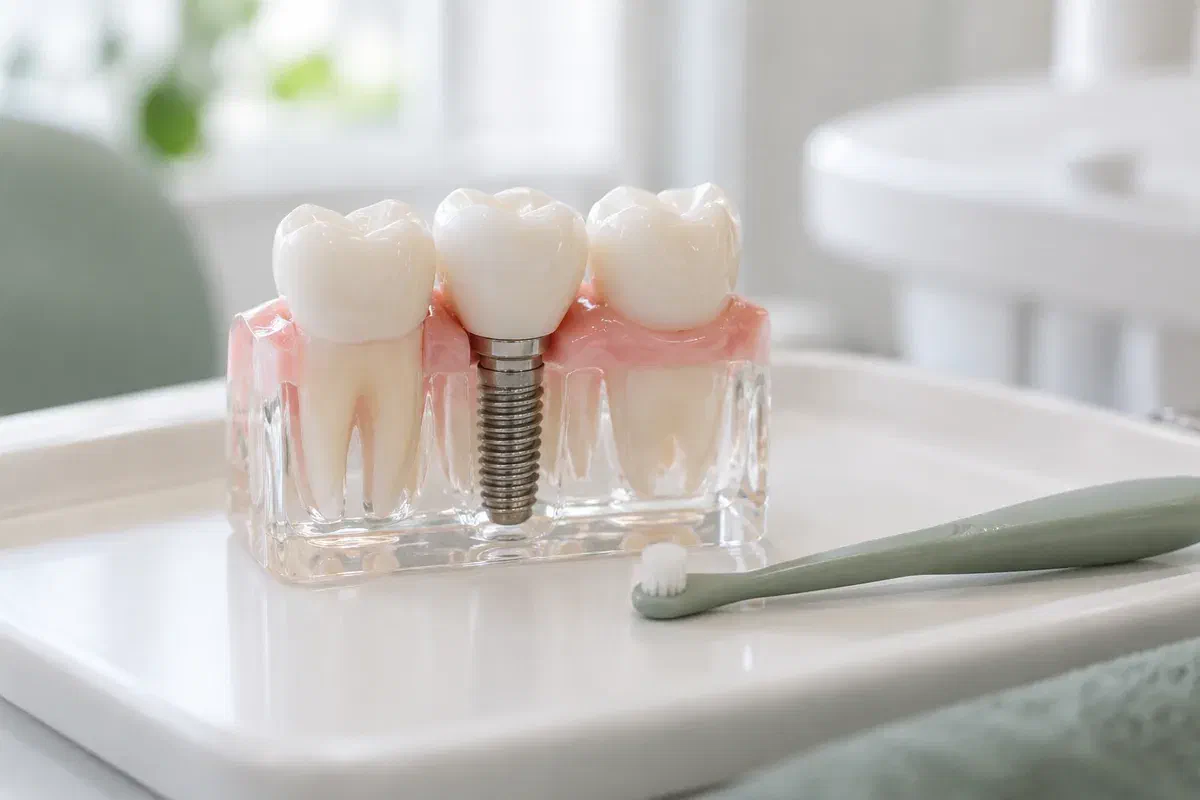
Implant teaching model beside a small brush used to illustrate targeted cleaning
Clues the gum gives you

What you notice while cleaning is useful information.

Changes often show up only for a moment, mid-brush. Describe where they happen, how regularly, and for how long rather than deciding what they are; those details give the examination a starting point.

Repeated bleeding at one implant

Blood on the brush at the same place, time after time, should be assessed. Tell us when it began, whether it hurts, and whether you have tried new tools or a different method. Bleeding on its own does not show how much support is affected.

The gum around the crown has changed

Redness, swelling, a gum edge that looks different, or a bad taste that persists should be mentioned. The dentist can weigh inflammation and other explanations rather than treating every visible change alike.

A gap or ledge you cannot clean

If a tight contact, a bulky contour, or tenderness stops you from cleaning one spot, show us exactly where. We can consider the method you use and the shape of the restoration at the same time.

If swelling appears suddenly, there is discharge, pain is increasing, or the implant moves, contact us without waiting for maintenance. Describe the symptoms on the phone so we can arrange a suitable assessment.

Why reviews keep paying off

Comparing visits shows whether a change is real.

A clean feeling today is welcome, but it tells only part of the story. Notes from each review let the team compare bleeding, measurements, and cleaning access over time and discuss whether the site is holding steady. Ask which findings are being followed and how they compare with your last appointment.

Care is also personal. A history of gum disease, smoking, manual difficulty with cleaning, and health conditions can each change the plan. Those factors shape the support you are offered. They are not grounds for putting off a visit because home care has been hard lately or a review slipped past.

Patient information: American Academy of Periodontology — peri-implant diseases

Move to treatment when findings call for it

Some reviews turn up signs that need a defined plan, not just another check later. You should understand the concern, what is proposed, and how the team will tell whether the area is improving.

Fit the cleaning method to the crown

If one area stays persistently hard to reach, the team can look at clearer instructions, other aids, or a fuller assessment of whether the restoration’s shape is part of the obstacle.

Remember the neighbouring teeth

The teeth beside the implant, and any other implants, need care too. A joined-up plan avoids looking at one site in isolation while gum trouble elsewhere is missed.

Step by step

What happens at a maintenance visit?

You should finish the appointment understanding the state of the gum around your implant and the purpose of the next step. If the site is tender or earlier checks were uncomfortable, let us know at the outset.

  1. Review how the implant has done

    We talk about when it was restored, any past inflammation or treatment, and changes in your health or medications. Records and your description show what has shifted and what is worth comparing.

  2. Examine and, if needed, measure

    The clinician checks the tissue and may take gentle readings around the implant. Bleeding, access for cleaning, and other findings are considered as a whole. Imaging may be advised when it would help judge the support.

  3. Explain the findings plainly

    We tell you whether the picture suggests routine maintenance, focused treatment, or further assessment. Any recommended cleaning, extra care, or referral should come with a reason, an expected role, and an estimate when relevant.

  4. Practise the cleaning and set a recheck

    We show you how to reach the problem area and agree when the response will be checked. A review after treatment may have a different purpose from your ongoing maintenance interval.

Daily habits

Reach every side, softly.

A routine works when you understand it well enough to repeat it on tired evenings. Ask for a demonstration on your own implant, and say if a physical or practical difficulty makes it hard to follow.

Use the aid sized for your gap

Choose the brush and interdental cleaners recommended for the space you have. Forcing a large tool into a narrow gap can injure the gum, and hard scrubbing after bleeding is not a substitute for careful technique.

Note what does not settle

Record repeated bleeding, swelling, soreness, or an unpleasant taste in a few words. Get in touch if it persists or worsens, and do not take an absence of strong pain as proof of health.

Keep us informed about your health

Mention new medicines, changes in diabetes care, smoking, or anything that affects how well you can clean. Ask about support with risk factors and continue prescribed medical treatment unless your physician advises a change.

Care that follows the findings

Not every inflamed implant needs the same response.

Ongoing maintenance and treatment of active disease are connected but cannot be swapped for one another. The dentist should explain which situation applies and what further information is needed before recommending more care.

For a stable implant

Ongoing supportive care

Keep to an individual schedule of professional reviews and home cleaning. Discuss the interval, the areas under watch, and which symptoms should prompt an earlier visit.

For gums needing focused care

Treatment for gum inflammation

Professional cleaning, changes to how you clean at home, and correcting contributing factors may all be involved. Reassessment afterward shows whether the tissue has responded well enough.

For suspected bone loss or lasting disease

A closer look at deeper disease

More advanced disease needs a specific plan and may involve a specialist. Discuss the diagnosis, the options, their limits, and follow-up instead of assuming maintenance alone will settle it.

Patient information: European Federation of Periodontology — peri-implant disease treatment

Frequently asked

Cleaning around implants: your questions

Ask about tools, symptoms, measurements, or follow-up. What matters is your own implant and how it has been cared for, not a general description of another person’s gum problem.

(905) 876-4488
Can the shape of my implant crown make it harder to keep the gum healthy?
It can. Some contours leave areas where plaque gathers and tools struggle to reach. The team can show you a method suited to the shape and, if access stays poor, discuss whether the restoration itself needs assessment.
Are water flossers a good idea around implants?
They can be helpful for some people, often alongside a brush or interdental aid. Whether one suits you depends on the space around your implant and your routine. Ask for advice specific to your mouth.
Is it safe to use an interdental brush with a metal wire near my implant?
Some people are advised to use coated or plastic-core brushes around implants. The right choice depends on your restoration and the gap size, so ask the team which type and size to use.
If the gum bleeds, should I avoid cleaning there for a while?
Avoiding the area lets deposits remain, and pressing harder can injure the tissue. Ask for an assessment if bleeding repeats, and for a gentle technique that suits the site.
Does past gum disease change how my implant is looked after?
Yes. Earlier periodontitis is relevant to implant risk and the timing of reviews. The team should consider your natural teeth and gums along with the implant and explain how the different areas of care fit together.
How will I know if treatment for an inflamed implant has worked?
A planned reassessment compares the tissue with earlier findings. If inflammation persists, the team may revisit access, contributing factors, the diagnosis, and whether more treatment or a specialist is needed.
From Burlington to Bronte Street

Show us the corner that worries you.

At our Bronte Street clinic in Milton, we can examine the tissue beside your implant, watch how you reach the awkward side, and suggest tools that fit. You will go home with the findings explained, a cleaning method that works, and a review date.

When you book, tell us about bleeding, swelling, tenderness, or earlier treatment near the implant, and which area is hardest to clean.

Visit Milton Dental Clinic
Unit 1, 342 Bronte St. S, Milton, ON L9T 5B7
Get directions Clinic hours
Monday–Thursday
11am–7pm
Friday–Sunday
By appointment only

Areas we serve

  • Milton
  • Oakville
  • Mississauga
  • Georgetown
  • Halton Hills
  • Acton
  • Campbellville
  • Brampton
  • Burlington
  • Puslinch
  • Rockwood
  • Erin
  • Caledon
  • Etobicoke
  • Old Milton
  • Bronte Meadows
  • Timberlea
  • Dorset Park
  • Dempsey
  • Clarke
  • Beaty
  • Coates
  • Harrison
  • Scott
  • Willmott
  • Ford
  • Bowes
  • Cobden
  • Walker
  • Mountain View
  • Milton Heights
  • Hawthorne Village
  • Valley View
  • Fallingbrook
  • Nassagaweya
  • Trafalgar
  • Esquesing
  • Nelson
  • Brookville
  • Moffat
  • Glen Williams
  • Norval
  • Limehouse
  • Stewarttown
  • Ashgrove
  • Hornby
  • Silver Creek
  • Speyside
  • Scotch Block
  • North Oakville
  • River Oaks
  • Glen Abbey
  • West Oak Trails
  • Palermo
  • Bronte Creek
  • College Park
  • Joshua Creek
  • Uptown Core
  • Preserve
  • Iroquois Ridge
  • Lisgar
  • Meadowvale
  • Meadowvale Village
  • Churchill Meadows
  • Erin Mills
  • Central Erin Mills
  • Streetsville
  • East Credit
  • Creditview
  • Heartland
  • Sheridan
  • Mount Pleasant
  • Credit Valley
  • Huttonville
  • Churchville
  • Springbrook
  • Northwest Brampton
  • Bram West
  • Fletcher's Meadow
  • Fletcher's Creek South
  • Alton Village
  • Orchard
  • Millcroft
  • Headon Forest
  • Tansley
  • Brant Hills
  • Tyandaga
  • Kilbride
  • Lowville
  • Aberfoyle
  • Morriston
  • Arkell
  • Hillsburgh
  • Freelton
  • Carlisle
  • Waterdown
  • Flamborough
  • Mountsberg

How can we help?

Milton Dental Clinic

Have a question about your smile? Choose the option that works best for you.

For urgent dental concerns, please call.
Messages are reviewed during clinic hours.