

Illustrative consultation about maintaining gum health around a dental implant
Restorative Dentistry

Implant Gum-Care Maintenance in Mississauga

If gum disease cost you the tooth an implant replaced, the same tendency deserves respect around the implant. For adults travelling from Mississauga, our reviews keep watch on implant tissue and natural teeth together, with follow-up shaped by your history.

When gum disease is part of your story

The reason you lost a tooth still matters.

For many people, an implant arrives at the end of a long stretch of gum problems. Periodontitis loosened a tooth, it was removed, and the implant filled the gap. That history does not disappear once the crown is fitted. People who have had periodontitis are generally considered at higher risk of trouble around implants, so the tissue there deserves steady attention.

Two conditions are on the dentist’s mind. Peri-implant mucositis means the gum around the implant is inflamed. Peri-implantitis means that, in addition, some of the bone supporting the implant has been lost. You cannot sort one from the other by sight or by comfort. The examination, your records, and imaging when it adds something are what settle the question.

Adults from Mississauga, often from western neighbourhoods such as Meadowvale and Churchill Meadows, see us at our Milton office for this ongoing care. Tell us about the gum treatment you had before the implant, who provided it, and what changed afterward. Those details help us decide how closely to watch each area and how to plan around your natural teeth as well.

Plan care around your gum history
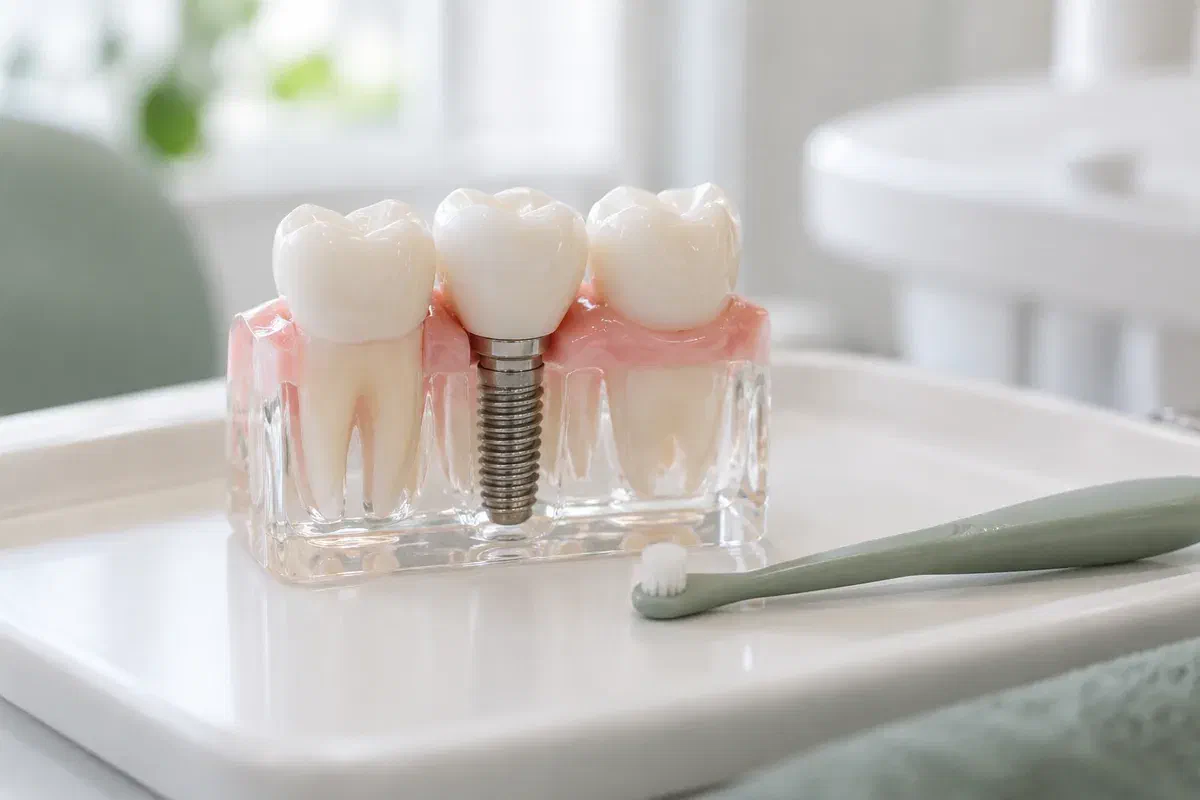
Implant teaching model beside a small brush used to illustrate targeted cleaning
Familiar warning signs

You may recognise these from before.

Anyone who has been through gum treatment knows the early signals. Around an implant, they can be quieter. Rather than labelling the problem, tell us where you notice it, how often, and since when.

Bleeding has crept back

Blood when you gently clean one implant, especially if it reminds you of how things began with your natural teeth, should be checked. Say whether it is tender and whether your routine has changed. Bleeding by itself says nothing certain about bone.

The tissue looks swollen or uneven

Redness, puffiness, a margin that seems to be shifting, or a stale taste are worth bringing up. An examination considers inflammation and other possibilities rather than assuming every change has one cause.

Cleaning is harder than the instructions suggest

Old habits from periodontal treatment may not translate perfectly to an implant. If one site is awkward or sore to reach, point it out so we can assess both the technique and the restoration.

New swelling, discharge, rising pain, or a sense that the implant has moved are reasons to phone us before a scheduled review. Describe what you are noticing and we will arrange the right kind of assessment.

Why steady follow-up helps

Higher risk calls for closer comparison.

With periodontitis in your background, a single reassuring visit counts for less. Findings recorded over months and years show whether the tissue around the implant, and around your remaining teeth, is staying settled. You are welcome to ask what is measured each time and what has changed since the previous review.

Smoking, diabetes, dexterity problems, and earlier periodontitis can all influence what support makes sense. Knowing about them lets us set a review interval and home routine that fit. They are never a reason to stay away because cleaning has been difficult or an appointment was pushed back.

Patient information: American Academy of Periodontology — peri-implant diseases

Act when monitoring is not enough

If findings point to active inflammation or disease, a defined plan should replace watchful waiting. Ask what the concern is, what is recommended, and how progress will be measured.

Check whether access is the obstacle

A site that remains difficult may need new instructions, a different aid, or an assessment of the restoration’s contour. Effort matters, but so does whether the tool can physically get there.

Treat the mouth as one system

Your natural teeth and other implants share the same risk factors. Coordinated care avoids focusing on the implant while periodontal problems elsewhere go unmanaged.

Our approach

Start with your gum history, end with a clear interval.

We want you to leave knowing how the implant site is doing and why the next step matters. If probing has been uncomfortable in past periodontal visits, mention it; we can take extra care.

  1. Map out what came before

    We ask about past gum treatment, when the implant was restored, any earlier inflammation around it, and current health or medicines. Records help show what to compare and where change is most likely.

  2. Assess implant and teeth together

    The clinician examines the implant site and may take light measurements, along with checks of your remaining teeth. An X-ray may be advised if it would help judge bone support around the implant.

  3. Describe the findings and options

    We explain whether the area fits routine maintenance, focused treatment, or further investigation. Any cleaning, added care, or referral we suggest should come with its reasoning, purpose, and an estimate where relevant.

  4. Set priorities and a review schedule

    We agree which sites need most attention at home and when we will look again. Follow-up after treatment can differ from the long-term interval, which may be shorter given your history.

Living with higher risk

Consistency matters more than intensity.

A routine you can sustain, gently, every day, will do more than an occasional heroic effort. Ask us to demonstrate cleaning on your own implant and mention any limitation that makes it hard to manage.

Keep to the recommended aids

Use the brushes and interdental cleaners selected for your implant. Avoid squeezing a tool that is too wide into a narrow space, and do not scrub harder when the tissue bleeds.

Watch for the old pattern

Make a brief note if bleeding, swelling, tenderness, or a bad taste keeps returning. Contact us if it continues or worsens. Comfort alone does not confirm the tissue is healthy.

Keep risk factors in the conversation

Tell us about changes in medicines, blood sugar control, smoking, or your ability to clean. We can talk about support for these, and you should continue medical care as prescribed unless your doctor advises otherwise.

Deciding what comes next

Stable, inflamed, or losing bone?

Supportive maintenance and active disease treatment are linked, yet each serves a different purpose. The dentist should explain which one your findings suggest and what remains to be clarified before recommending further care.

When things are holding steady

Regular supportive reviews

Continue an individual plan of professional reviews and daily cleaning. Talk about the interval, which sites are being followed, and the symptoms that should bring you in early.

When the soft tissue is inflamed

Targeted gum treatment

Care may include professional cleaning, changes to home routine, and addressing contributing factors. A reassessment shows whether the gum has responded adequately.

When bone support is in question

Deeper disease workup

More advanced disease needs a defined plan and may involve a periodontist or other specialist. Discuss the diagnosis, options, limits, and follow-up rather than assuming maintenance will resolve it.

Patient information: European Federation of Periodontology — peri-implant disease treatment

Questions we hear

Gum disease history and your implant

Ask anything about symptoms, measurements, or follow-up. Your own implant and periodontal history are what count, not someone else’s experience with theirs.

(905) 876-4488
I had periodontitis before my implant. Am I more likely to have problems around it?
A history of periodontitis is associated with higher risk of peri-implant disease. That does not mean problems are inevitable, but it is a good reason for regular reviews and careful home care tailored to you.
Should my periodontist or my general dentist look after my implant?
Either arrangement can work, and some people alternate. What matters is that someone is monitoring the implant and natural teeth with shared records. We can discuss how our reviews fit with any specialist care you already have.
How often will I need implant gum-care visits?
There is no single interval. It depends on your history, current findings, and how well you can clean. People with past gum disease may be seen more often, and the plan can change as findings change.
Does bleeding around my implant mean the bone is affected?
Not by itself. Bleeding can come from soft-tissue inflammation alone. An examination, comparison with earlier findings, and imaging if needed help the dentist determine what is going on.
Can I use the same cleaning routine I learned during gum treatment?
Parts of it may carry over, but implants can need different aids or angles. Ask for a demonstration on your implant so the routine suits its shape and the space around it.
What happens if my implant gum does not improve with first-line care?
It should be reassessed. The team may review access, contributing factors, and the diagnosis, and consider further treatment or specialist input. Persistent inflammation deserves a clear plan rather than repeating what has not worked.
Implant care for Mississauga

Bring your history. We will plan around it.

Our Bronte Street clinic in Milton welcomes adults from Mississauga for ongoing implant gum care. We will talk through your periodontal background, examine the implant and surrounding teeth, and agree on home priorities and a review date.

Let us know about previous gum treatment, any bleeding or swelling near the implant, and the name of your periodontist if you have one.

Visit Milton Dental Clinic
Unit 1, 342 Bronte St. S, Milton, ON L9T 5B7
Get directions Clinic hours
Monday–Thursday
11am–7pm
Friday–Sunday
By appointment only

Areas we serve

  • Milton
  • Oakville
  • Mississauga
  • Georgetown
  • Halton Hills
  • Acton
  • Campbellville
  • Brampton
  • Burlington
  • Puslinch
  • Rockwood
  • Erin
  • Caledon
  • Etobicoke
  • Old Milton
  • Bronte Meadows
  • Timberlea
  • Dorset Park
  • Dempsey
  • Clarke
  • Beaty
  • Coates
  • Harrison
  • Scott
  • Willmott
  • Ford
  • Bowes
  • Cobden
  • Walker
  • Mountain View
  • Milton Heights
  • Hawthorne Village
  • Valley View
  • Fallingbrook
  • Nassagaweya
  • Trafalgar
  • Esquesing
  • Nelson
  • Brookville
  • Moffat
  • Glen Williams
  • Norval
  • Limehouse
  • Stewarttown
  • Ashgrove
  • Hornby
  • Silver Creek
  • Speyside
  • Scotch Block
  • North Oakville
  • River Oaks
  • Glen Abbey
  • West Oak Trails
  • Palermo
  • Bronte Creek
  • College Park
  • Joshua Creek
  • Uptown Core
  • Preserve
  • Iroquois Ridge
  • Lisgar
  • Meadowvale
  • Meadowvale Village
  • Churchill Meadows
  • Erin Mills
  • Central Erin Mills
  • Streetsville
  • East Credit
  • Creditview
  • Heartland
  • Sheridan
  • Mount Pleasant
  • Credit Valley
  • Huttonville
  • Churchville
  • Springbrook
  • Northwest Brampton
  • Bram West
  • Fletcher's Meadow
  • Fletcher's Creek South
  • Alton Village
  • Orchard
  • Millcroft
  • Headon Forest
  • Tansley
  • Brant Hills
  • Tyandaga
  • Kilbride
  • Lowville
  • Aberfoyle
  • Morriston
  • Arkell
  • Hillsburgh
  • Freelton
  • Carlisle
  • Waterdown
  • Flamborough
  • Mountsberg

How can we help?

Milton Dental Clinic

Have a question about your smile? Choose the option that works best for you.

For urgent dental concerns, please call.
Messages are reviewed during clinic hours.