

Illustrative patient and hygienist discussing cleaning tools for an implant restoration
Restorative Dentistry

Implant Hygiene Appointments in Old Milton

Had your implant for years, perhaps placed by another dentist? Implant hygiene care near Old Milton picks up where that work left off, with careful cleaning and an updated home routine for the crown, bridge, or denture you rely on.

Long-standing implants, fresh attention

An older implant still deserves a current routine.

Plenty of people around Milton’s historic downtown have lived with an implant restoration for a decade or more. Over that time, the cleaning instructions they first received can fade, or the products on offer change. A lone crown, a linked bridge, and a removable overdenture each have their own hard-to-reach margins, and those details still matter years later.

So the appointment is not simply a shine on the tooth you can see. The team checks the gum and surrounding tissue, notes where deposits sit, and asks about the corners you find awkward. When something points to a dentist’s assessment or a separate course of treatment, you should hear that plainly instead of having it treated as part of a routine clean.

Records from the clinic that placed your implant are helpful, but a missing file does not stop the visit. Tell us what you remember and what your routine looks like now. Bring the tools you reach for each evening, mention anything that pinches or snags, and ask to try a new method in the chair before taking it home.

Request an implant hygiene visit
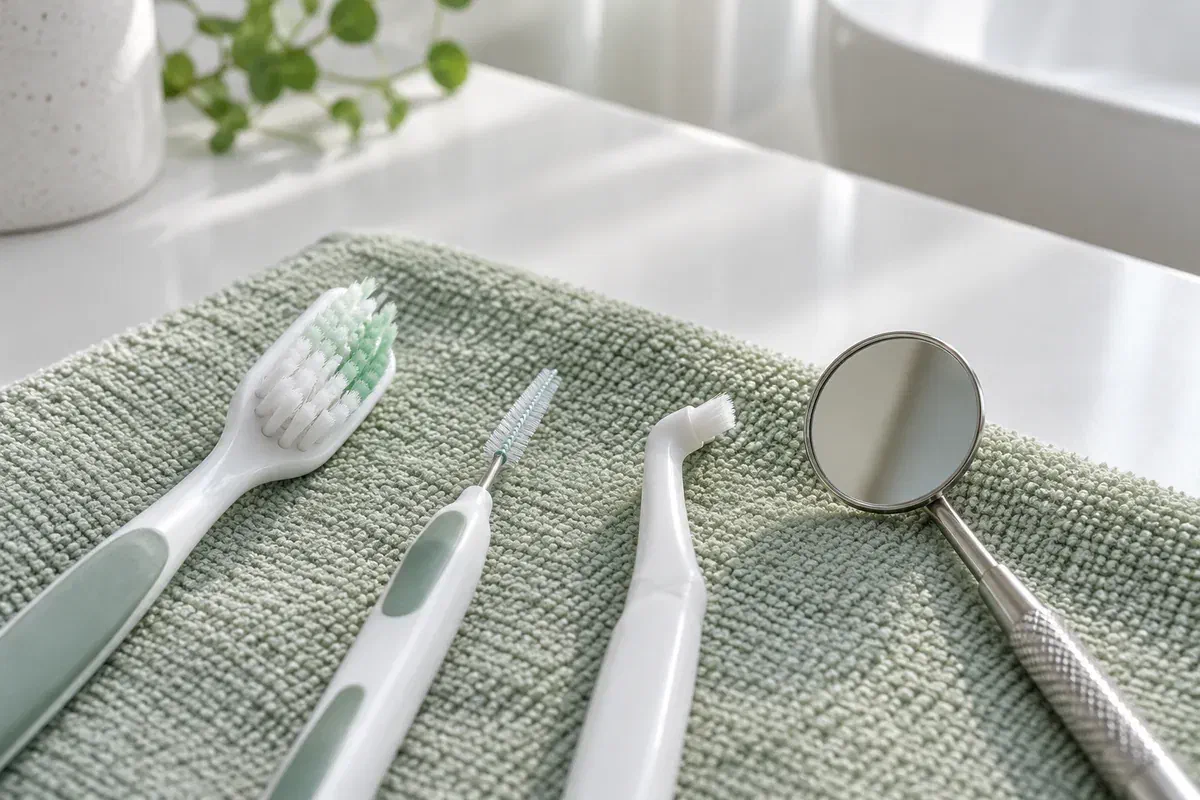
Soft toothbrush, interdental brush, single-tuft brush and dental mirror on a pale towel
Tell us before the cleaning starts

Habits formed years ago are worth a second look.

Concrete details let the team tailor their suggestions. A threader you gave up on, a bridge whose underside you have never seen, or a spot that feels tender are all worth pointing out at the beginning.

The tools you were given no longer seem right

Spaces around a restoration can need different aids, and your needs may have shifted. Bring whatever you currently use and explain how it behaves, so any change accounts for reach, comfort, and the shape of the work.

Hard deposits that brushing won’t shift

Calculus around an implant calls for professional removal and a conversation about why it collects there. Resist picking at it with sharp household items or ordering a scaling tool to try at home.

Dental visits have become harder over time

Stiff jaws, a sensitive gag reflex, worry about the chair, or trouble holding your mouth open are all worth mentioning. Agree on breaks and comfort steps first so the appointment can be shaped around them.

Swelling, bleeding that keeps returning, new pain, or any looseness in the restoration needs to be checked. Mention these when you book so a suitable appointment can be arranged.

Why regular visits still matter

Care in the chair, backed by care at the sink.

Periodic professional care lets deposits be cleared in a suitable way and shows whether your home cleaning still reaches the surfaces it needs to. It is also a chance to ask about technique and products while looking at your own restoration, which is far more useful than a diagram of somebody else’s mouth.

Daily cleaning remains the backbone of looking after an implant. Even frequent appointments cannot keep compensating for a margin you cannot get to, or for a method that has become too fiddly to manage. The aim is suitable professional care, a routine that makes sense to you, and a plain next step for any concern left open.

Patient information: European Federation of Periodontology — implant care and prevention

Aids matched to each gap

Have the recommended method shown to you and your own attempt checked. Good access means reaching the surface without wedging a brush in, missing a key area, or adding steps you will not keep up.

Reading the gum around the implant

The state of the tissue guides what care makes sense. When a spot bleeds or stays tender, ask what that suggests and whether it needs watching, a fuller assessment, or a dedicated treatment plan.

Adjusting as eyesight or grip changes

Weaker vision, stiff fingers, a tremor, or a change in who helps you at home can make cleaning harder. Speak up so the team can look at an easier method and the right level of professional support.

What happens during the appointment

History first, then the tissue, the cleaning, and your turn.

Exactly what is done depends on your restoration and on what the team sees. Ask what the visit covers, whether a separate examination makes sense, and how tender areas will be managed.

  1. Catch up on your implant’s story

    Expect questions about your health, when and where the implant was placed, and how you clean it. Mention past repairs, replaced attachments, or advice from another dentist or specialist that could change the plan.

  2. Look closely at gum tissue and reach

    The implant sites and, as appropriate, the rest of the mouth are examined. This reveals where buildup gathers, whether your routine gets there, and whether a further assessment by the dentist should follow.

  3. Professional cleaning for the implant surfaces

    Instruments and techniques are chosen to suit the materials being cleaned. Speak up the moment something feels uncomfortable and use your agreed signal to pause; your visit may differ from a neighbour’s.

  4. Practise at the chair and plan ahead

    Try the suggested aids while the team watches your technique. Confirm which products to keep, where to focus, and when to return, plus any separate follow-up for a finding from the appointment.

Between visits, at home in Old Milton

Fewer steps, done properly, every day.

Follow the guidance given for your particular restoration. If a new aid feels clumsy after you get home, phone the clinic for help instead of pushing it in harder or abandoning that part of your mouth.

Keep to the size you were fitted with

Each aid is chosen for a particular space and angle. A thicker brush is not necessarily better, and something that slides neatly under one bridge may need a different approach around another implant.

Remember the teeth that are still your own

Natural teeth and implant restorations share a mouth but are not built alike. Carry on with fluoride toothpaste and your recommended tooth care, as well as the implant-specific methods you were taught.

Call if tenderness or bleeding lingers

Ask beforehand what is usual after your care. Contact the team if symptoms continue or worsen, and keep any reassessment booked rather than leaving an open problem for the next routine clean.

Sorting out what you need

Not every finding is a cleaning job.

A hygiene appointment may uncover a problem that cannot be fully handled in that sitting. The team should explain which needs belong to routine maintenance and which need their own assessment.

For regular professional upkeep

Ongoing implant maintenance

Suitable cleaning and coaching help keep an established restoration in good order. The interval between visits and the focus of each one follow your needs and past findings.

When the gum looks or feels different

Investigating inflamed gum tissue

Ongoing bleeding, puffiness, or other tissue changes may call for a diagnosis and a treatment plan. Cleaning alone should not replace looking into a concern about the support around an implant.

When the restoration itself is the issue

Assessing wear, looseness, or damage

A crown that shifts, a denture clip that has worn, or a bridge with a chip may need repair planning. Describe the mechanical issue so it can be checked, rather than assuming better cleaning will fix it.

Old Milton implant hygiene questions

Things people ask about older implants.

The small practical points are often what make the difference. Ask to see something demonstrated again, request written notes, or explain why earlier advice proved hard to keep.

(905) 876-4488
My implant was placed at another clinic years ago. Can I still book here?
Yes. Share what you know about the implant and restoration, and any records you can obtain from the original clinic. The team will assess what is in your mouth now and suggest a maintenance plan from there.
Does an implant restoration ever wear out or need replacing?
Crowns, bridges, and denture attachments can wear or be damaged over time. A hygiene visit may reveal signs of this, and the dentist can explain whether repair or replacement planning is worth discussing.
Arthritis makes small brushes difficult. Are there easier options?
Tell the team about it. They can look at aids with larger handles, different designs, or a simpler sequence of steps, and check that whatever you try still reaches the important surfaces.
Could a family member come in to learn the routine with me?
If you would like a relative or caregiver to help at home, ask whether they can join part of the appointment. Seeing the method demonstrated can make it easier for them to support you.
Do I need to have my bridge taken off for it to be cleaned properly?
Usually not. Many restorations are assessed and cleaned where they sit. Removal depends on the design and a clinical reason, and if it is suggested, the dentist should explain the options and any separate procedure.
It has been years since my last implant cleaning. Where do I start?
Book a review and describe any symptoms or difficulties. There is no need to feel embarrassed. A long gap may mean the first visit includes extra assessment before regular maintenance resumes.
Implant hygiene for Old Milton

A short trip from downtown to Bronte Street.

Book at our Bronte Street practice to arrange professional implant hygiene care and a home routine you can keep up. Bring your questions and the tools you use now so the time focuses on what matters most to you.

Tell us about your implant restorations and whether you have noticed soreness, bleeding, or any movement.

Visit Milton Dental Clinic
Unit 1, 342 Bronte St. S, Milton, ON L9T 5B7
Get directions Clinic hours
Monday–Thursday
11am–7pm
Friday–Sunday
By appointment only

Areas we serve

  • Milton
  • Oakville
  • Mississauga
  • Georgetown
  • Halton Hills
  • Acton
  • Campbellville
  • Brampton
  • Burlington
  • Puslinch
  • Rockwood
  • Erin
  • Caledon
  • Etobicoke
  • Old Milton
  • Bronte Meadows
  • Timberlea
  • Dorset Park
  • Dempsey
  • Clarke
  • Beaty
  • Coates
  • Harrison
  • Scott
  • Willmott
  • Ford
  • Bowes
  • Cobden
  • Walker
  • Mountain View
  • Milton Heights
  • Hawthorne Village
  • Valley View
  • Fallingbrook
  • Nassagaweya
  • Trafalgar
  • Esquesing
  • Nelson
  • Brookville
  • Moffat
  • Glen Williams
  • Norval
  • Limehouse
  • Stewarttown
  • Ashgrove
  • Hornby
  • Silver Creek
  • Speyside
  • Scotch Block
  • North Oakville
  • River Oaks
  • Glen Abbey
  • West Oak Trails
  • Palermo
  • Bronte Creek
  • College Park
  • Joshua Creek
  • Uptown Core
  • Preserve
  • Iroquois Ridge
  • Lisgar
  • Meadowvale
  • Meadowvale Village
  • Churchill Meadows
  • Erin Mills
  • Central Erin Mills
  • Streetsville
  • East Credit
  • Creditview
  • Heartland
  • Sheridan
  • Mount Pleasant
  • Credit Valley
  • Huttonville
  • Churchville
  • Springbrook
  • Northwest Brampton
  • Bram West
  • Fletcher's Meadow
  • Fletcher's Creek South
  • Alton Village
  • Orchard
  • Millcroft
  • Headon Forest
  • Tansley
  • Brant Hills
  • Tyandaga
  • Kilbride
  • Lowville
  • Aberfoyle
  • Morriston
  • Arkell
  • Hillsburgh
  • Freelton
  • Carlisle
  • Waterdown
  • Flamborough
  • Mountsberg

How can we help?

Milton Dental Clinic

Have a question about your smile? Choose the option that works best for you.

For urgent dental concerns, please call.
Messages are reviewed during clinic hours.