You are ready to stop removing your teeth
For adjacent missing teeth, a fixed bridge may be considered when implants can be planned beneath it. Ask how a fixed design changes your cleaning, and what maintenance visits look like.


A fixed bridge on implants can fill a run of missing teeth, but it only works well if you can keep it clean. For adults travelling from Burlington, this page covers how suitability is judged, how treatment is staged, and what daily care and future maintenance really involve.
Picture brushing your teeth at the end of a long day, then threading a cleaning aid beneath a row of joined replacement teeth. That small ritual is part of owning an implant-supported bridge: a fixed restoration that fills several neighbouring gaps and is held by implants in the jaw, so the natural teeth beside it are not carrying the load.
Planning such a bridge means balancing several things at once. Bone volume, the length of the space, the way you bite, the visible result and that evening cleaning routine all influence how many implants are suggested and where they go. A layout that suits one mouth can be impractical in another, even with the same number of missing teeth.
Coming from Burlington, you can use the first appointment to ask practical questions as well as clinical ones. Show us where food catches, what is awkward about any current partial, and how the gap affects your speech or smile. We will explain the treatment and the long-term care in a way that lets you judge whether it fits your life, including the honest possibility that a different option suits you better.
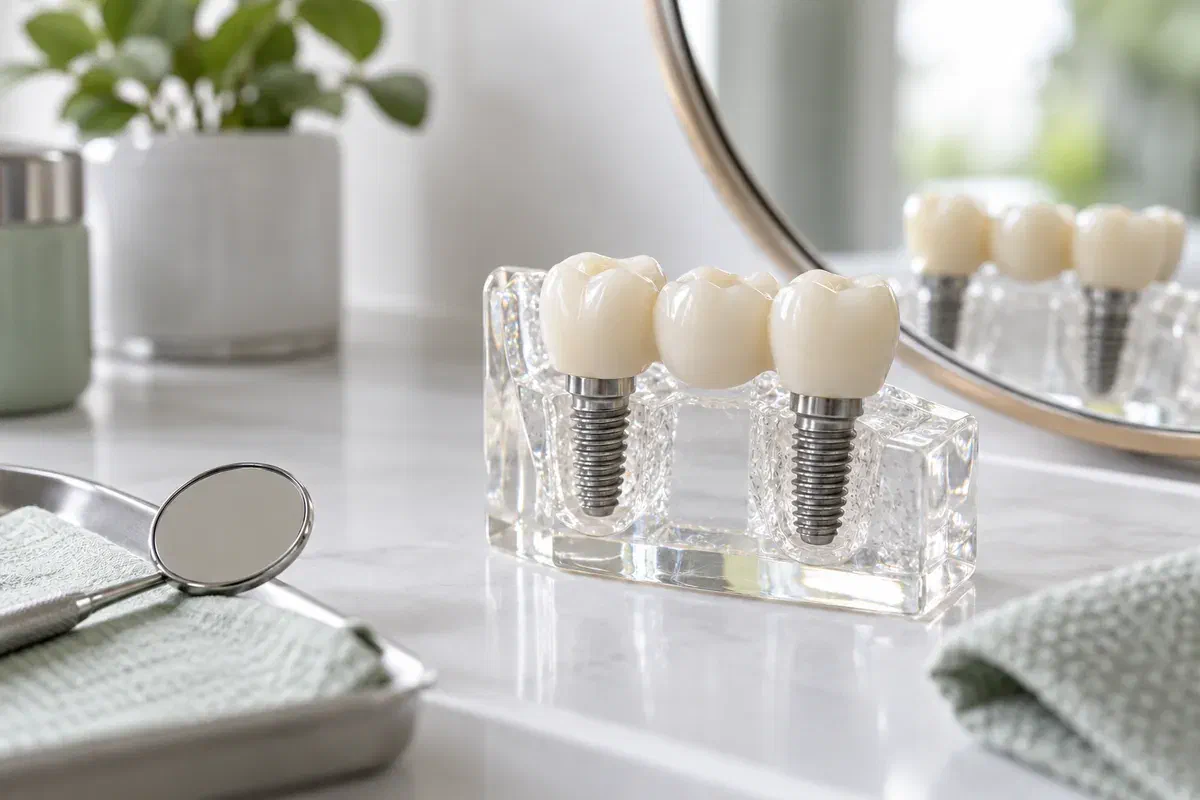
The gap’s location and the health of nearby teeth and gums shape what can be offered. Arrive with your own priorities, and we will weigh chewing, appearance, timing and practical upkeep with you.
For adjacent missing teeth, a fixed bridge may be considered when implants can be planned beneath it. Ask how a fixed design changes your cleaning, and what maintenance visits look like.
With implant support, the teeth on either side do not have to be prepared as anchors. They still need examining, and any issues found may influence the plan and the comparison with alternatives.
Let us know whether the issue is movement, bulk, sore spots or food collecting underneath. An implant bridge should be evaluated against those specific problems rather than assumed to fix all of them.
When teeth are still present where a bridge is proposed, their diagnosis and any sensible way to keep them should be discussed before extraction is included in the plan.
In a suitable mouth, an implant bridge restores a span of missing teeth with a fixed result. Its shape follows the space and your bite, and it stands apart from the adjoining natural teeth. Ask your dentist to describe the improvement that is realistic for you, not an ideal case.
Every benefit has a matching commitment. Implant surgery carries risks, healing is checked before moving on, and components may need work over the years. Compare those duties with a removable partial, a bridge on natural teeth, or a decision to leave things as they are for now.
Patient information: American Academy of Periodontology — multiple-tooth implant replacement
The replacement teeth, implants and biting forces are planned as a unit. Ask why a given arrangement suits your gap, instead of measuring plans by how many implants they include.
Tooth size, colour, gum contour and the junction with natural tissue all show. Ask which details can be previewed during planning or a provisional stage, and what your gums might limit.
Space for brushes and threaders under the bridge is planned in. Seeing the routine demonstrated before treatment helps you decide whether the arrangement suits your dexterity and habits.
Order and timing depend on the site, any preliminary treatment and your healing. Ask for the planned visits, temporary teeth arrangements, the clinicians involved and costs, explained together.
Your dentist reviews teeth, gums, bite and medical history and selects imaging for planning. Alternatives, limits and the possible need for a specialist opinion are discussed openly.
You learn the proposed implant sites, any preparatory work and the surgical approach. Healing times vary by case, and stable support must be confirmed before the restoration proceeds.
Impressions or scans guide the lab. Fit, tooth position, bite and the gum relationship are reviewed, with a provisional bridge or extra checks when the case benefits from them.
The completed bridge is assessed and attached using the chosen system. You receive a cleaning demonstration, tips for adapting, and a schedule for checking the bridge and implants.
Healing instructions after surgery are different from long-term care of the finished bridge. Follow your team’s guidance on eating, cleaning and return visits at each point.
Ask to see which threaders, brushes or water flossers fit your bridge, then practise in the chair. Regular floss rarely passes between joined teeth the way it does between natural ones.
A wobble, clicking, a rough or chipped edge, or a bite that suddenly feels different should be checked. Avoid poking at the bridge, and never glue a loose component yourself.
The teeth, joins and gum tissue around each implant need routine review. Ask how often you should return and whether a history of gum disease changes that interval.
Choosing an implant bridge means thinking about support, appearance and upkeep. These answers can frame your conversation without assuming one design suits every gap.
Set up a consultation to talk about replacing several missing teeth in a row. We will go through your goals, explain what an implant bridge would need for support and cleaning, and compare it honestly with the alternatives.
Notes or images from earlier extractions, implants or partials in the area are useful if you have them.
