The denture slips, and adhesive is a daily chore
Describe when it loosens and what relines or adjustments have been made. That lets us judge whether an improved conventional denture, implant retention or another option fits the underlying cause.


Stiff fingers, a weaker grip or a parent who needs a hand with their denture can all change which implant design makes sense. For households in Burlington, we compare removable and fixed options with handling, cleaning and future help in mind, not only how firmly the teeth attach.
Picture the end of the day, at the bathroom sink. With some implant dentures you unclip the appliance and brush it; with others you clean around and under teeth that stay put. Implants anchored in the jaw can help retain or carry a denture replacing many teeth, and that daily moment is where designs really differ.
An overdenture gets its grip from implant attachments while the gum tissue still shares the work, and it is removed for cleaning. A fixed restoration depends more fully on the implants and only comes off in the clinic. Ask to try handling a sample, since the effort needed to unclip one can surprise people.
From Burlington, families sometimes come together, especially when an adult child helps with appointments. That is welcome. We talk about what you want to change, then look at bone, gum tissue, health and practical care, including who might help with cleaning if your hands become less reliable.
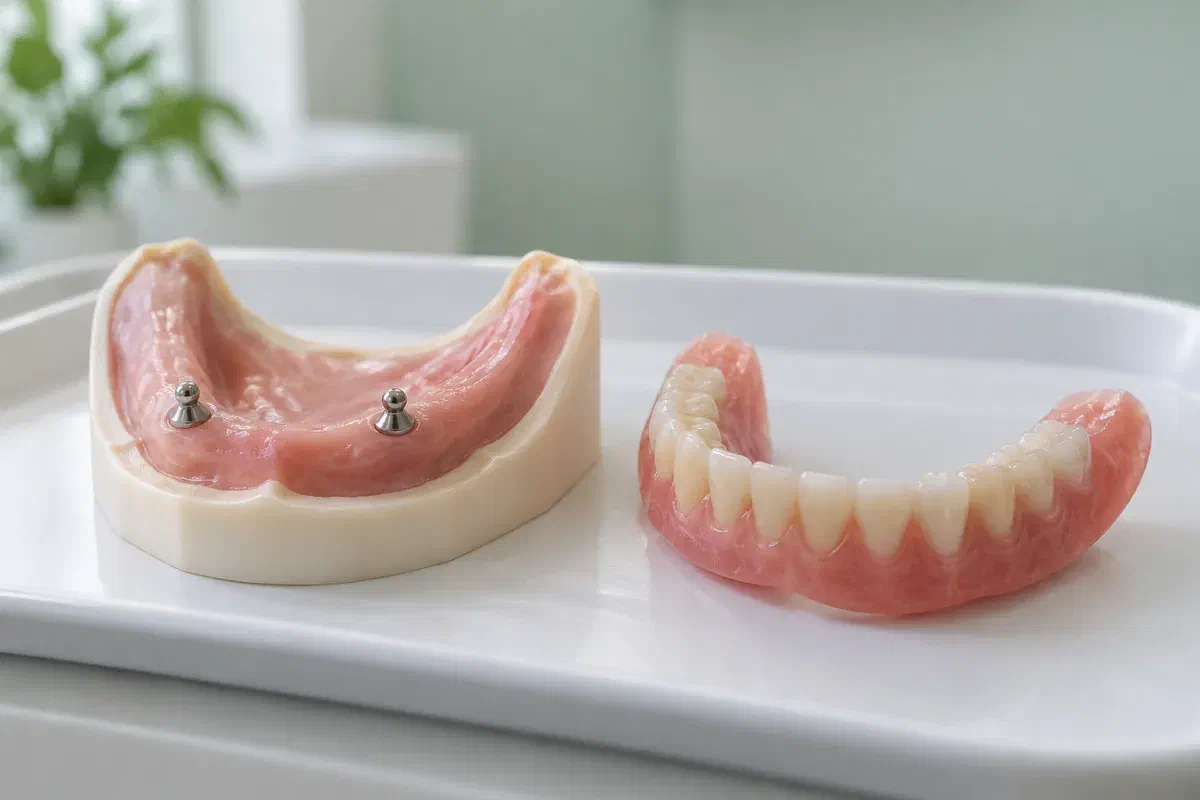
Implants may solve some denture problems but not others, so the current appliance and the mouth supporting it still need assessing. Pinning down the real cause of discomfort or looseness keeps the plan pointed at the right target.
Describe when it loosens and what relines or adjustments have been made. That lets us judge whether an improved conventional denture, implant retention or another option fits the underlying cause.
Removing an overdenture takes some finger strength, while a fixed design demands careful cleaning beneath it. Compare feel, effort and professional upkeep honestly rather than assuming one is automatically simpler.
If remaining teeth may be lost, ask about their outlook and any alternatives first. Then look at how the transition would work, what temporary teeth would be worn and who would help with care after the fitting.
Implants are not an option for everyone or for every part of the jaw. The assessment should spell out the limits in your case and compare the approaches that are realistic for your health and support at home.
In an appropriate mouth, connecting the denture to implants may hold it more securely or steadily than gum support alone. It is worth hearing that benefit in everyday terms, such as how it should feel at dinner, how long adapting might take and whether it could reduce the need for adhesive.
A more secure denture still asks for daily attention and is not a promise of unlimited chewing. Implant surgery, healing, maintenance and potential repairs all come with it. Seeing the gains and the commitments together helps you settle on something that suits your mouth and how you live.
Patient information: Cleveland Clinic — removable and fixed implant-supported dentures
A removable attachment system and a fixed restoration support teeth in different ways and ask different things of your hands. Find out why one is recommended and what would change with the other.
The position of the teeth, the material replacing lost gum and bone, and support for the lips shape how the denture looks and sounds. Ask what can be adjusted at try-in and where some getting used to it is expected.
Think about what you can do today and what a family member or caregiver might do in future. Cleaning access, part replacement and professional checks should be understood from the very beginning.
Implant dentures typically involve a number of visits, sometimes with more than one clinician. Ask for the full order of events, including preparatory treatment, interim teeth, healing reviews, the final fit and ongoing checks.
We look at whatever natural teeth remain, your gum tissue, your health history and the denture you wear now. Imaging and records help assess suitability, while your concerns about eating, speaking, handling and cost shape the discussion.
Where appropriate, removable and fixed designs are weighed with the proposed implant arrangement and other choices. We go over surgical risks, added treatment, temporary teeth and any parts of the estimate that may shift.
Each agreed step is carried out in order, and healing is confirmed before the next one begins. Impressions, lab work and try-in visits build the appliance around its support, with timing guided by your clinical picture.
When fitted, the denture is checked and its use explained. You or a helper practise any removal and insertion, learn the cleaning steps and book the early review plus long-term maintenance.
Early healing has its own instructions, separate from caring for the finished denture. Keep written guidance where you and any helper can find it, and ask about wear, cleaning, food and contacts at each stage.
With a clip-in overdenture, you lift it out on the schedule you are given and clean it along with your gums. Fixed teeth are cleaned in the mouth, around and beneath; never attempt to release it at home.
Ask which brushes, cleaners and storage suit the denture materials and attachments, and whether larger-handled aids could help. Avoid very hot water, household chemicals and improvised tools.
Report sore spots, returning looseness, trouble removing the denture or a bite that changes. Attachments and materials wear with time, and maintenance may be needed even when the implants remain stable.
No question is too basic, even after years of wearing a denture. Implants add choices about treatment, handling and the support required once the appliance is in.
Schedule a consultation at our Bronte Street practice to look at your current denture or plans to replace several teeth. We can go through suitable designs, explain how treatment proceeds and show what care each one needs.
Bring the dentures you use now and any notes on previous implants or restorative care, and feel free to bring a helper.
