Your denture lifts, slides or rubs
Note when it shifts and which adjustments have been made before. That record helps us decide whether an improved conventional denture, implant support or another approach answers the underlying problem.


Implant dentures unfold over several visits, which matters when you are coming from Etobicoke. Our Milton team maps the stages in advance, groups appointments where it is clinically sensible, and explains which problems need a call first and when nearer urgent care makes more sense.
Treatment of this kind is a series, not a single sitting. Implants placed in the jaw help retain or carry a denture that replaces multiple teeth, and getting there involves assessment, surgery, healing checks, try-ins and a fitting. Seeing that series laid out early is what makes it manageable from a distance.
The design also shapes how often you will return. A removable overdenture clips onto attachments, rests partly on the gums and comes out for cleaning, with attachment servicing over time. A fixed restoration leans more fully on the implants and is removed only in the clinic for professional maintenance.
Because Etobicoke is one of the longer trips to our practice, we talk honestly about logistics alongside the clinical side. First comes what you want to change, then bone, gums, health and daily care. After that, we can discuss how many visits each option is likely to need.
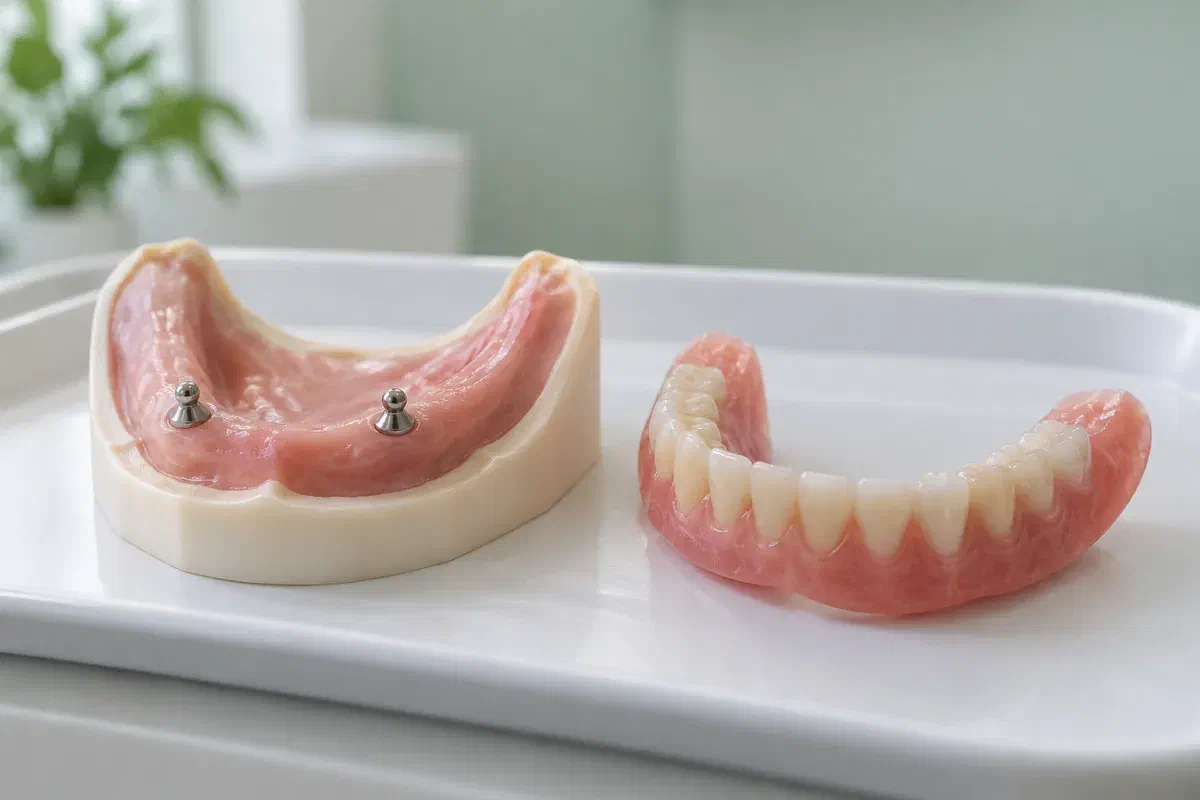
Implants can help with some denture issues, though the appliance you wear and the tissues beneath it still need examining. Understanding why it is loose or sore keeps you from travelling for treatment aimed at the wrong cause.
Note when it shifts and which adjustments have been made before. That record helps us decide whether an improved conventional denture, implant support or another approach answers the underlying problem.
Both need professional upkeep and a home routine. Compare removal, cleaning access, grip, feel and how often each typically needs servicing, rather than assuming fixed is always the lower-maintenance choice.
If many teeth may be lost, ask about their outlook and alternatives first. A replacement plan should describe the transition, temporary teeth and every stage beyond the first fit, so you can plan the trips.
Implant treatment does not suit every person or site. Your examination should set out the limits in your case and compare realistic options for your health and circumstances.
In an appropriate mouth, connecting a denture to implants can improve retention or stability over tissue support alone. Ask what that means day to day: how securely the appliance should sit, how long adapting may take and which of your concerns it is likely to resolve.
The benefit does not replace the need for care or guarantee unlimited function. Surgery, healing, maintenance and later repairs are all part of it, and each may mean a visit. Factor those into the decision so the plan suits your clinical needs and your travel.
Patient information: Cleveland Clinic — removable and fixed implant-supported dentures
A removable attachment system and a fixed restoration handle support differently and are serviced differently. Ask why one suits you, and what follow-up the other would involve.
Tooth position, replacement material for lost tissue and lip support influence look and comfort. Ask which features can be checked during fabrication so changes happen before the final fit.
Consider what you can do now and what help you may need in future. Cleaning access, part replacement and reviews should be understood from the start, including how often they would mean a trip.
Several visits are usual, sometimes with more than one clinician. Ask for the full sequence in advance, including preparation, any temporary appliance, healing checks, final fitting and ongoing reviews, so you can plan time away.
The dentist examines remaining teeth, gums, health history and your current denture. Records and imaging help gauge suitability, while your thoughts on chewing, speech, handling, cost and travel shape the discussion.
Removable and fixed options are compared where suitable, along with the implant arrangement and alternatives. Risks, extra treatment, temporary teeth, possible estimate changes and the likely number of appointments are discussed.
The treating team follows the agreed order and checks healing before progressing. Impressions, fabrication and try-ins build the appliance around its support; timing depends on your clinical situation, not on scheduling alone.
At the fitting, the appliance is checked and explained. Practise any removal and insertion, learn the cleaning routine and set dates for early review and future maintenance.
Early-healing instructions differ from long-term care. Keep written guidance close and ask about wear, cleaning, food and how to reach us, including what to do outside our hours.
A removable overdenture comes out as directed so it and your gums can be cleaned. A fixed restoration is cleaned around and beneath in place; never try to release it yourself.
Ask which brushes, cleaners and storage suit the denture and attachments. Avoid very hot water, household chemicals and improvised tools that might be used on other appliances.
Let us know about sore spots, returning movement, difficulty removing the denture or a changed bite. Parts and materials wear, and maintenance can be needed while implants remain stable.
Ask about design and logistics, even if you have worn dentures for years. Implants introduce decisions about treatment, handling and the support you need afterwards.
Reserve a consultation at our Bronte Street practice to discuss the denture you wear or plans to replace several teeth. We will review designs, outline the sequence and expected visits, and explain the care each option needs.
Bring your dentures, medication list and any information about earlier implants or restorative work.
