

Illustrative patient and dentist reviewing an implant denture teaching model
Restorative Dentistry

Implant-Supported Dentures in Oakville

Removable or fixed? That single choice shapes how an implant denture is cleaned, maintained and lived with. If you are coming from Oakville, our Milton team can lay the two side by side, alongside a conventional denture, so the decision rests on your mouth and your routine.

The fork in the road

Two designs, two very different routines

Most conversations about implant dentures arrive at the same question sooner or later: should the teeth come out at night or stay in? Implants set in the jaw can help hold or carry a denture that replaces many missing teeth, and the way the appliance attaches to them sets the tone for everything that follows.

With an overdenture, attachments grip the appliance while the gums still share some of the load; you unclip it to clean. A fixed restoration relies more completely on the implants and is taken off only by a clinician. Labels vary between offices, so ask where the support comes from rather than trusting a name.

For people travelling from Oakville, it helps to know early which design is realistic, because the number of visits and the type of follow-up differ. We start with what you want to improve, then look at your bone, gums, health and how much hands-on care you are comfortable giving the appliance.

Weigh up removable and fixed designs
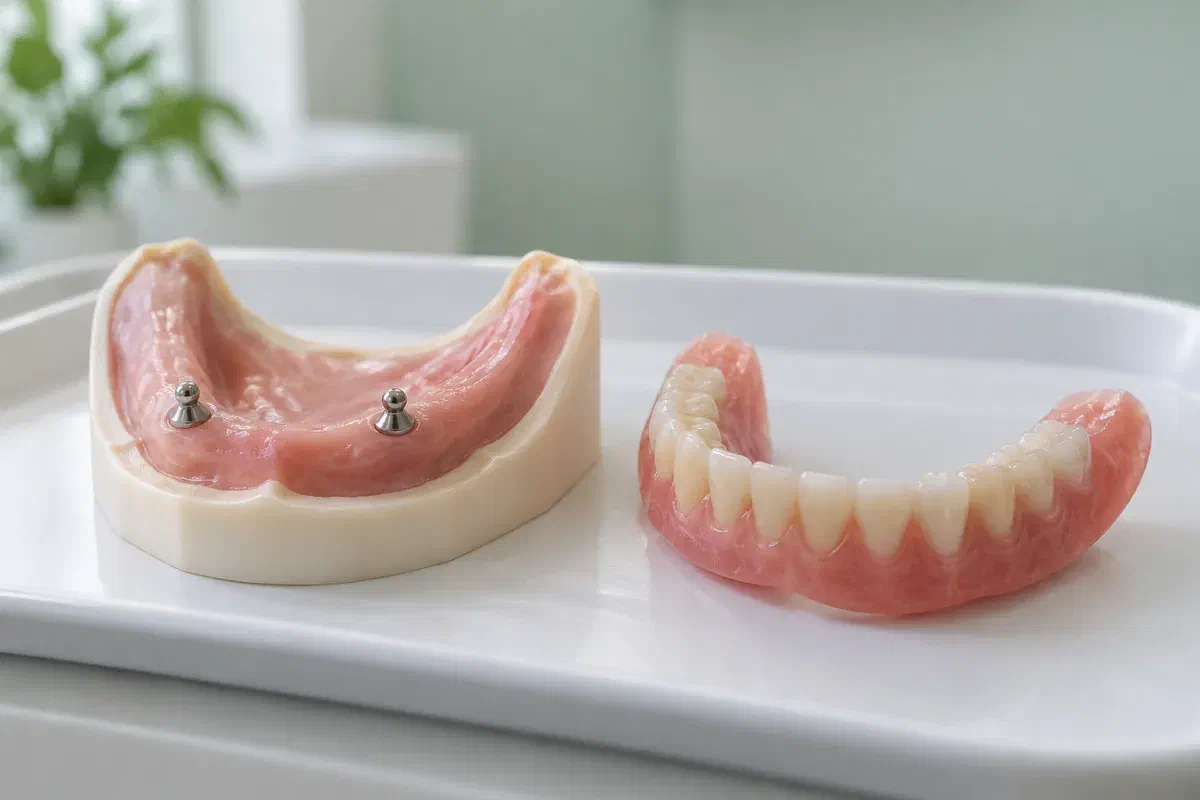
Lower removable overdenture beside a teaching model with two implant attachment heads
Sorting out priorities

What would make the biggest difference?

Implants may ease certain denture problems, yet the current appliance and the supporting tissues still need examining. Knowing exactly why a denture is uncomfortable or unstable keeps you from choosing treatment for the wrong reason.

Movement that interrupts meals or conversation

Describe the moments when the denture shifts and the adjustments already made. From there, we can tell whether improving the conventional denture, adding implant support or some other step suits the cause.

Leaning toward fixed, but not certain

A fixed appliance has its own demands. Compare daily cleaning under the teeth, removal for a clip-in design, dexterity, how each one feels and the professional servicing both need before deciding which is simpler for you.

Preparing for significant tooth loss

Ask about the outlook for teeth that may be removed and any way of saving them. A replacement plan should describe how you will manage in between, which temporary teeth you would wear and what happens after the first fit.

Implant treatment does not suit every person or every site in the jaw. Your examination should explain the constraints that apply to you and compare options that are workable for your health.

Where implants can help

Security you notice in small moments

If implants suit you, attaching a denture to them may give better retention or stability than relying on the gums. Ask us to put the expected change into everyday language: how it should feel when you bite, how long settling in might take and which complaints it is likely to address.

That gain still comes with responsibilities and does not mean eating without any limits. Surgery, healing, maintenance visits and possible repairs are all part of the commitment. Seeing benefits and obligations together helps you pick a plan that suits both your clinical needs and your preferences.

Patient information: Cleveland Clinic — removable and fixed implant-supported dentures

Understand the reasoning behind a design

Removable attachments and a fixed restoration manage support differently. Ask what makes the recommended choice suit your mouth, and how your experience would change with the other option.

Include looks and speech from the start

Where teeth are positioned, how much material replaces lost tissue and how the lips are supported can influence appearance and comfort. Ask which features are reviewed at try-in and where getting used to it may take time.

Picture maintenance ten years on

Consider what you manage easily today and what help might be needed in future. Cleaning access, replacement parts and professional reviews should be understood as part of the plan right from the start.

How treatment is sequenced

Planning first, then implants, then teeth

Several appointments are typical, and more than one clinician may take part. Ask for a clear outline that includes preparatory care, any temporary appliance, healing checks, the final fit and future reviews, so you can plan visits from Oakville.

  1. Assess your mouth and your priorities

    The dentist reviews remaining teeth, gums, health history and your present denture. Records and imaging help determine suitability, while your thoughts on chewing, speech, handling and budget guide what we discuss.

  2. Decide on the design and the plan

    Removable and fixed options are compared where both apply, along with the implant layout and alternatives. Surgical risks, extra procedures, temporary teeth and the parts of the estimate that might change are clarified.

  3. Place implants and build the appliance

    The treating team works through the agreed sequence, checking healing before going further. Impressions, fabrication and try-ins develop the denture around the implant support, with timing that depends on your situation.

  4. Fit, review and teach daily care

    At fitting, the appliance is checked and its use explained. You rehearse any removal and insertion, learn how to clean it and confirm the early follow-up and ongoing maintenance schedule.

After your appliance is fitted

Care for the denture you chose

Guidance during early healing is separate from long-term care of the finished appliance. Keep the written instructions handy and ask for clarification on wear, cleaning, eating and contact details whenever needed.

Each design has its own routine

An overdenture is taken out as instructed for cleaning it and the tissues beneath. A fixed restoration is cleaned around and under while in place; leave its connections alone at home.

Use the right products and tools

Ask which brushes, cleansers and storage habits suit your denture materials and attachments. Avoid very hot water, household cleaners or improvised tools that might work on a different kind of appliance.

Keep regular reviews booked

Mention sore areas, renewed looseness, difficulty removing it or a different bite. Attachment parts and denture materials can wear, so upkeep may be needed even while the implants stay stable.

Comparing the approaches

Support, removal and upkeep in one view

These options differ in where support comes from, whether they come out, what treatment is needed and how they are maintained. The most useful one is clinically appropriate and practical for you, with drawbacks explained in advance.

Designed to come out for cleaning

A removable implant overdenture

Attachments help keep the denture in place, and you remove it on the schedule you are given. Ask how it sits on the gums, how much effort unclipping takes and what attachment servicing involves.

Designed to stay in place

A fixed implant restoration

The teeth stay attached through eating and cleaning. Planning has to address implant support, how you will reach beneath the restoration and professional maintenance or removal when indicated.

Designed without implants

A conventional denture

A new denture, or work on the current one, may still be a fair choice. Ask what improvement is realistic, which limits remain and how it stacks up against implant treatment.

Your questions about the two designs

Clearing up the choice

Bring up the design and the practical stages, even if dentures are nothing new to you. Implants bring fresh decisions about treatment, handling and the support needed once the appliance is fitted.

(905) 876-4488
Do fixed implant teeth ever need to come out?
Yes, a clinician may remove a fixed restoration for maintenance, cleaning or repair when indicated. You should not try to remove it yourself. Ask how often professional removal is expected for the proposed design.
Is a removable overdenture harder to clean than fixed teeth?
They are cleaned differently rather than one being simply harder. A removable appliance comes out, which can make access easier, while a fixed one requires cleaning beneath it in place. Ask to practise the routine for each before choosing.
Which design tends to need fewer implants?
The number depends on your examination and the restoration design, not on a standard rule. Ask why a particular number and position are proposed, and how that would change if you chose the other type.
Can I start with a removable design and switch to fixed later?
Sometimes a plan can allow for changes, but it depends on implant positions, bone and the appliance design. Ask whether future flexibility is realistic in your case before treatment begins, rather than assuming it.
Does a fixed implant denture feel more like natural teeth?
Many people find a fixed design feels secure, but it is still a restoration and some adaptation is normal. How it looks and feels depends on tooth position and tissue support. Ask what to expect during the adjustment period.
How can I keep the number of trips from Oakville manageable?
Ask us to outline the expected appointments at the planning stage, so you can see where visits might be grouped. Some stages depend on healing and cannot be rushed, but knowing the sequence makes scheduling easier.
Implant dentures for Oakville

Talk through both designs before you choose.

Arrange a visit to our Bronte Street practice to review the denture you wear today or plans to replace multiple teeth. We will discuss which designs suit you, outline the treatment stages and explain the ongoing care each requires.

Please bring your current dentures and any information about past implants or restorative work.

Visit Milton Dental Clinic
Unit 1, 342 Bronte St. S, Milton, ON L9T 5B7
Get directions Clinic hours
Monday–Thursday
11am–7pm
Friday–Sunday
By appointment only

Areas we serve

  • Milton
  • Oakville
  • Mississauga
  • Georgetown
  • Halton Hills
  • Acton
  • Campbellville
  • Brampton
  • Burlington
  • Puslinch
  • Rockwood
  • Erin
  • Caledon
  • Etobicoke
  • Old Milton
  • Bronte Meadows
  • Timberlea
  • Dorset Park
  • Dempsey
  • Clarke
  • Beaty
  • Coates
  • Harrison
  • Scott
  • Willmott
  • Ford
  • Bowes
  • Cobden
  • Walker
  • Mountain View
  • Milton Heights
  • Hawthorne Village
  • Valley View
  • Fallingbrook
  • Nassagaweya
  • Trafalgar
  • Esquesing
  • Nelson
  • Brookville
  • Moffat
  • Glen Williams
  • Norval
  • Limehouse
  • Stewarttown
  • Ashgrove
  • Hornby
  • Silver Creek
  • Speyside
  • Scotch Block
  • North Oakville
  • River Oaks
  • Glen Abbey
  • West Oak Trails
  • Palermo
  • Bronte Creek
  • College Park
  • Joshua Creek
  • Uptown Core
  • Preserve
  • Iroquois Ridge
  • Lisgar
  • Meadowvale
  • Meadowvale Village
  • Churchill Meadows
  • Erin Mills
  • Central Erin Mills
  • Streetsville
  • East Credit
  • Creditview
  • Heartland
  • Sheridan
  • Mount Pleasant
  • Credit Valley
  • Huttonville
  • Churchville
  • Springbrook
  • Northwest Brampton
  • Bram West
  • Fletcher's Meadow
  • Fletcher's Creek South
  • Alton Village
  • Orchard
  • Millcroft
  • Headon Forest
  • Tansley
  • Brant Hills
  • Tyandaga
  • Kilbride
  • Lowville
  • Aberfoyle
  • Morriston
  • Arkell
  • Hillsburgh
  • Freelton
  • Carlisle
  • Waterdown
  • Flamborough
  • Mountsberg

How can we help?

Milton Dental Clinic

Have a question about your smile? Choose the option that works best for you.

For urgent dental concerns, please call.
Messages are reviewed during clinic hours.