

Illustrative patient and dentist reviewing an implant denture teaching model
Restorative Dentistry

Implant-Supported Dentures in Old Milton

You may have worn the same denture for years and simply learned to work around it. For people in Old Milton, close by our Bronte Street practice, we can look at whether implant support is worth considering now, and explain the stages, upkeep and alternatives honestly before you decide.

After many years with one denture

Is it time to rethink the habits you’ve built around it?

Long-time denture wearers often adapt without noticing: cutting food smaller, avoiding certain dishes, reaching for adhesive before going out. Gums and jawbone also change shape gradually after teeth are lost, so an appliance that once fit well can begin to rock. Implants are one way to give a denture firmer anchorage.

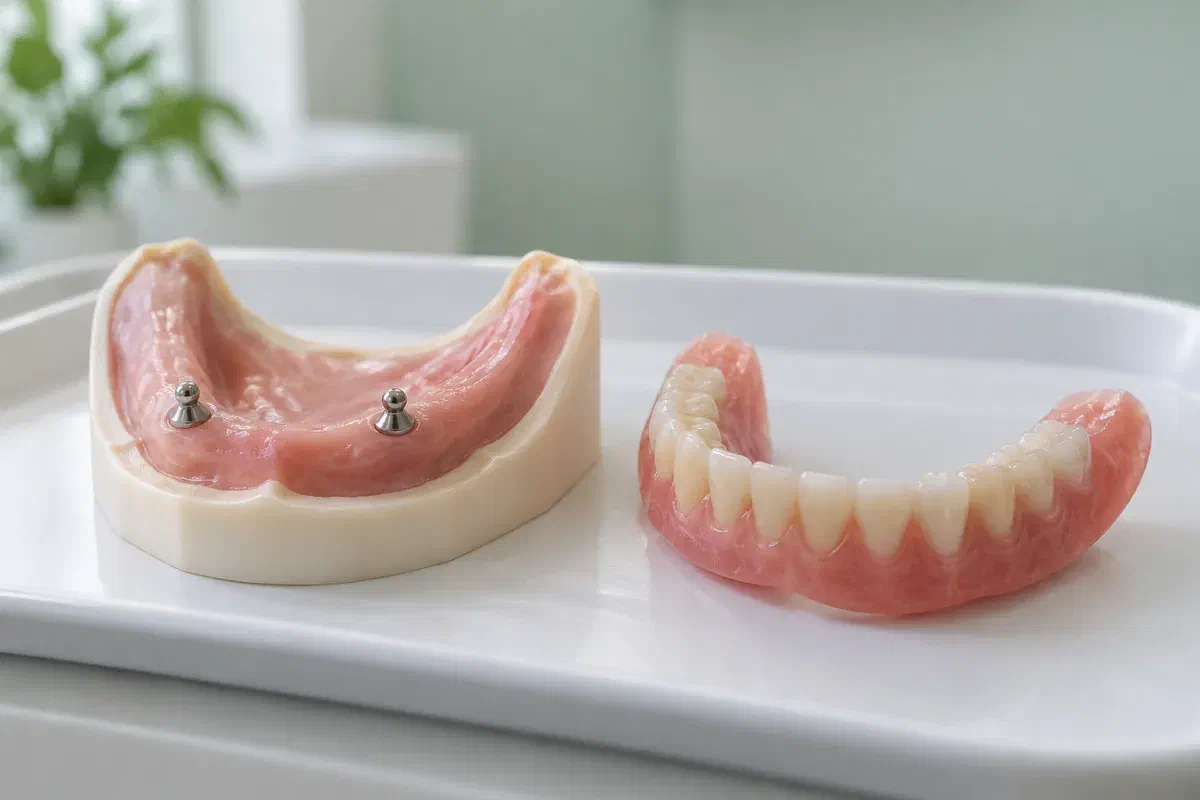
Two broad families exist. An overdenture snaps onto implant attachments, still takes some load on the gums, and comes out each day for cleaning. A fixed restoration leans more heavily on the implants and is only removed by a clinician. Ask to handle a model of each so the difference feels real, not theoretical.

Many people in Old Milton, Milton’s historic downtown, come to us with a specific frustration rather than a request for implants. That is a good place to begin. We review your health, bone and gum tissue alongside what you hope to change, then talk about which options are realistic and which are not.

Compare implant denture designs
Lower removable overdenture beside a teaching model with two implant attachment heads
Reasons people come in

Which of these sounds familiar?

Implants answer some denture complaints well and others less so. Your existing appliance and the mouth beneath it deserve a proper look first, so the treatment chosen matches the real cause of the trouble.

An older denture that rocks or drops

Note when it happens, such as biting into an apple or speaking on the phone, and list past relines. That history helps us judge whether a new conventional denture, implant attachments or another approach makes most sense.

Wondering if fixed teeth would be simpler

Fixed does not always mean easier. Each design asks something of you, from removal and insertion to cleaning under the teeth. Grip strength, comfort and professional upkeep belong in the comparison too.

Remaining natural teeth that are failing

Before taking out teeth, ask how long they might reasonably last and whether they could be kept. If replacement is the plan, it should cover the transition period, any interim denture and the work after the first fitting.

Not everyone, and not every area of the jaw, is suited to implants. Your assessment should be clear about your own limitations and compare the choices that genuinely fit your health and circumstances.

Possible gains from implant support

Fewer workarounds at the table

In a suitable mouth, linking the denture to implants can make it more secure or stable than gum support alone allows. The benefit is best described practically: how firmly it should sit, how long adjusting may take, and which of the habits you have developed it might let you drop.

None of that removes the need for daily care, and it does not promise you can bite into anything. There is surgery and healing to plan for, regular maintenance, and the possibility of repairs later on. Put those commitments next to the potential benefits so the choice suits your mouth and your routine.

Patient information: Cleveland Clinic — removable and fixed implant-supported dentures

Ask what each design is meant to do

An attachment-retained overdenture and a fixed restoration tackle the support problem in different ways. Find out why one is recommended for you, and what would differ if you chose the other route.

Consider how your face and voice may change

Tooth placement, the material that stands in for lost gum and bone, and lip support all influence appearance and speech. Ask what can be reviewed while the appliance is being made and what may take time to get used to.

Plan for help you might need later

Think beyond your current abilities to what assistance could be useful in future. How the appliance is cleaned, which parts may need replacing and how often it should be reviewed ought to be clear from the outset.

What treatment involves

Four stages, each with its own check

Expect several appointments, and possibly more than one practitioner. Ask for the order of events in writing, covering preparatory treatment, any temporary denture, healing reviews, the final fit and ongoing maintenance.

  1. An examination built around your concerns

    We examine your remaining teeth, gums, medical history and current denture. Imaging and records help gauge suitability, and what you tell us about chewing, speech, handling and budget shapes the conversation.

  2. Choosing a design and confirming the plan

    If both are suitable, we compare removable and fixed approaches, the suggested number and position of implants, and other options. Surgical risks, added treatment, interim teeth and which costs could shift should all be spelled out.

  3. Carrying out implant and denture stages

    The treating team follows the agreed sequence and checks healing before each next step. Impressions, laboratory work and try-ins build the appliance around the support, with timing set by your clinical circumstances.

  4. Fitting, adjusting and learning the care

    When the appliance is fitted, the team checks it and shows you how it works. You practise any removal and placement, learn the cleaning routine, and arrange the first review and longer-term maintenance.

Once it is fitted

Different appliance, different routine

Instructions for early healing are not the same as those for the finished denture. Hold on to the written guidance and ask about wear, cleaning, food and who to contact at each stage.

Clean it the way your design needs

A removable overdenture is taken out as directed so the appliance and gums can be cleaned. A fixed restoration is cleaned in place, around and underneath; its connections should never be undone at home.

Handle it with suitable products

Ask which brushes, soaks and storage methods are right for the materials and attachments. Hot water, household chemicals and improvised tools can do damage, even if they seemed fine on an older denture.

Keep up with review appointments

Tell us about pressure spots, a return of movement, trouble taking it out or a bite that feels off. Parts and denture materials wear with use, so maintenance can be needed while the implants themselves stay healthy.

Three paths to consider

How would each one fit your routine?

The approaches vary in support, whether they come out, the treatment they need and how they are kept up. The best fit is clinically sound and workable for you, with its drawbacks explained beforehand.

If taking it out daily suits you

A removable implant overdenture

Attachments improve retention, and you remove the denture for cleaning as instructed. Ask how much it still relies on the gums, how much effort removal takes and how the attachments are serviced.

If a fixed design is appropriate

A fixed implant restoration

The teeth remain in place day and night, including during cleaning. Planning must cover implant support, cleaning access beneath the appliance, and professional maintenance or removal when necessary.

If you prefer to avoid implants

A conventional denture

A replacement denture or a reline of your current one may still be reasonable. Ask what improvement is likely, what limits remain and how that compares with an implant option.

Questions from long-time wearers

Things worth asking before you commit

Every question is welcome, however long you have worn a denture. Implants add decisions about treatment, daily handling and the support you will need afterwards.

(905) 876-4488
Why does a denture that fit well years ago feel loose now?
After teeth are lost, the gums and bone underneath gradually change shape, while the denture stays the same. Wear on the teeth of the appliance can also play a part. An exam can show whether a reline, a new denture or implants would address it.
Am I too old to be considered for implants?
Age alone does not decide suitability. General health, medications, bone, healing and your ability to care for the appliance matter more. The dentist can explain what your own history means for treatment and whether coordination with your physician is needed.
Do I have to give up my familiar denture to get implants?
Not always. Some existing dentures can be adapted to implant attachments, depending on their condition, fit and design. Others are better replaced. Have your current appliance examined before assuming either way.
Will an implant overdenture feel very different from what I wear now?
It may feel more secure, and the attachments add a new sensation when seating and removing it. Some adaptation is normal. Ask what to expect in the first weeks and how adjustments are handled if pressure spots develop.
What should I compare besides the first fee?
Look at the full sequence: assessment, preparatory work, implant stages, interim and final appliances, follow-up and future maintenance. A lower starting cost may not reflect the total commitment of a particular design.
Is it easy to get to appointments from Old Milton?
Our Bronte Street practice is close to Milton’s historic downtown, which can make the several visits involved easier to manage. Ask us to set out the stages ahead of time so you can plan around them.
Implant dentures for Old Milton

Bring your denture, and your questions.

Book a consultation at our Bronte Street practice to discuss the appliance you wear today or plans to replace a number of teeth. We will explain which designs could suit you, how treatment unfolds and what care each one involves.

Bring the dentures you wear now, plus any details of previous implants or restorative treatment.

Visit Milton Dental Clinic
Unit 1, 342 Bronte St. S, Milton, ON L9T 5B7
Get directions Clinic hours
Monday–Thursday
11am–7pm
Friday–Sunday
By appointment only

Areas we serve

  • Milton
  • Oakville
  • Mississauga
  • Georgetown
  • Halton Hills
  • Acton
  • Campbellville
  • Brampton
  • Burlington
  • Puslinch
  • Rockwood
  • Erin
  • Caledon
  • Etobicoke
  • Old Milton
  • Bronte Meadows
  • Timberlea
  • Dorset Park
  • Dempsey
  • Clarke
  • Beaty
  • Coates
  • Harrison
  • Scott
  • Willmott
  • Ford
  • Bowes
  • Cobden
  • Walker
  • Mountain View
  • Milton Heights
  • Hawthorne Village
  • Valley View
  • Fallingbrook
  • Nassagaweya
  • Trafalgar
  • Esquesing
  • Nelson
  • Brookville
  • Moffat
  • Glen Williams
  • Norval
  • Limehouse
  • Stewarttown
  • Ashgrove
  • Hornby
  • Silver Creek
  • Speyside
  • Scotch Block
  • North Oakville
  • River Oaks
  • Glen Abbey
  • West Oak Trails
  • Palermo
  • Bronte Creek
  • College Park
  • Joshua Creek
  • Uptown Core
  • Preserve
  • Iroquois Ridge
  • Lisgar
  • Meadowvale
  • Meadowvale Village
  • Churchill Meadows
  • Erin Mills
  • Central Erin Mills
  • Streetsville
  • East Credit
  • Creditview
  • Heartland
  • Sheridan
  • Mount Pleasant
  • Credit Valley
  • Huttonville
  • Churchville
  • Springbrook
  • Northwest Brampton
  • Bram West
  • Fletcher's Meadow
  • Fletcher's Creek South
  • Alton Village
  • Orchard
  • Millcroft
  • Headon Forest
  • Tansley
  • Brant Hills
  • Tyandaga
  • Kilbride
  • Lowville
  • Aberfoyle
  • Morriston
  • Arkell
  • Hillsburgh
  • Freelton
  • Carlisle
  • Waterdown
  • Flamborough
  • Mountsberg

How can we help?

Milton Dental Clinic

Have a question about your smile? Choose the option that works best for you.

For urgent dental concerns, please call.
Messages are reviewed during clinic hours.