A crown that lifts or rocks
Note whether the movement is new or familiar. Twisting or tugging the crown could break a fragile tooth beneath it, so leave the hands-on check to the dentist.


You look inside a crown that has come loose and see what appears to be a piece of tooth. That changes the conversation. For households around Campbellville, our dentist examines the crown and what remains of the tooth, then explains whether it can be rebuilt, resecured, or needs another plan.
Most loose crowns come away empty, leaving the shaped tooth behind. Occasionally, though, there is something inside: a fragment of tooth, filling material, or a post. That usually means the failure happened in the tooth or its core rather than only in the cement, and it is worth knowing before anyone talks about putting the crown back.
Even when the crown is empty, the cause can sit in several places. The bond may have let go, the crown may be cracked, or the tooth and any build-up beneath it may have changed. Decay can develop unseen under a crown that looked perfectly sound. And neither a broken core nor an empty crown is automatically the end of the tooth or a guarantee that you will need a new crown.
When you phone, describe what you can see inside the crown, if it has come off, or how it moves, if it is still on. Mention whether the tooth has had a root canal, any recent dental work, and any pain or swelling. That gives the dentist a clearer idea of what the appointment needs to cover.
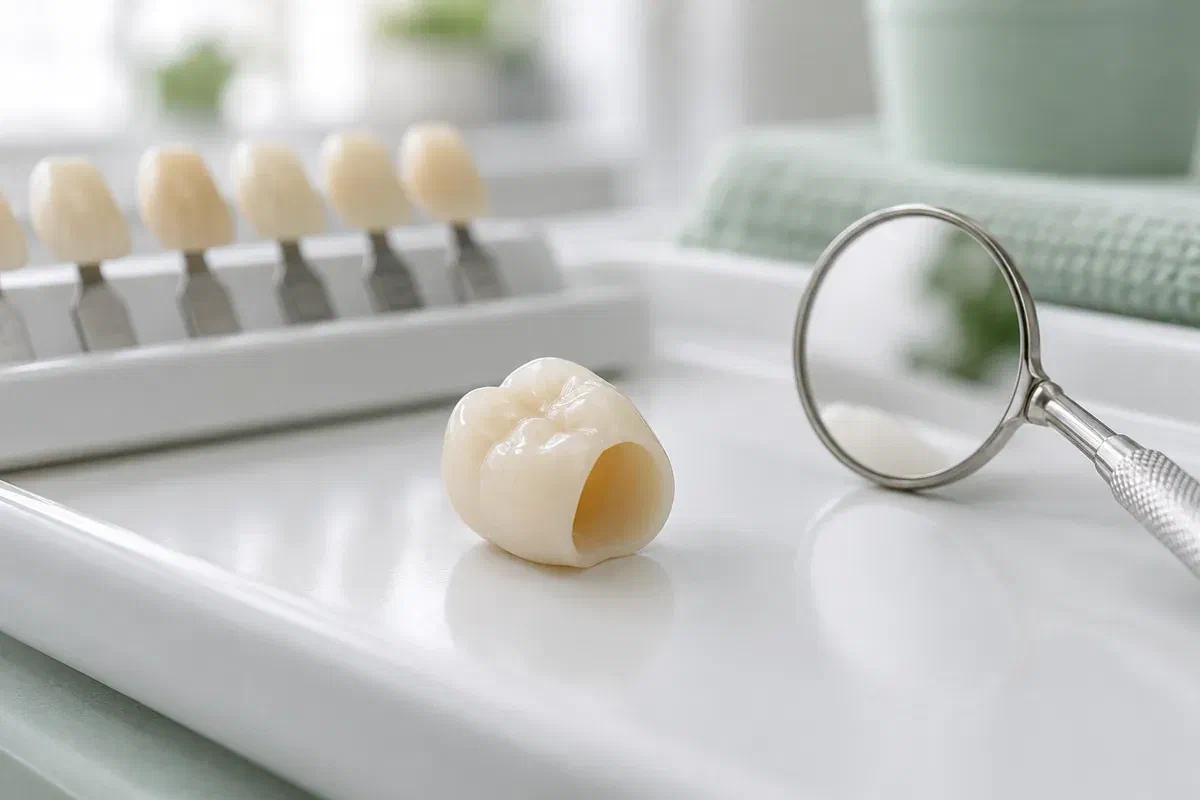
A crown doesn’t need to fall out before you get in touch. Tell us what you are feeling, and try to leave it alone, because repeated testing can loosen it further or damage a weakened tooth.
Note whether the movement is new or familiar. Twisting or tugging the crown could break a fragile tooth beneath it, so leave the hands-on check to the dentist.
Feeling the crown move or land early when you bite can suggest it is no longer seated properly. Describe it rather than chewing hard on that side to confirm it.
New sensitivity, a bad taste, or food lodging at the edge can all help the dentist narrow things down. None is specific to one cause, so the dentist reads them against what the examination reveals.
Please phone soon about any crown movement. Let us know about significant pain, swelling, a fall or knock, or a crown that seems to have come off with tooth attached, so the team can advise on timing.
If the crown is intact and fits, and enough sound tooth remains to hold it, resecuring may still be possible. That decision follows examination and preparation. It is not as simple as cementing back whatever has come out.
Where part of the tooth or core has broken, it usually needs rebuilding before any crown can be secure. Ask the dentist what has broken, what can be kept, and why the suggested approach is expected to be more reliable.
Patient information: Cleveland Clinic — dental crown care and signs to report
A crown can come loose because the bond failed, or because the tooth under it broke. The dentist looks at each, which explains why one person needs only recementing and another needs more.
Once part of the structure is gone, the tooth may need a new core, and sometimes a post, before it can hold a crown. Ask how much healthy tooth remains and what that means.
If rebuilding is needed, the first visit may include a temporary measure to protect the tooth. Ask whether the work is final, and what precautions and next steps apply if it is not.
We start with your account and, if you have it, the crown itself. What follows depends on the findings, and rebuilding a tooth or making a new crown may take more than one appointment.
The dentist asks about the crown’s history and how it came loose, then examines the crown, the remaining tooth, your gums, and your bite. An X-ray may be taken to see the root and any post or core.
Where a crown is still on but needs removing for inspection, you will hear why and what the risks are. The dentist is checking whether the crown and what remains of the tooth can support a repair.
Before treatment, the findings, other options, and an estimated fee are explained. A sound crown on a solid tooth may be rebonded; a broken core, decay, or poor support may mean rebuilding first or a new crown.
After treatment, the dentist checks that the crown seats well and your bite feels even. Ask about eating, cleaning, temporary limits, and what to do if the crown moves or the tooth aches before your next visit.
Ask us for instructions that fit your situation. Advice can vary for a temporary crown, a permanent crown, and a tooth that has broken or lost some of its structure.
A tooth that has lost part of itself can be fragile. Keep hard and sticky food away from it and chew on the other side until you have advice. Try not to probe it with your tongue.
Place the crown and anything that came out with it in a small clean container and bring them along. Don’t glue anything back, hold it in your mouth, or force the crown onto the tooth.
Ask when you can eat normally and how to clean around the new or resecured crown. If your bite feels high, discomfort lingers, or movement returns, phone us rather than assuming that is expected.
Everything here concerns a crown over a natural tooth. Implant crowns, with their screws and abutments, are repaired another way, so mention an implant when booking.
Reach out to the Bronte Street team once a crown has moved or come away. We will examine the crown and the tooth, explain what can be kept or rebuilt, and recommend a repair that suits.
Pain, swelling, or part of the tooth came away with the crown? Please phone and let us know.
