

Illustrative consultation about an existing metal filling
Restorative Dentistry

Metal Filling Replacement in Georgetown

Big silver fillings can leave thin walls of tooth around them. If you are coming from Georgetown, we will check how much support remains and explain whether a filling, an onlay or a crown fits best.

Large fillings, thin walls

When a filling has outgrown its tooth

Picture a molar where most of the chewing surface is silver. Over decades, that filling may have been enlarged or redone more than once. Each round leaves less natural tooth, and the remaining walls, called cusps, can become thin enough to flex or crack under a hard bite.

That does not mean the tooth is failing. Many large amalgams work for years. But when a fine crack line appears, a corner chips away or chewing starts to feel uncertain, the conversation shifts from colour to structure. Replacing the metal may help, or the tooth may need a restoration that covers and braces the cusps.

From Georgetown, it is worth mentioning any history of repairs on that tooth when you book. We will look at the filling, the walls around it and your bite, then explain whether a new filling would hold or whether more support makes sense.

Check a large metal filling
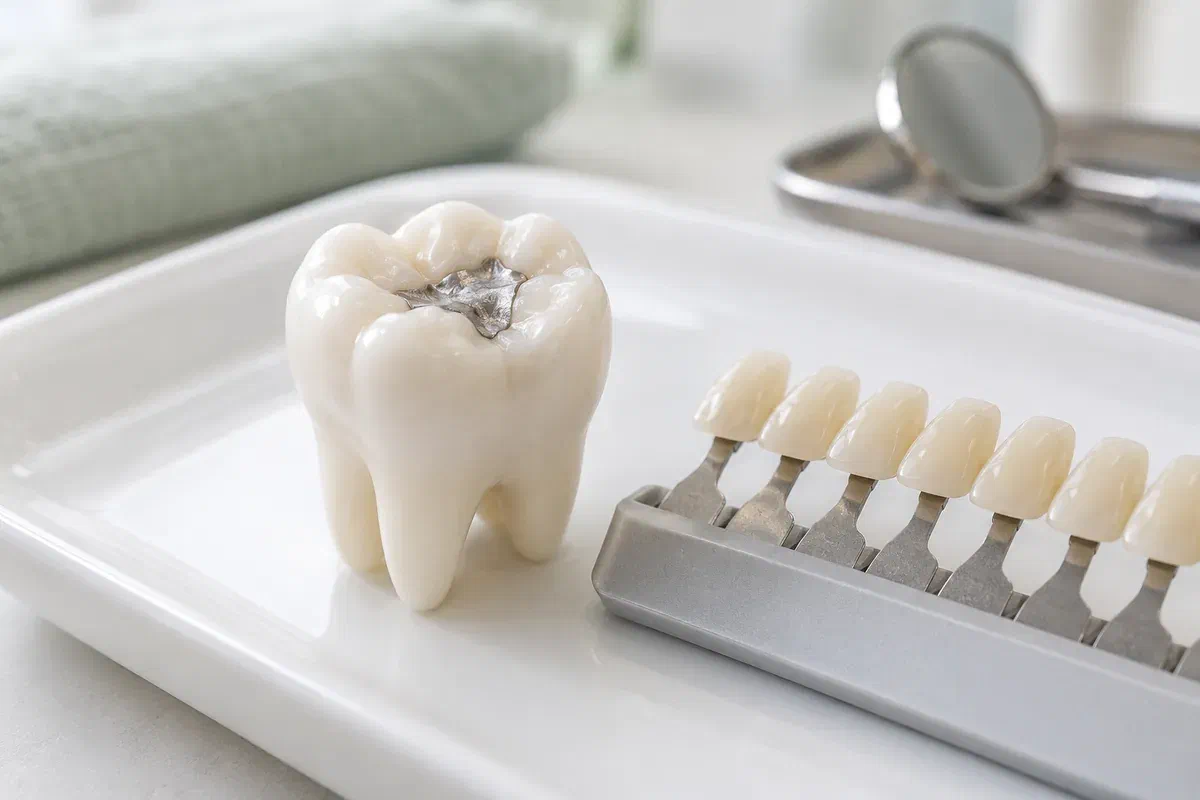
Teaching model of an intact silver filling beside a tooth shade guide
Signs of a stressed tooth

Strength is the question here, not shade.

With a big restoration, the most important issue is often how well the tooth itself is holding up. These signs help the dentist judge that.

A corner that has broken

A piece of tooth or filling breaking off, even painlessly, is a sign that the walls may be thin. Note when it happened and whether anything sharp remains. Depending on the size and position, a direct repair or a larger restoration may be suggested.

A sharp pain on biting

A quick, sharp pain when you bite on something, or when you release, can point to a crack. The amalgam may be involved, but so might the nerve, the gums or a neighbouring tooth. Simply swapping the filling may not stop a crack from spreading.

A wish to change the look

If a large filling also bothers you visually, tell us. Tooth-coloured options exist for bigger repairs too, but the choice depends heavily on how much support the tooth needs. We will explain the trade-offs clearly.

A large amalgam that is intact, with no decay or cracks, may continue to serve well. Size alone is not a reason to replace it, so ask what the dentist sees that supports a change.

What good support achieves

Brace the walls before they break.

When a large filling needs replacing, the goal is to restore strength as well as seal. A well-chosen restoration can hold thin cusps together, spread biting forces and reduce the chance of a more serious fracture later.

For a modest cavity, a direct composite filling may be enough. For a tooth with thin walls, an onlay that covers the weakest cusps, or a crown that covers the whole tooth, may be more protective. Ask how the recommendation balances preserving tooth, strength, appearance and long-term upkeep.

Patient information: CDA — tooth-coloured filling materials

A plan aimed at structure

You should understand whether the treatment is addressing decay, a fractured filling, a cracked or thin cusp, or appearance. Knowing the main problem helps you compare a filling, an onlay and a crown.

Options shown side by side

Ask the dentist to explain the differences between a direct filling, an onlay and a crown for this tooth, including how much tooth each removes and how many visits each requires.

Protection from future stress

If you clench or grind, discuss a night guard. Avoiding very hard foods on heavily restored teeth and keeping regular checkups can help the new restoration last.

Planning a stronger repair

Assess the structure, then choose the restoration.

You will have time to ask about each option before treatment. Tell us if strength, cost, appearance or number of visits matters most.

  1. Check the tooth's strength

    The dentist examines the filling, the cusps around it, any crack lines, your bite and symptoms. X-rays and bite tests may help. Ask to see the tooth on a camera image so you can understand the findings.

  2. Weigh filling against coverage

    You discuss whether a new filling, an onlay or a crown is most suitable, along with fees and timelines. Once the old amalgam is removed, cracks or decay may be more extensive than expected, which could change the plan.

  3. Remove and rebuild

    After freezing, the area is kept dry, the amalgam is taken out and the walls are inspected closely for cracks. A direct filling may be placed, or the tooth is prepared for an onlay or crown with a temporary until the final restoration is ready.

  4. Fit and adjust

    Shape and bite are checked carefully so the restored tooth does not take too much force. If a second visit is needed, you will know when it is and how to look after the temporary in the meantime.

Caring for a rebuilt tooth

Treat it gently for the first while.

Aftercare depends on the type and size of the restoration. Call if the tooth feels unstable or chewing becomes difficult.

Avoid chewing while numb

Wait for sensation to return before eating on that side, and be careful with hot drinks. With a temporary in place, avoid sticky and hard foods until the final restoration is fitted.

Notice how it handles pressure

If the tooth feels high, sore when biting, or sharp on release, let us know. Do not test it on ice, nuts or hard candy. Describing the feeling helps the dentist decide whether an adjustment or further assessment is needed.

Clean carefully around the edges

Brush with a fluoride toothpaste and floss or use interdental brushes daily. When cleaning near a temporary, slide floss out sideways. Report food trapping or catching so the area can be checked.

Options for a heavily filled tooth

Filling, onlay or crown?

Each option offers a different balance of strength, conservation and visits. Your priorities and the dentist's findings guide the choice.

When it is holding up well

Keep and monitor

An intact large filling without cracks or decay can often stay. Agree on what to watch for, such as new sensitivity or chipping, and how often it should be reviewed. Leaving it alone means no further tooth is cut away, which matters on a tooth that has already lost a lot.

If enough tooth remains

Replace with a new filling

A direct filling may be suitable if the walls are strong enough. Ask why the dentist believes a filling will hold and whether the work can be completed in one visit.

If cusps need protection

Cover with an onlay or crown

An onlay or crown can brace weakened walls, and if the nerve is affected, root canal treatment may be needed first. Changing to a white filling alone would not solve a structural problem.

Georgetown questions on large fillings

What to know about big, old restorations

Heavily filled teeth raise their own questions. These answers help you prepare for a discussion about your tooth.

(905) 876-4488
Why do large old fillings sometimes lead to cracked teeth?
A large filling leaves less natural tooth around it. Over time, biting forces and temperature changes can stress the thin walls, and cracks can develop. Not every large filling causes problems, but the dentist will check for early signs such as fine lines, chipped corners or tenderness when you bite on something firm.
What is the difference between an onlay and a crown?
An onlay covers and protects part of the chewing surface, usually the weakest cusps, while a crown covers the entire visible tooth. An onlay often conserves more tooth. The right choice depends on how much structure remains and where it is weak.
Can a weakened tooth be fixed without a crown?
Sometimes. A direct filling or an onlay may be enough if the walls are strong enough. The dentist will explain why a particular option is recommended and what the risks would be of choosing a smaller restoration.
What should I do if a piece of my filled tooth breaks off?
Keep the area clean, avoid chewing on that side and call us. If there is pain, swelling or a sharp edge cutting your tongue, mention it so we can advise how soon to come in. Save the piece if you find it.
Will I know before the appointment if I need a crown?
Often the exam gives a good indication, but the final decision may depend on what is found once the old filling is removed. The dentist should explain that possibility beforehand and how they would discuss any change with you.
Can replacing a large filling lead to root canal treatment?
It can, if decay or a crack has reached the nerve, or if the nerve is already inflamed. The dentist will look for signs during the exam and explain what would happen if this is discovered during treatment, including whether the work would pause so you can decide on next steps.

Patient information: FDA — decisions about existing amalgam fillings

Help for Georgetown teeth

Let's see how much support is left.

Book an exam at our Bronte Street clinic to look at a large or broken filling, a sharp pain on biting or a cosmetic concern. We will explain the options and why each one might suit your tooth before you decide.

Call us directly for severe pain, swelling or a broken tooth. Online requests are for routine, non-urgent visits.

Visit Milton Dental Clinic
Unit 1, 342 Bronte St. S, Milton, ON L9T 5B7
Get directions Clinic hours
Monday–Thursday
11am–7pm
Friday–Sunday
By appointment only

Areas we serve

  • Milton
  • Oakville
  • Mississauga
  • Georgetown
  • Halton Hills
  • Acton
  • Campbellville
  • Brampton
  • Burlington
  • Puslinch
  • Rockwood
  • Erin
  • Caledon
  • Etobicoke
  • Old Milton
  • Bronte Meadows
  • Timberlea
  • Dorset Park
  • Dempsey
  • Clarke
  • Beaty
  • Coates
  • Harrison
  • Scott
  • Willmott
  • Ford
  • Bowes
  • Cobden
  • Walker
  • Mountain View
  • Milton Heights
  • Hawthorne Village
  • Valley View
  • Fallingbrook
  • Nassagaweya
  • Trafalgar
  • Esquesing
  • Nelson
  • Brookville
  • Moffat
  • Glen Williams
  • Norval
  • Limehouse
  • Stewarttown
  • Ashgrove
  • Hornby
  • Silver Creek
  • Speyside
  • Scotch Block
  • North Oakville
  • River Oaks
  • Glen Abbey
  • West Oak Trails
  • Palermo
  • Bronte Creek
  • College Park
  • Joshua Creek
  • Uptown Core
  • Preserve
  • Iroquois Ridge
  • Lisgar
  • Meadowvale
  • Meadowvale Village
  • Churchill Meadows
  • Erin Mills
  • Central Erin Mills
  • Streetsville
  • East Credit
  • Creditview
  • Heartland
  • Sheridan
  • Mount Pleasant
  • Credit Valley
  • Huttonville
  • Churchville
  • Springbrook
  • Northwest Brampton
  • Bram West
  • Fletcher's Meadow
  • Fletcher's Creek South
  • Alton Village
  • Orchard
  • Millcroft
  • Headon Forest
  • Tansley
  • Brant Hills
  • Tyandaga
  • Kilbride
  • Lowville
  • Aberfoyle
  • Morriston
  • Arkell
  • Hillsburgh
  • Freelton
  • Carlisle
  • Waterdown
  • Flamborough
  • Mountsberg

How can we help?

Milton Dental Clinic

Have a question about your smile? Choose the option that works best for you.

For urgent dental concerns, please call.
Messages are reviewed during clinic hours.