

Illustrative discussion of denture retention with a patient and dentist
Restorative Dentistry

Mini Dental Implants in Rockwood

Why is it usually the lower denture, not the upper, that gets talk of mini implants? From Rockwood, we can explain the difference between the two jaws and assess whether narrow implants suit your case.

Upper, lower, or both?

Two jaws, two different stories

Plenty of people wear a full upper denture that behaves well and a lower one that never quite settles. The lower denture has less surface to rest on and a moving tongue beside it, so it often lifts. That is the setting where mini dental implants are most often discussed: a few very narrow implants with attachments that help retain a complete lower denture. They are not a small-format version of every implant treatment.

An upper denture is a separate question. Bone in the upper jaw differs, and the forces and design needs are not the same, so a mini implant is not automatically suitable there. For either jaw, the dentist assesses the denture, the bone, your bite and how easily you could keep attachments clean.

If you are travelling from Rockwood, bring both dentures, even if only one is causing trouble. At our Bronte Street practice the dentist can look at how they work together, outline alternatives and recommend specialist planning when the situation calls for it.

Ask about your upper and lower
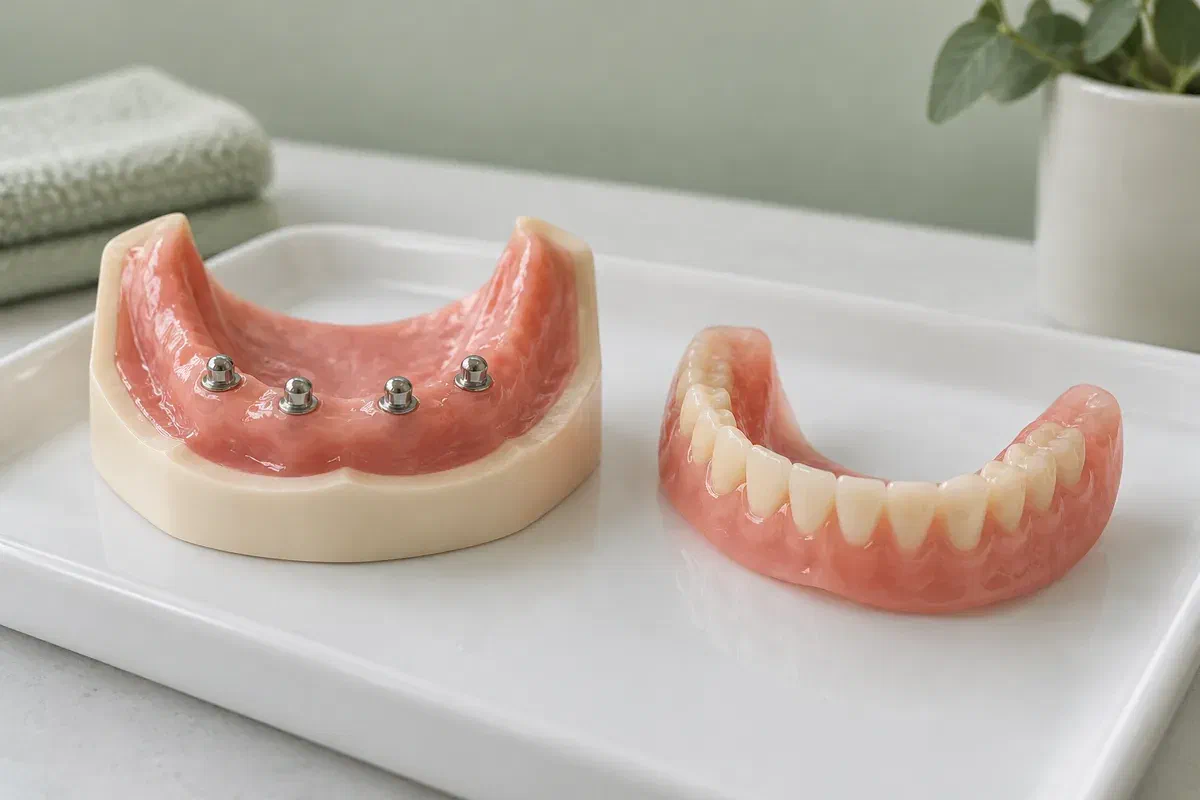
Illustrative lower-jaw model with four small attachment heads and a removable denture
Where the trouble usually sits

Most often, it is the lower denture.

Unstable dentures have several possible causes. Attachments may improve hold, but the appliance still requires a good fit, an even bite and a routine you can keep.

A lower that will not stay seated

Note when it lifts, whether while speaking, eating or swallowing, and bring it even if you rarely wear it now. Its fit and age help the dentist judge whether adjustment would help or whether implant retention deserves consideration.

A slim lower ridge

Bone loss can leave the lower ridge narrow, which complicates planning. Mini implants are considered in some situations, but adequate bone and safe positioning are still needed. A narrower implant never shortens the anatomical review.

Hoping to treat the upper too

Some proposals suggest the same approach for both jaws. Bring the plan and ask what the implants would hold in each, how the dentures would be removed and what repairs could arise. The two jaws may need different answers.

Mini implants are not a default choice for an upper denture, a back-tooth crown or a fixed full-arch bridge. Each requires its own assessment and evidence before it is recommended.

Possible benefits for the lower jaw

When the lower denture is the weak link

In a suitable lower overdenture, mini implant attachments may help it resist being lifted by the tongue or food. Your gums usually keep sharing part of the load. Ask the dentist which aspects would improve and which would still depend on the base fitting your ridge well.

Slim implants have limits. Mechanical strength, chewing forces and space for the denture all need consideration, especially if the opposing upper denture or natural teeth bite heavily. A careful proposal explains why this design suits your situation rather than treating narrow as better.

Patient information: ITI — narrow implant indications and limitations

Say what bothers you most

It might be the lower denture lifting every time you sip a drink. A clear complaint helps the dentist explain whether retention would address it, or whether the upper denture also needs work.

Removing it is still routine

An overdenture comes out daily so your mouth and the attachment heads can be cleaned. Ask for a demonstration and decide whether the handling, along with caring for an upper denture, suits your routine.

Compare plans for both jaws

Review the treatment with and without mini implants, and consider what each jaw needs. Include denture work, maintenance and part replacement so the long-term picture is clear.

Planning across both jaws

Start with how the dentures meet.

Ask which stages are suggested, who performs them and how your dentures are handled in between. Timing depends on what is found.

  1. History, health and both dentures

    We review your denture experience, medical history, oral health and goals. Mention smoking, grinding, medications and earlier implants. Tell us which denture troubles you and what you find hardest with eating or cleaning.

  2. Imaging and a design proposal

    X-rays or scans may be needed to evaluate bone and plan the restoration. The dentist explains the suggested implants, risks, alternatives and whether referral makes sense. Planning still applies to narrow implants.

  3. Placement and recovery time

    If treatment goes ahead, placement is a surgical procedure with comfort and aftercare tailored to you. The lower denture might connect early or after healing, depending on findings. Confirm what you can wear and eat.

  4. Fit, balance and follow-up

    The lower denture and attachments are checked together, along with how they meet the upper. Practise putting it in and taking it out with guidance, learn the cleaning steps and keep your reviews.

Caring for two dentures

Keep both appliances in good shape.

Instructions should cover healing and long-term wear. Keep them handy, especially if a family member helps with your daily care.

Ease the lower denture into use

Wear it only as instructed after surgery and while adjusting. A secure click is no sign it is ready for ordinary chewing. Ask us about anything unclear regarding eating or removal.

Clean attachments and upper alike

Have the team show you how to clean around each implant head and inside the lower denture without harming the housings, while keeping up care of the upper. Tell us about any difficulty with grip or vision.

Look into changes promptly

Renewed lifting usually means something has changed, perhaps a worn insert or a shift in how the base sits. Avoid bending or repairing anything at home. Bring both dentures and any loose piece to the appointment.

Patient information: Cambridge University Hospitals — implant treatment and maintenance

Options to discuss from Rockwood

What each jaw might need

Anatomy, general health, the restoration desired and maintenance all influence the choice. Ask which trade-offs matter in your mouth.

Without implant surgery

Improve one or both dentures

A reline or a new set can sometimes bring the two dentures back into balance with no implants at all. After examining both, the dentist can tell you how far that might go and where conventional dentures would still fall short.

For a suitable selected case

Lower overdenture on mini implants

This may be discussed for an appropriate lower denture. Confirm how support and retention work, the soundness of the existing base and the maintenance expected. Do not decide on implant diameter alone.

Particularly for the upper jaw

Other implant designs

Standard implants or other restorative plans may be more appropriate, especially for an upper denture or heavier loads. Extra procedures or specialist input could be needed. Ask why a given option is recommended.

Upper and lower questions

Sorting out which jaw needs what

Proposals that sound similar may involve different dentures, procedures and ongoing care. Discussing them helps you compare.

(905) 876-4488
Can mini implants hold an upper denture?
They are not automatically suitable for the upper jaw. Bone and design needs differ there, and any such plan requires specific assessment and evidence. Ask the dentist what options could be considered for your upper denture.
Why does my lower denture move when my upper stays put?
Compared with the upper, a lower denture usually has less area to rest on and sits beside the tongue, so suction and stability are harder to achieve. Bone changes over time can add to this. An examination helps decide what would improve it.
Will my upper denture need changing if I get lower implants?
Possibly. The two dentures need to meet properly, so the dentist will check the upper’s fit and wear. Sometimes adjustment is enough, while other times a new upper is advised so the bite is balanced.
Can my current lower denture be adapted for attachments?
It depends on fit, thickness, condition and available space. Some dentures can be modified, while worn ones may need replacing. Ask whether the estimate includes adaptation, a new denture or a temporary appliance.
Does medical history affect mini implant treatment?
It can. Certain conditions and medications influence healing and bleeding. Share your full health history and medication list, and the dentist may coordinate with your physician before surgery.
How should I plan appointments from Rockwood?
Ask for an outline of the likely stages at the first visit so you can group appointments where possible. Healing sets the timing of some steps. Call before travelling if something changes suddenly.
Coming in from Rockwood

Bring both dentures with you.

Visit our Bronte Street practice with your upper and lower appliances. We will look at suitability, how the two dentures work together and your questions before any implant plan is discussed.

Please phone us about an existing implant that is painful or moving. Online requests are for non-urgent visits.

Visit Milton Dental Clinic
Unit 1, 342 Bronte St. S, Milton, ON L9T 5B7
Get directions Clinic hours
Monday–Thursday
11am–7pm
Friday–Sunday
By appointment only

Areas we serve

  • Milton
  • Oakville
  • Mississauga
  • Georgetown
  • Halton Hills
  • Acton
  • Campbellville
  • Brampton
  • Burlington
  • Puslinch
  • Rockwood
  • Erin
  • Caledon
  • Etobicoke
  • Old Milton
  • Bronte Meadows
  • Timberlea
  • Dorset Park
  • Dempsey
  • Clarke
  • Beaty
  • Coates
  • Harrison
  • Scott
  • Willmott
  • Ford
  • Bowes
  • Cobden
  • Walker
  • Mountain View
  • Milton Heights
  • Hawthorne Village
  • Valley View
  • Fallingbrook
  • Nassagaweya
  • Trafalgar
  • Esquesing
  • Nelson
  • Brookville
  • Moffat
  • Glen Williams
  • Norval
  • Limehouse
  • Stewarttown
  • Ashgrove
  • Hornby
  • Silver Creek
  • Speyside
  • Scotch Block
  • North Oakville
  • River Oaks
  • Glen Abbey
  • West Oak Trails
  • Palermo
  • Bronte Creek
  • College Park
  • Joshua Creek
  • Uptown Core
  • Preserve
  • Iroquois Ridge
  • Lisgar
  • Meadowvale
  • Meadowvale Village
  • Churchill Meadows
  • Erin Mills
  • Central Erin Mills
  • Streetsville
  • East Credit
  • Creditview
  • Heartland
  • Sheridan
  • Mount Pleasant
  • Credit Valley
  • Huttonville
  • Churchville
  • Springbrook
  • Northwest Brampton
  • Bram West
  • Fletcher's Meadow
  • Fletcher's Creek South
  • Alton Village
  • Orchard
  • Millcroft
  • Headon Forest
  • Tansley
  • Brant Hills
  • Tyandaga
  • Kilbride
  • Lowville
  • Aberfoyle
  • Morriston
  • Arkell
  • Hillsburgh
  • Freelton
  • Carlisle
  • Waterdown
  • Flamborough
  • Mountsberg

How can we help?

Milton Dental Clinic

Have a question about your smile? Choose the option that works best for you.

For urgent dental concerns, please call.
Messages are reviewed during clinic hours.