
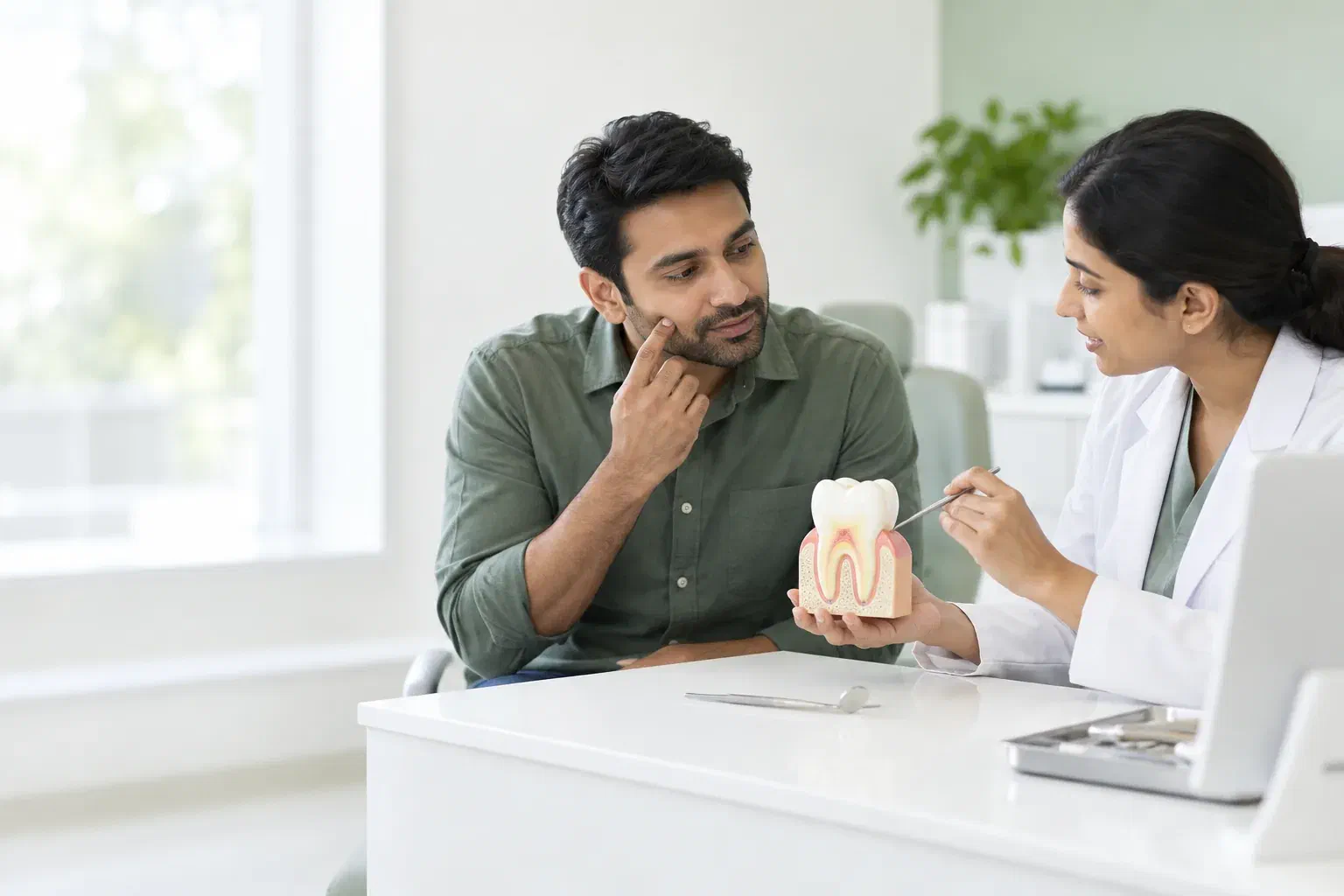
Illustrative consultation about a back tooth using a molar teaching model
Restorative Dentistry

Molar Root Canals in Burlington

Been told a back tooth needs a root canal and not sure what to ask next? From Burlington, book a visit where the diagnosis, the stages and the final restoration are explained before you decide.

Before you say yes

What exactly is being recommended, and why?

Hearing the words “root canal” can stop a conversation cold, and the questions often surface on the drive home. Put simply, the treatment deals with the pulp, the soft tissue at the core of the tooth. When that tissue in a molar is infected or too inflamed to recover, removing it may allow the tooth to stay.

Two conditions have to hold for that to make sense. There needs to be a clear diagnosis that the pulp is the problem, and the molar has to be restorable, with enough sound tooth and healthy support around it. Pain by itself does not settle either question.

If you are coming from Burlington, it helps to treat the first appointment as a briefing. You can ask how the diagnosis was reached, how many visits are planned, whether an endodontist would be involved, and what restoration will protect the tooth once the canals are done.

Ask your molar questions in person
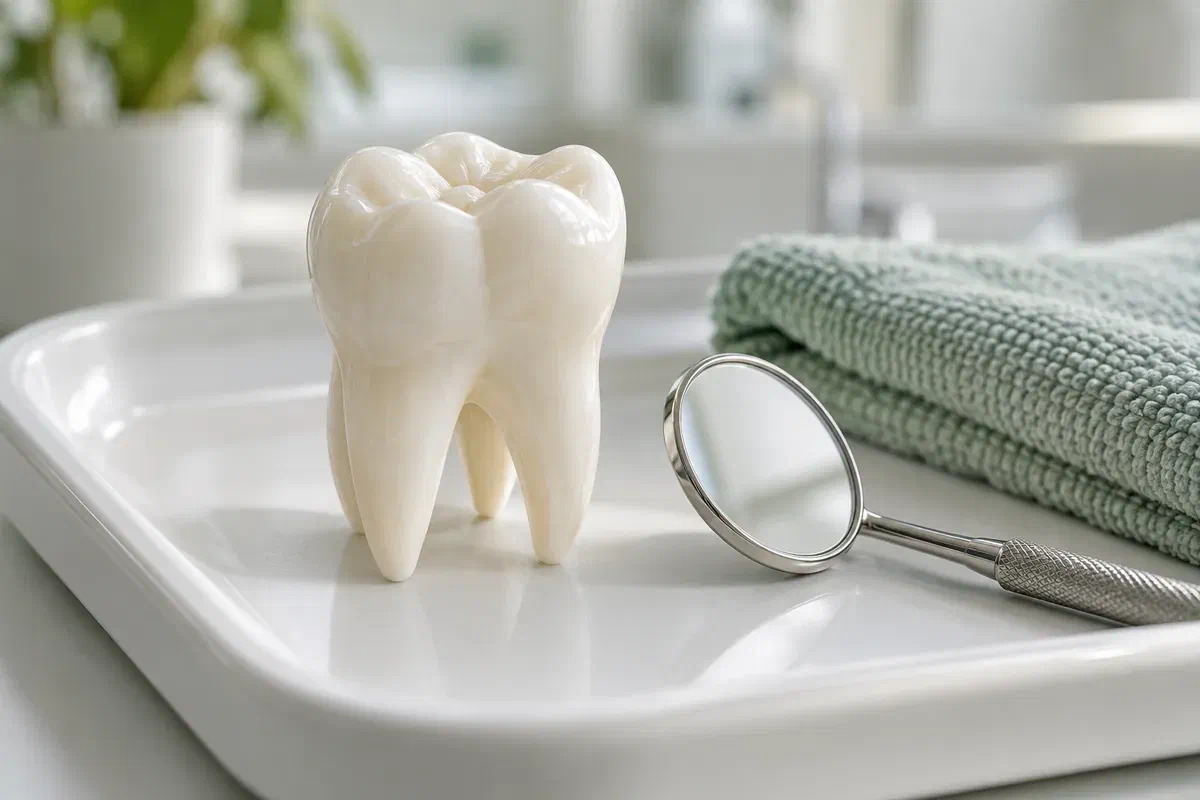
An intact molar teaching model and dental mirror on a clean tray
Symptoms to describe

Your account shapes the examination

Mention when it began, whether it is improving or worsening, and any history of fillings, crowns or trauma on the affected side.

Meals have turned careful

Pain on chewing can come from a number of causes. It helps to know whether it hurts as you bite, as you let go, or only with certain temperatures. Please avoid prodding the tooth to test it; the dentist will examine your bite directly.

Sensitivity that will not fade

Notice how long discomfort carries on after something hot or cold. Tell us if it also arrives with no trigger at all, or wakes you in the night. That is quite different from a brief, ordinary twinge.

Swelling, a bump or a broken edge

Puffy gums, a small blister that keeps coming back, or damage around a large filling should be examined even if pain is modest. Mention drainage or a strange taste. A calm stretch does not reveal the condition inside the tooth.

Please call promptly about severe pain or swelling. Seek emergency medical care if swelling affects your breathing or swallowing.

Weighing retention

Why a dentist might suggest saving the molar

A working natural molar plays a real part in your bite. If the infection or inflammation inside can be treated and the tooth can be restored, keeping it may be a reasonable aim. That has to be set against fractures, missing tooth structure, gum health and other findings.

Expect the benefit to be explained in plain terms, with no promise about lifespan. Ask what makes this tooth suitable, what could limit its prognosis, and how the final restoration supports the plan. Saving a molar means restoring it, not only treating the canals.

Patient information: AAE — understanding root canal treatment

Judging the full tooth

The dentist considers how usable the molar will be after treatment. You are entitled to hear both the positives and the reservations, particularly where a large filling or crack is already present.

Knowing the order of events

Seeing how the canal treatment and restoration fit together makes it easier to plan around work and family. If two offices are involved, ask who provides each stage and how records will be shared.

Comfort discussed upfront

Bring up any nervousness, limited jaw opening or a tough past experience. Agree on a signal to stop. These details let the team plan a visit you can follow and take part in.

The treatment sequence

Understand the stages before the first one begins

Appointment count and length differ between teeth. Ask in advance about the diagnosis, the scope, fees, alternatives and how the molar will be protected afterward.

  1. Diagnosis and a restorability check

    The dentist goes over your symptoms, examines the tooth and nearby tissues and uses suitable tests and X-rays. Ask whether the molar can be rebuilt, and whether its canal shape or other findings suggest seeing an endodontist.

  2. Anaesthetic and dental dam

    The tooth is numbed with local anaesthetic and isolated with a dental dam. An opening is then made to reach the canal system. If you feel pain, say so; pausing to adjust is part of good care.

  3. Canal cleaning and filling

    The canals are cleaned, shaped and disinfected, then filled when appropriate for that stage. A temporary filling may protect the tooth between visits. Ask whether internal treatment is complete and what remains.

  4. The final restoration and follow-up

    The molar then needs a permanent restoration, often one that covers its chewing cusps. Confirm when it should be placed and what precautions apply until then. Follow-up checks the tooth and tissues, not just how it feels.

Home care between stages

Be patient with the treated molar

Follow the instructions for the stage you have reached. What applies after the canal visit may change once the final restoration is placed.

Go easy on that side

Wait for the numbness to wear off before eating, and avoid heavy chewing on the treated tooth until it has been restored. Ask what you can eat comfortably in the meantime. Hard or sticky foods can crack or dislodge a temporary filling.

Do not skip the next visit

A comfortable tooth may still be unfinished. If plans change, phone to talk through the remaining treatment rather than cancelling quietly. Confirm whether your next visit is for the canals, the restoration or a review.

Report new or worsening symptoms

Call about increasing pain, swelling, a high bite or a lost temporary. Mention when it started and which stage you are at. Use medication only as advised for you, and check with the team about anything uncertain.

Your options

Retain, treat differently, or remove

Ask why the suggested treatment matches your diagnosis. Understanding the alternatives makes the decision yours.

When the tooth can be rebuilt

Root canal plus restoration

Treatment addresses the problem inside the tooth and then restores it for chewing. Think about both stages together, including any specialist care and the final restoration. An estimate covering only the canals may not reflect the whole plan.

When the pulp is not responsible

A different approach for a different cause

A filling, bite adjustment, gum treatment or another approach may be more suitable if the problem lies elsewhere. Ask what distinguishes your diagnosis. Having had a root canal before is not a reason to choose one for this tooth.

When retention is not advisable

Extraction and replacement planning

Removing the molar may be discussed if it cannot be restored predictably or if you prefer not to keep it. Ask how the gap would affect your bite and which replacement options could suit, with their own stages and fees.

Questions to bring from Burlington

Get the answers you need to decide

A treatment plan for a molar may involve more than one choice. It is fine to bring a written list or a family member to help you remember.

(905) 876-4488
What should I ask before agreeing to a molar root canal?
Useful questions include how the diagnosis was made, whether the tooth is restorable, how many visits are planned, whether a specialist is involved, and what the final restoration will be. Ask about fees for each stage, too.
Can I get a second opinion on my molar?
Yes. Some people like to have another dentist or an endodontist review the findings before deciding. Ask for copies of relevant X-rays and notes so they can be shared. If symptoms are severe, do not let the search delay urgent care.
What happens if I put off treatment on an infected molar?
An untreated infection does not usually resolve on its own and may spread or cause more damage to the tooth and bone. Symptoms can come and go. Talk with the dentist about the risks of waiting in your particular situation.
Will my molar be weaker after a root canal?
A treated back tooth has often lost structure to decay, earlier fillings and the access opening, so it may be more prone to fracture. That is why a restoration protecting the cusps is often recommended. Ask what suits your tooth.
How soon should the final restoration follow the root canal?
Your dentist will recommend a timeframe. Temporary fillings are not designed to last, and delaying the permanent restoration can leave the tooth exposed to leakage or breakage. Book the next stage before you leave if possible.
Can I drive home after the appointment?
With local anaesthetic alone, many people feel able to drive. If anything beyond local anaesthetic is planned, ask in advance whether you need someone to take you home, and follow the instructions you are given.
Planning a visit from Burlington

A clear explanation, then your decision

Book an assessment at our Bronte Street practice in Milton and go through the full plan for your molar. Bring your symptoms, any earlier recommendations and the questions that matter to you about keeping and restoring the tooth.

If the pain is severe or swelling appears, please call us. Online and email requests are for non-urgent enquiries.

Visit Milton Dental Clinic
Unit 1, 342 Bronte St. S, Milton, ON L9T 5B7
Get directions Clinic hours
Monday–Thursday
11am–7pm
Friday–Sunday
By appointment only

Areas we serve

  • Milton
  • Oakville
  • Mississauga
  • Georgetown
  • Halton Hills
  • Acton
  • Campbellville
  • Brampton
  • Burlington
  • Puslinch
  • Rockwood
  • Erin
  • Caledon
  • Etobicoke
  • Old Milton
  • Bronte Meadows
  • Timberlea
  • Dorset Park
  • Dempsey
  • Clarke
  • Beaty
  • Coates
  • Harrison
  • Scott
  • Willmott
  • Ford
  • Bowes
  • Cobden
  • Walker
  • Mountain View
  • Milton Heights
  • Hawthorne Village
  • Valley View
  • Fallingbrook
  • Nassagaweya
  • Trafalgar
  • Esquesing
  • Nelson
  • Brookville
  • Moffat
  • Glen Williams
  • Norval
  • Limehouse
  • Stewarttown
  • Ashgrove
  • Hornby
  • Silver Creek
  • Speyside
  • Scotch Block
  • North Oakville
  • River Oaks
  • Glen Abbey
  • West Oak Trails
  • Palermo
  • Bronte Creek
  • College Park
  • Joshua Creek
  • Uptown Core
  • Preserve
  • Iroquois Ridge
  • Lisgar
  • Meadowvale
  • Meadowvale Village
  • Churchill Meadows
  • Erin Mills
  • Central Erin Mills
  • Streetsville
  • East Credit
  • Creditview
  • Heartland
  • Sheridan
  • Mount Pleasant
  • Credit Valley
  • Huttonville
  • Churchville
  • Springbrook
  • Northwest Brampton
  • Bram West
  • Fletcher's Meadow
  • Fletcher's Creek South
  • Alton Village
  • Orchard
  • Millcroft
  • Headon Forest
  • Tansley
  • Brant Hills
  • Tyandaga
  • Kilbride
  • Lowville
  • Aberfoyle
  • Morriston
  • Arkell
  • Hillsburgh
  • Freelton
  • Carlisle
  • Waterdown
  • Flamborough
  • Mountsberg

How can we help?

Milton Dental Clinic

Have a question about your smile? Choose the option that works best for you.

For urgent dental concerns, please call.
Messages are reviewed during clinic hours.