
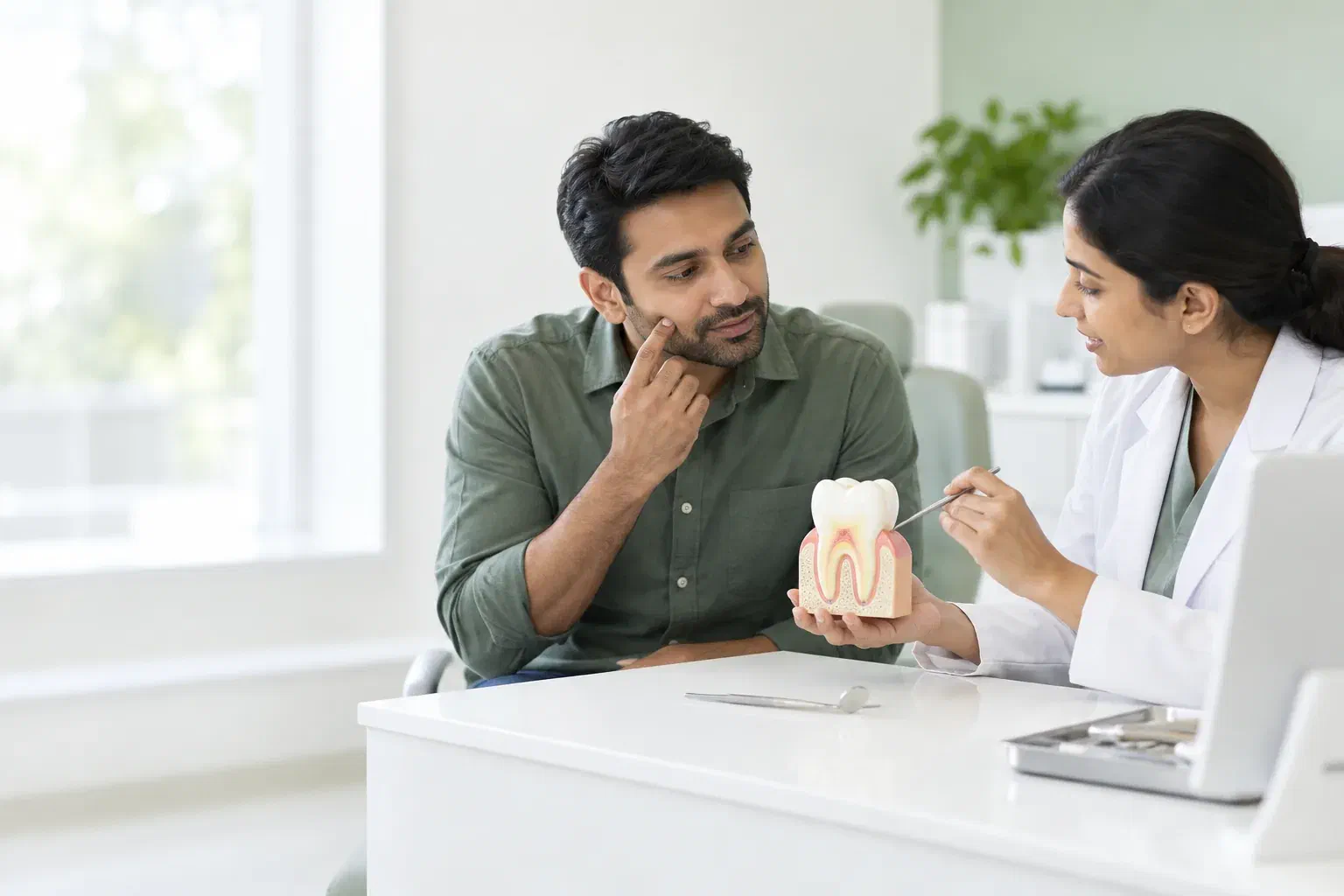
Illustrative consultation about a back tooth using a molar teaching model
Restorative Dentistry

Molar Root Canals in Caledon

A sharp zing when you release a bite can point to a cracked molar, and cracks can reach the pulp. For households in Caledon, we assess the crack, the nerve and whether the tooth can be rebuilt.

When a crack is the starting point

A fracture line you may never see

Biting on a seed or an unexpected bit of bone, then feeling a sharp zing as you open, is a classic story with cracked molars. The crack itself is often invisible to you. Over time it can let bacteria and irritation reach the pulp, the living tissue inside, and that is when a root canal may come into the conversation.

Whether it actually helps depends on where the crack runs. Some cracks stay in the crown of the tooth and can be managed with a protective restoration, with or without canal treatment. Others extend deep down the root, which can make the tooth impossible to restore. The examination has to work out which situation you are in.

For anyone travelling from Bolton or one of Caledon’s other villages, an early assessment gives you options while they still exist. Ask what the dentist can see, whether the pulp is involved, how the tooth would be protected, and whether an endodontist should take a closer look before any decision is made.

Have a possibly cracked molar checked
An intact molar teaching model and dental mirror on a clean tray
What a crack can feel like

Sharp, brief and hard to repeat

Cracked teeth can be elusive. Note when the first jolt happened, what you were eating, how often it recurs and any large fillings or crowns on that side.

A jolt on biting or release

Pain that flashes as you let go of a bite is a common feature of cracks, though other problems can cause it. Note which foods trigger it. Please avoid deliberately biting hard to reproduce it, since that can extend a crack; the dentist has gentler ways to test.

Temperature pain that starts to linger

At first, a cracked tooth may react briefly to cold. If the reaction begins to last, appears without a trigger or wakes you, the pulp may be more affected. That change is important to report.

Gum swelling beside the tooth

A localized swelling, a bump that keeps returning or a narrow pocket along one side of a molar can be linked to a deep crack or an infection. Mention any taste or drainage. Comfort for a stretch does not mean the crack has healed; teeth do not knit back together.

Call promptly about significant pain or swelling. If swelling affects breathing or swallowing, seek emergency medical care immediately.

Can a cracked molar be kept?

It depends on depth, direction and the pulp

Provided the crack is limited and the pulp can be treated, keeping the molar with a protective restoration may be realistic. A tooth that still chews comfortably is an asset to your bite. Cracks that run deep into the root, however, can make retention unpredictable, so this is weighed carefully.

Expect a candid account of the likely benefit with no guarantee about longevity. Cracked teeth carry particular uncertainty. Ask what the dentist sees, what would change the outlook, and how the final restoration is meant to hold the tooth together under chewing forces.

Patient information: AAE — understanding root canal treatment

Mapping the crack

Magnification, dyes, bite tests and probing along the gum can help show where a crack goes. Ask how far it appears to extend and what that means for restoring the molar afterward.

Protecting the tooth early

Sometimes a temporary band or restoration is placed to stabilize the molar while the pulp is assessed or treated. If a second clinician is part of your care, confirm who handles each stage and how findings will be shared.

Comfort in a tender tooth

Cracked molars can be very sensitive to pressure. Tell us about anxiety, jaw discomfort or a past hard appointment, and agree on a pause signal, so the visit can be planned around you.

Treating a cracked molar

Assess the crack first, then the canals

The sequence and number of visits depend on the crack and the pulp. It is reasonable to ask, before anything starts, what the diagnosis is, how much work is proposed, what it costs, what else could be done and how the tooth will be held together afterward.

  1. Locate the crack and test the pulp

    Your symptoms are reviewed and the tooth is examined with bite tests, temperature tests and X-rays, keeping in mind that many cracks do not show on X-rays. Ask whether the molar appears restorable and whether an endodontist should assess it.

  2. Stabilize, numb and isolate

    A temporary band or covering may be placed to brace the tooth. For canal treatment, local anaesthetic is given and a dental dam isolates the molar. Let the team know at once if you feel discomfort.

  3. Treat the canals if needed

    Affected pulp is removed, and the canals are cleaned, shaped, disinfected and sealed. Sometimes the crack can be examined more closely from inside the tooth. Ask whether that changed the outlook.

  4. Hold the tooth together

    Cracked back teeth generally need a restoration that covers and braces its cusps, placed without long delay. Confirm the timing. Follow-up checks healing and whether the crack is behaving, rather than relying on comfort.

Protecting a fragile tooth

Treat a cracked molar like it could split

Follow the instructions for your current stage. The guidance before the final restoration is often stricter than after.

No hard biting on that side

After numbness fades, chew on the opposite side and avoid ice, hard candy, nuts and crusty bread until the molar is fully restored. A crack can lengthen under force, even with a temporary in place.

Prioritize the restoration

With a cracked tooth, the final restoration is especially important. Book it as advised, and if something interferes, call to reschedule quickly rather than leaving the molar unbraced.

Notice new symptoms

Tell us about worsening pain, swelling, a piece breaking off or a temporary that loosens. Describe when it started and what treatment you have had. Use medication only as directed for you.

Possible outcomes

Different cracks, different decisions

Ask how the extent of the crack shapes the recommendation. Understanding every option helps you decide.

When the crack is limited and the pulp is affected

Root canal and a protective restoration

Treating the pulp and then covering the cusps may allow the molar to be kept. Plan both stages together, including any specialist assessment. An estimate for the canals alone will not include the restoration that holds the tooth together.

When the pulp looks healthy

A restoration without canal treatment

If testing suggests the pulp is sound, a protective restoration may be placed first and the tooth monitored. Ask what signs would mean root canal treatment is needed later.

If the fracture runs too deep

Removal and replacement planning

Where the tooth has split, or the fracture extends far down the root, the molar may not be keepable. Talk about what an empty space at the back would change for your chewing, and which replacements might suit, each with separate stages and fees.

Caledon questions

What people ask about cracked back teeth

Fractured teeth can raise several decisions. Write down what you were eating when it started; it can help the assessment.

(905) 876-4488
Why does my molar hurt when I let go of a bite?
Releasing pressure can let the parts of a cracked tooth move slightly, which may cause a sharp pain. It is a common pattern with cracks, though not the only explanation. The dentist will test the tooth to find out.
Can a crack in my tooth be seen on an X-ray?
Often not, especially early or when the crack runs in a direction the image cannot show. The dentist may rely on bite tests, magnification, dyes and gum measurements as well. X-rays still help assess the root and bone.
Can a root canal fix a cracked molar?
Root canal treatment addresses the pulp, not the crack itself. If the crack is limited, treatment plus a protective restoration may allow the tooth to be kept. A deep crack into the root may not be manageable.
What happens if the crack reaches below the gum line?
Damage that extends below the gum or down the root can be harder to restore and may affect the outlook. Ask the dentist or an endodontist how far yours appears to go and what that means for your options.
Should I stop chewing ice and hard candy?
It is a good idea, especially with a cracked or treated molar. Very hard foods put high force on back teeth. Mention any habits such as chewing pens or ice so the dentist can discuss protecting your other teeth.
Could grinding have caused my molar to crack?
Clenching and grinding are among the factors that can contribute to cracks. If signs of grinding are found, the dentist may discuss a night guard to help protect your teeth. Ask whether it applies to you.
Molar care for Caledon

Catch the crack while there are choices

Book an exam with our Bronte Street team for an assessment of the crack, the pulp and the restoration plan. Bring a note of when the pain started, what you were eating and any questions about saving the molar.

For severe pain or swelling, please call us. Email and online forms are for non-urgent requests.

Visit Milton Dental Clinic
Unit 1, 342 Bronte St. S, Milton, ON L9T 5B7
Get directions Clinic hours
Monday–Thursday
11am–7pm
Friday–Sunday
By appointment only

Areas we serve

  • Milton
  • Oakville
  • Mississauga
  • Georgetown
  • Halton Hills
  • Acton
  • Campbellville
  • Brampton
  • Burlington
  • Puslinch
  • Rockwood
  • Erin
  • Caledon
  • Etobicoke
  • Old Milton
  • Bronte Meadows
  • Timberlea
  • Dorset Park
  • Dempsey
  • Clarke
  • Beaty
  • Coates
  • Harrison
  • Scott
  • Willmott
  • Ford
  • Bowes
  • Cobden
  • Walker
  • Mountain View
  • Milton Heights
  • Hawthorne Village
  • Valley View
  • Fallingbrook
  • Nassagaweya
  • Trafalgar
  • Esquesing
  • Nelson
  • Brookville
  • Moffat
  • Glen Williams
  • Norval
  • Limehouse
  • Stewarttown
  • Ashgrove
  • Hornby
  • Silver Creek
  • Speyside
  • Scotch Block
  • North Oakville
  • River Oaks
  • Glen Abbey
  • West Oak Trails
  • Palermo
  • Bronte Creek
  • College Park
  • Joshua Creek
  • Uptown Core
  • Preserve
  • Iroquois Ridge
  • Lisgar
  • Meadowvale
  • Meadowvale Village
  • Churchill Meadows
  • Erin Mills
  • Central Erin Mills
  • Streetsville
  • East Credit
  • Creditview
  • Heartland
  • Sheridan
  • Mount Pleasant
  • Credit Valley
  • Huttonville
  • Churchville
  • Springbrook
  • Northwest Brampton
  • Bram West
  • Fletcher's Meadow
  • Fletcher's Creek South
  • Alton Village
  • Orchard
  • Millcroft
  • Headon Forest
  • Tansley
  • Brant Hills
  • Tyandaga
  • Kilbride
  • Lowville
  • Aberfoyle
  • Morriston
  • Arkell
  • Hillsburgh
  • Freelton
  • Carlisle
  • Waterdown
  • Flamborough
  • Mountsberg

How can we help?

Milton Dental Clinic

Have a question about your smile? Choose the option that works best for you.

For urgent dental concerns, please call.
Messages are reviewed during clinic hours.