
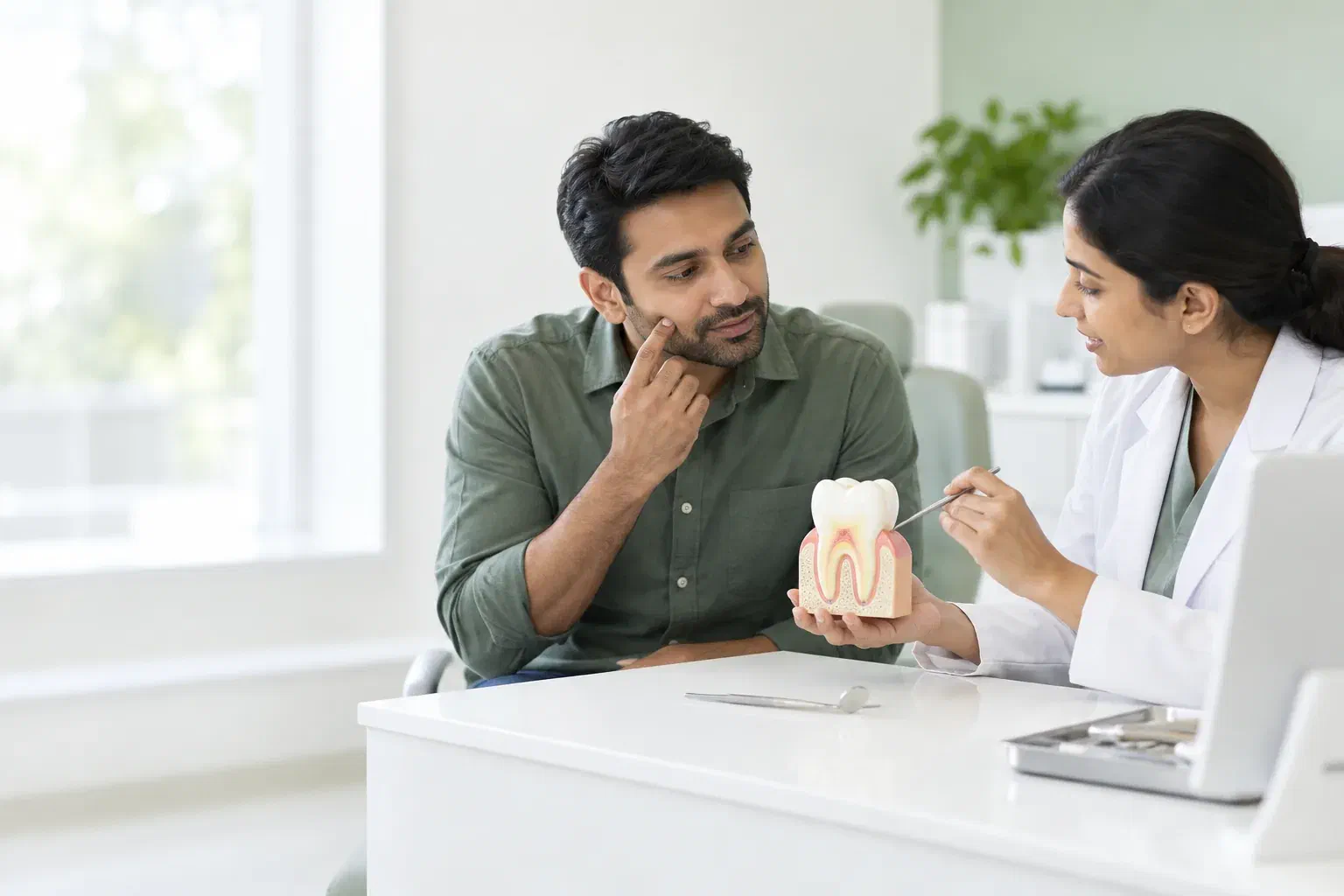
Illustrative consultation about a back tooth using a molar teaching model
Restorative Dentistry

Molar Root Canals in Campbellville

Rural days are planned around chores, work and trips into town. For Campbellville households, we set out the molar root canal stages early, so the time between visits and the final restoration are easier to manage.

Between one visit and the next

The in-between weeks deserve a plan too

Most attention goes to the appointment itself, yet much of molar treatment happens in the gaps: the days with a temporary filling, the wait before the final restoration, the moment you wonder whether a twinge is normal. Knowing the full sequence ahead of time makes those weeks easier, especially when town trips are grouped.

Root canal treatment is considered when the pulp, the soft core of a molar, is infected or too inflamed to recover, and the tooth itself is still worth rebuilding. The examination has to confirm both points. Pain shows that something needs attention; it does not decide the treatment.

Campbellville sits within Milton’s boundaries, out in rural Nassagaweya, and many households here like to plan visits around farm work, commuting or school. Ask how many appointments your molar is likely to need, whether an endodontist should treat part of it, and what will protect it in between.

Map out care for a sore molar
An intact molar teaching model and dental mirror on a clean tray
Tell us what you have noticed

Bring the story of the tooth

Mention when symptoms started, whether they are changing, and any earlier fillings, crowns or knocks to that side. If you can, note what time of day the discomfort is worst.

Chewing on that side has stopped

A molar that is sore to bite on may be cracked, inflamed at the root or affected by something else. Pay attention to whether it hurts on clenching or opening, and to temperature. Rather than pressing on it to test, leave that to the exam.

A long ache after a cold drink

Time how long discomfort lasts after something hot or cold. Mention pain that starts with no trigger or wakes you up. A lingering or spontaneous ache is not the same as the quick sensitivity many people notice.

Something new on the gum

A swollen area, a small bump that comes and goes, or a broken edge near an old filling should be examined even when it is not very painful. Let us know about drainage or a strange taste. Feeling fine for a few days is not proof of healing.

Call promptly about strong pain or swelling. If swelling affects breathing or swallowing, seek emergency medical care rather than waiting for an appointment.

Why retention is considered

Your molar may still have work to do

Natural back teeth help spread chewing forces evenly. If the problem inside a molar can be treated and enough sound tooth remains for a solid restoration, keeping it can be a good aim. Cracks, gum support and the size of earlier repairs all have to be weighed first.

A clear explanation describes the benefit without promising a lifespan. Ask why the tooth seems suitable, what could limit how it does, and how the final restoration helps. Treating the canals is a step toward keeping the molar, not the finish line.

Patient information: AAE — understanding root canal treatment

Both sides of the assessment

The dentist judges whether the molar can work well again after treatment. Ask to hear the encouraging findings as well as the worries, especially if the tooth is already heavily filled.

Visits planned as a set

When you know how the canals and the restoration fit together, you can book them around seasonal work or family plans. If a specialist is involved, ask who handles which stage and how records travel.

A pace that suits you

Tell us about nerves, a jaw that tires or a past visit that was hard going. Agree on a signal for a pause, so the team can plan an appointment you can follow.

Four parts to the journey

Each step prepares the next

There is no fixed number of appointments; it depends on the tooth. Before beginning, ask about the diagnosis, the extent of treatment, fees, alternatives and what will protect the molar after.

  1. Work out what is wrong

    Your symptoms are discussed, the molar and gums are examined, and suitable tests and X-rays are taken. You will learn whether the tooth looks restorable and whether its root anatomy suggests involving an endodontist.

  2. Numbing and the dental dam

    Local anaesthetic comes first, followed by a dental dam that keeps the tooth isolated. An access opening lets the clinician find each canal. Speak up if you feel pain, and the team will stop and adjust.

  3. Canal care

    Each canal is cleaned, shaped, disinfected and sealed when it is ready. Where a second visit is needed, a temporary filling protects the tooth in the meantime. Ask before you leave whether the inside work is done.

  4. Permanent repair and a later check

    The molar is then rebuilt with a suitable restoration, often covering its cusps. Find out how soon this should happen and what to avoid until then. Reviews assess healing rather than relying on how the tooth feels.

Looking after a temporary

A short-term covering needs gentle treatment

Keep the instructions for your current stage. The advice following a canal visit may not match the advice once the final restoration is in.

Choose meals with the temporary in mind

Wait for full feeling to return before eating and avoid chewing hard on the treated side until it is restored. Ask what is fine to eat. Jerky, nuts, ice and sticky sweets are common culprits when a temporary cracks.

Plan the restoration visit early

If you group trips into town, book the final restoration before you leave the canal appointment. Should a date stop working, call to rearrange it rather than letting the temporary stay in longer than advised.

Watch and report

Phone about rising pain, swelling, a bite that seems high or a temporary that has come loose. Note when it started and which stage you have reached. Follow the medication advice given to you.

Deciding what to do

Several roads, one diagnosis to guide you

Ask why the proposed treatment fits the findings. You should understand each alternative before you choose.

For a molar worth rebuilding

Root canal followed by restoration

The internal problem is treated and the tooth is then restored so it can chew again. Plan both together, including any specialist visits. A quote for the canal stage on its own may not show the whole cost.

If the pulp turns out healthy

A treatment matched to another cause

When the exam points elsewhere, the answer might be a replacement filling, a small change to how your teeth meet, or care for the gums. Ask what finding supports that. Past root canals on other teeth are not a reason to repeat one here.

If saving it is not realistic

Removal and what could replace it

Extraction may be discussed if the molar cannot be predictably restored or if you decide against keeping it. Find out what the gap would mean for your bite and what replacement choices exist, with their own stages and fees.

Questions from Campbellville

Small details that make treatment smoother

A molar plan can involve several decisions. Keep a list on the fridge and add to it as questions come up.

(905) 876-4488
Can I line up my molar visits with other family appointments?
Often, yes. Let the front desk know who else in the household needs care and which days you are usually in town. Grouping visits can help, as long as the molar’s stages stay on the recommended timeline.
What is a build-up, and why might my molar need one?
A build-up replaces missing tooth structure inside and around the treated molar, giving the final restoration a solid base. Whether you need one depends on how much tooth remains. Ask if it is part of your plan and how it is billed.
I have a latex allergy. Does that affect treatment?
Please tell the team before your appointment. Dental dams and gloves are available in non-latex materials, and your allergy should be recorded in your file. Mention any other allergies too.
Can two molars be treated in the same appointment?
It is sometimes possible, but it depends on the teeth, the diagnosis and how comfortable you are with a longer visit. Ask the dentist whether combining them suits your situation or whether separate visits are better.
Is chewing gum all right after a root canal?
Avoid gum while you have a temporary filling, since it can pull the temporary loose. After the final restoration, ask whether there are any restrictions for your particular tooth.
Why is my molar root canal planned over two visits?
Some teeth need more time because of infection, complex canals or how long you can comfortably keep your mouth open. A temporary filling protects the tooth between visits. Ask what the second appointment will complete.
Molar care for Campbellville

Plan the visits, then the gaps between them

Come to our Bronte Street practice for an assessment and a full walk-through of the treatment, from canals to the final restoration. Bring your symptoms, past advice and the days that suit your household.

Phone us for severe pain or swelling. Use email or online requests for anything non-urgent.

Visit Milton Dental Clinic
Unit 1, 342 Bronte St. S, Milton, ON L9T 5B7
Get directions Clinic hours
Monday–Thursday
11am–7pm
Friday–Sunday
By appointment only

Areas we serve

  • Milton
  • Oakville
  • Mississauga
  • Georgetown
  • Halton Hills
  • Acton
  • Campbellville
  • Brampton
  • Burlington
  • Puslinch
  • Rockwood
  • Erin
  • Caledon
  • Etobicoke
  • Old Milton
  • Bronte Meadows
  • Timberlea
  • Dorset Park
  • Dempsey
  • Clarke
  • Beaty
  • Coates
  • Harrison
  • Scott
  • Willmott
  • Ford
  • Bowes
  • Cobden
  • Walker
  • Mountain View
  • Milton Heights
  • Hawthorne Village
  • Valley View
  • Fallingbrook
  • Nassagaweya
  • Trafalgar
  • Esquesing
  • Nelson
  • Brookville
  • Moffat
  • Glen Williams
  • Norval
  • Limehouse
  • Stewarttown
  • Ashgrove
  • Hornby
  • Silver Creek
  • Speyside
  • Scotch Block
  • North Oakville
  • River Oaks
  • Glen Abbey
  • West Oak Trails
  • Palermo
  • Bronte Creek
  • College Park
  • Joshua Creek
  • Uptown Core
  • Preserve
  • Iroquois Ridge
  • Lisgar
  • Meadowvale
  • Meadowvale Village
  • Churchill Meadows
  • Erin Mills
  • Central Erin Mills
  • Streetsville
  • East Credit
  • Creditview
  • Heartland
  • Sheridan
  • Mount Pleasant
  • Credit Valley
  • Huttonville
  • Churchville
  • Springbrook
  • Northwest Brampton
  • Bram West
  • Fletcher's Meadow
  • Fletcher's Creek South
  • Alton Village
  • Orchard
  • Millcroft
  • Headon Forest
  • Tansley
  • Brant Hills
  • Tyandaga
  • Kilbride
  • Lowville
  • Aberfoyle
  • Morriston
  • Arkell
  • Hillsburgh
  • Freelton
  • Carlisle
  • Waterdown
  • Flamborough
  • Mountsberg

How can we help?

Milton Dental Clinic

Have a question about your smile? Choose the option that works best for you.

For urgent dental concerns, please call.
Messages are reviewed during clinic hours.