
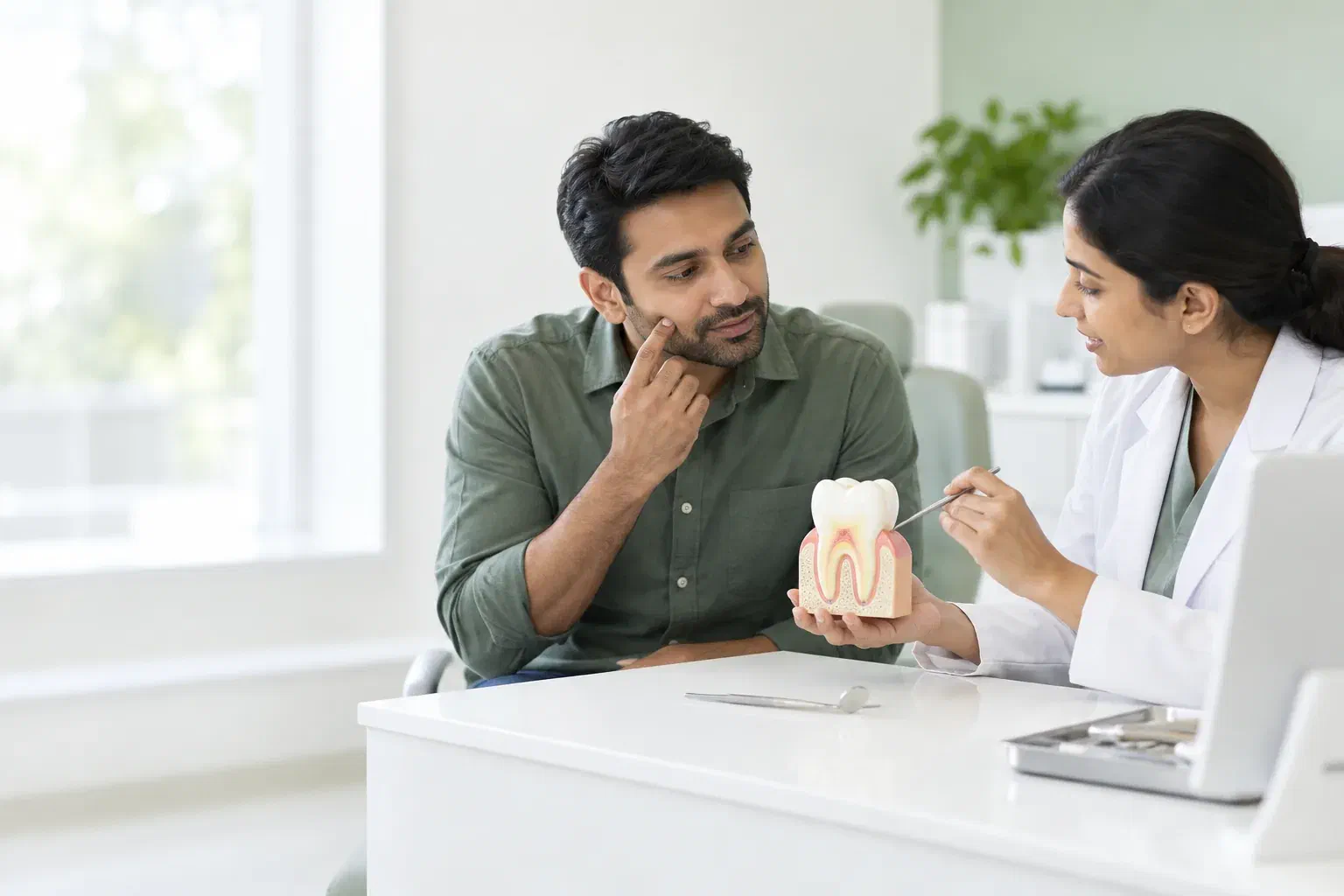
Illustrative consultation about a back tooth using a molar teaching model
Restorative Dentistry

Molar Root Canals in Milton

Started chewing only on one side? That habit often points to a back tooth that needs attention. In Milton, we find the source first, then plan both the inside treatment and the repair that follows.

When one side starts doing all the work

The quiet habit that says a molar needs a look

Plenty of people only notice a problem when they catch themselves steering every bite to the other side of the mouth. Your molars are the wide grinding teeth at the back, and inside each one is soft pulp tissue. If that pulp becomes inflamed beyond recovery or infected, a root canal may be one way to keep the tooth.

Keeping it is not automatic, though. The dentist also has to judge whether enough sound structure remains to rebuild the tooth and whether the gums and bone around it can support it over time. A sore molar is a reason to be examined; the examination is what decides whether root canal treatment actually fits.

For people here in Milton, the first visit is usually about narrowing things down: which tooth, what is causing it, and what the full plan would involve. Expect to talk about the internal work, the restoration that protects the chewing surface afterward, and whether a specialist should handle any part of it.

Ask about a molar that is bothering you
An intact molar teaching model and dental mirror on a clean tray
Signs worth mentioning

What you notice at the table matters

Before your visit, think about when the trouble started, whether it is getting better or worse, and any fillings, crowns or knocks that involved that side of your jaw.

Biting brings a jolt

Pain on chewing has more than one possible cause. Note whether it hits as you bite down, as you let go, or only with hot or cold food. Try not to keep pressing on the tooth to check; leave the testing to the dentist, who can look at your bite directly.

An ache that outstays the drink

If coffee or ice water leaves a throb that hangs around after you swallow, tell us how long it lasts. Mention too if it starts on its own or keeps you awake. That pattern is different from the quick twinge many people get from cold.

Something looks different at the gum

Puffiness, a small pimple-like bump that comes and goes, or a fracture near an old filling deserves attention even when it barely hurts. Let us know about a bad taste or drainage. A spell of calm does not tell you what is going on inside.

Call us soon if pain is severe or your face is swelling. Swelling that affects breathing or swallowing needs emergency medical care right away.

The case for keeping a back tooth

A molar is part of how your whole bite works

A healthy natural molar helps share chewing forces across your teeth. If its internal problem can be managed and the tooth can be rebuilt soundly, keeping it may make sense. That has to be balanced against any cracks, how much tooth is left, the state of the gums and the rest of what the exam shows.

A good conversation explains the likely benefit plainly, without promising how many years the tooth will last. Ask what makes this molar a fair candidate, what might shorten its outlook, and how the final restoration supports it. Finishing the canals is only one part of saving the tooth.

Patient information: AAE — understanding root canal treatment

Looking at the tooth as a whole

The dentist weighs whether the molar can be made useful again once the inside is treated. It is fair to ask for the reassuring findings and the worrying ones, particularly when a big filling or old damage is already there.

Stages that fit together

Seeing how the root canal and the final repair connect makes booking easier. If a specialist is also involved, ask who does which step and how notes, images and advice will move between offices.

Comfort planned in advance

Mention nerves, a stiff jaw or a past visit that went badly. Settle on a signal for when you need a break. Knowing this ahead of time lets the team shape an appointment you can follow and feel part of.

How treatment usually unfolds

Four stages, each with its own purpose

Visit length and number differ from tooth to tooth. Before anything begins, ask about the diagnosis, how much work is planned, the fees, the alternatives and how the tooth will be protected later.

  1. Find the cause, check the structure

    Your symptoms are reviewed, the tooth and surrounding tissues are examined, and suitable tests and X-rays are taken. This is the time to ask whether the molar can be rebuilt and whether its canals look complex enough to involve an endodontist.

  2. Numbing and isolation

    Local anaesthetic is given, and a thin protective sheet called a dental dam keeps the tooth isolated. The clinician then opens into the tooth to locate its canals. Speak up if something feels sore; you do not have to push through it.

  3. Treating the canals

    The canals are cleaned, shaped, disinfected and sealed as the stage allows. A temporary filling may cover the opening until the next visit. Ask whether the inside work is finished and what is still needed before the permanent repair.

  4. Rebuilding and checking in

    A suitable permanent restoration comes next, frequently one that covers and protects the chewing cusps. Confirm when it should be done and how to look after the tooth until then. Later reviews check healing rather than relying on how the tooth feels.

Looking after the tooth

Go gently until the final repair is in

Hold on to the instructions for the stage you are at. What you are told after the first canal visit can be different from the advice once the permanent restoration is placed.

Eat with care

Wait until the numbness wears off before chewing, and keep heavy pressure off the treated side until it has been restored. Ask which foods are sensible in the meantime. A temporary filling is not built to handle nuts, hard candy or toffee.

Book and keep the next step

Relief is good news, but it does not mean treatment is finished. If something comes up and you need to move a visit, call so we can talk about what is still outstanding. Know whether the next appointment is for canals, the restoration or a check.

Report anything new

Let us know about pain that is building, a bite that hits first on that tooth, swelling or a temporary that has come out. Say when it began and which stage you have reached. Take medication only as advised for you, and ask if anything is unclear.

Weighing your choices

Three paths, depending on what the exam finds

Ask how the recommendation matches your diagnosis, and make sure you understand the other options before you decide.

For a suitable tooth that can be rebuilt

Root canal treatment followed by a restoration

This route treats the problem inside the tooth and then restores it so you can chew on it. Talk through both halves together, including the final repair and any specialist care. A quote for the canals alone may leave out a large part of the plan.

When the pulp is healthy

Another treatment for another cause

If the source turns out to be elsewhere, a filling, a bite adjustment, gum care or something else may suit better. Ask what finding points that way. A past root canal on a different tooth is not, by itself, a reason to choose one now.

When keeping the tooth will not work

Extraction and planning for the gap

Removal may come up if the tooth cannot be restored reliably or you decide not to keep it. Ask how the space could affect your bite and which replacement options might suit, each with its own steps and costs.

Your questions

What people in Milton tend to ask about back-tooth root canals

Molar treatment can involve several choices along the way. Jotting your questions down beforehand can help you remember them in the chair.

(905) 876-4488
How long will my mouth stay numb after a molar root canal visit?
It varies with the anaesthetic used and the area treated, but numbness in a lower molar can sometimes last a few hours. Avoid chewing, hot drinks and biting your cheek until feeling returns. Ask the team what to expect for your appointment.
Can I go back to work the same day?
Many people do, though it depends on how you feel and the type of work you do. Some prefer to book the rest of the day lightly. If you have a physical job or need to speak a lot, mention it when scheduling so timing can be discussed.
Why might my molar feel tender for a few days afterward?
The tissues around the root can be sensitive to pressure for a short time after treatment. Follow the advice you are given and keep pressure off the tooth. Call if the tenderness is getting worse, swelling appears or your bite feels high.
Is a molar root canal harder to do than one on a front tooth?
Often it is more involved. Molars usually have more canals, their shapes vary, and they sit farther back, which makes access trickier. Ask what your assessment shows and how it may affect visit length, fees or a referral to a specialist.
Do I really need a crown after the canals are treated?
Back teeth take heavy chewing forces, and a treated molar often needs a restoration that protects its cusps. The right choice depends on how much tooth remains. Ask what is recommended for yours, when it should be done and whether it is a separate fee.
My molar stopped hurting. Should I still come in?
Yes. Pain fading does not confirm the problem has gone away, and sometimes it means the pulp has changed. Keep your appointment and describe how the symptoms shifted. The dentist will weigh the exam and tests together with what you report.
Back-tooth care close to home

Come in and get a clear plan for that molar

Book an assessment at our Bronte Street practice in Milton and go through the whole plan, from the canals to the final restoration. Bring notes on your symptoms, any earlier advice and your questions about keeping the tooth.

For severe pain or swelling, please phone us. Online forms and email are best for non-urgent questions.

Visit Milton Dental Clinic
Unit 1, 342 Bronte St. S, Milton, ON L9T 5B7
Get directions Clinic hours
Monday–Thursday
11am–7pm
Friday–Sunday
By appointment only

Areas we serve

  • Milton
  • Oakville
  • Mississauga
  • Georgetown
  • Halton Hills
  • Acton
  • Campbellville
  • Brampton
  • Burlington
  • Puslinch
  • Rockwood
  • Erin
  • Caledon
  • Etobicoke
  • Old Milton
  • Bronte Meadows
  • Timberlea
  • Dorset Park
  • Dempsey
  • Clarke
  • Beaty
  • Coates
  • Harrison
  • Scott
  • Willmott
  • Ford
  • Bowes
  • Cobden
  • Walker
  • Mountain View
  • Milton Heights
  • Hawthorne Village
  • Valley View
  • Fallingbrook
  • Nassagaweya
  • Trafalgar
  • Esquesing
  • Nelson
  • Brookville
  • Moffat
  • Glen Williams
  • Norval
  • Limehouse
  • Stewarttown
  • Ashgrove
  • Hornby
  • Silver Creek
  • Speyside
  • Scotch Block
  • North Oakville
  • River Oaks
  • Glen Abbey
  • West Oak Trails
  • Palermo
  • Bronte Creek
  • College Park
  • Joshua Creek
  • Uptown Core
  • Preserve
  • Iroquois Ridge
  • Lisgar
  • Meadowvale
  • Meadowvale Village
  • Churchill Meadows
  • Erin Mills
  • Central Erin Mills
  • Streetsville
  • East Credit
  • Creditview
  • Heartland
  • Sheridan
  • Mount Pleasant
  • Credit Valley
  • Huttonville
  • Churchville
  • Springbrook
  • Northwest Brampton
  • Bram West
  • Fletcher's Meadow
  • Fletcher's Creek South
  • Alton Village
  • Orchard
  • Millcroft
  • Headon Forest
  • Tansley
  • Brant Hills
  • Tyandaga
  • Kilbride
  • Lowville
  • Aberfoyle
  • Morriston
  • Arkell
  • Hillsburgh
  • Freelton
  • Carlisle
  • Waterdown
  • Flamborough
  • Mountsberg

How can we help?

Milton Dental Clinic

Have a question about your smile? Choose the option that works best for you.

For urgent dental concerns, please call.
Messages are reviewed during clinic hours.