
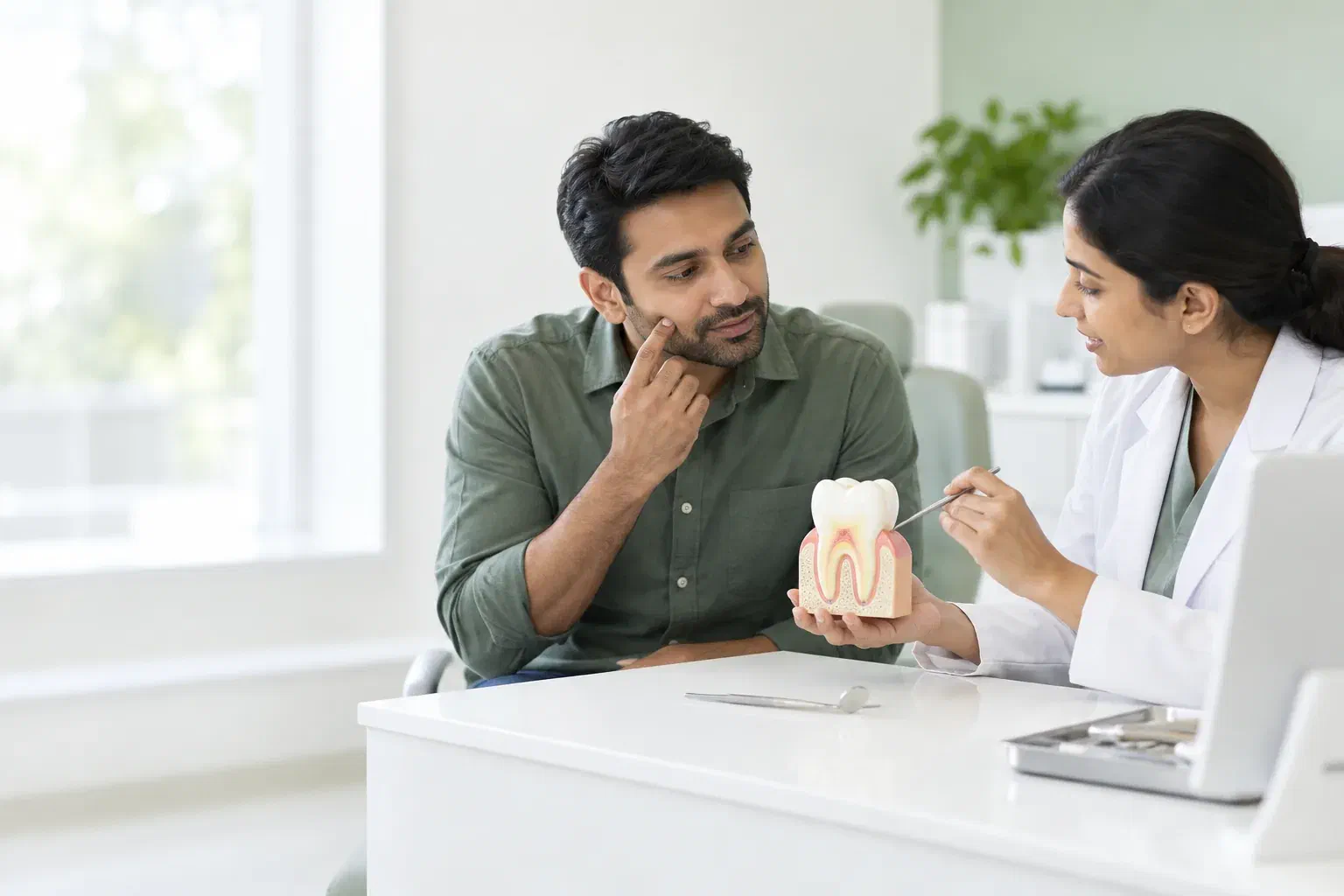
Illustrative consultation about a back tooth using a molar teaching model
Restorative Dentistry

Molar Root Canals in Old Milton

An old filling or crown on a back tooth can serve well for decades, then start to ache. For Old Milton, we look at what is happening underneath and plan treatment that protects the molar afterward.

Old repairs, new symptoms

When a long-trusted filling begins to complain

A large silver filling placed many years ago, or a crown you had almost forgotten about, can sit quietly on a back molar for a long time. Then one day the tooth aches on chewing or reacts to a hot drink. Deep or repeated repairs can sometimes leave the pulp, the living tissue inside the tooth, inflamed or infected.

When that inflammation cannot settle, a root canal may be one way of keeping the molar. It is only worth doing if the tooth can then be rebuilt and kept healthy, so the dentist looks closely at what lies under the old restoration, the gum and bone support, and any cracks.

Many people living on the established streets of Old Milton, Milton’s historic downtown, carry this kind of dental history. The visit is a chance to sort out which tooth is responsible, whether the pulp is truly the issue, and what both the internal treatment and the new restoration would involve.

Talk to us about an aching back tooth
An intact molar teaching model and dental mirror on a clean tray
Clues to bring with you

Small details help us find the right tooth

Let us know roughly when the symptoms began, whether they are steady or shifting, and the history of fillings, crowns or injuries on that side.

Chewing has become uncomfortable

Several problems can make a molar hurt on biting, including a crack beneath an old filling. Note whether it hurts as you clamp down or as you open, and whether temperature plays a part. Resist pressing on it again and again; the bite can be checked properly in the chair.

Heat or cold that echoes

A reaction that keeps going long after a sip of tea is worth timing. Mention if the ache appears without any trigger or disturbs your sleep. Those clues separate it from the brief sensitivity many teeth show now and then.

Changes around an older restoration

A dark line at the edge of a crown, a broken corner of filling, gum swelling or a bump that keeps returning should be looked at, even with little pain. Tell us about any odd taste. A quiet week is not proof that things have settled.

For strong pain or facial swelling, phone the clinic without delay. If swelling interferes with breathing or swallowing, go to emergency medical care.

Is the molar worth keeping?

Sometimes yes, and the reasons should be clear

A natural molar that can still do its job helps you chew evenly. If the inside can be treated and enough tooth remains to restore it, retention may be sensible. Older teeth with big repairs need a careful look at cracks, remaining structure and gum health before anyone recommends it.

You should leave knowing what is realistic, not holding a promise about how long it will last. Ask why this tooth looks like a reasonable candidate, what could work against it, and how the new restoration fits in. A finished root canal on its own does not save a molar.

Patient information: AAE — understanding root canal treatment

An honest read of what remains

With an old, heavily filled tooth, the amount of sound structure matters a great deal. Ask the dentist to explain both the hopeful signs and the concerns before you commit to treatment.

One plan from start to finish

Understanding how the canal work and the final restoration connect makes it easier to book. If a specialist shares the care, find out who does each part and how your records and X-rays will be passed along.

Attention to how you cope in the chair

Mention a stiff jaw, worry about dental work, or a past appointment that was hard. Agree on a hand signal for a break. That way the visit can be paced in a way that suits you.

Step by step

What happens, and why, at each visit

Some molars are treated in one appointment, others in several. Before starting, ask about the diagnosis, the scope, the fees, other choices and how the tooth will be covered afterward.

  1. Diagnosis and a look under the old repair

    Your history and symptoms are reviewed, the tooth is examined and tested, and X-rays are taken. Older restorations may need to be assessed or removed to judge what is left. Ask whether the canals look straightforward or whether an endodontist should be involved.

  2. Getting ready

    The area is numbed with local anaesthetic, and a dental dam is placed to keep the tooth clean and dry. An opening is made to reach the canal system inside. If you feel discomfort, say so, and the clinician can pause and reassess.

  3. Cleaning and sealing the canals

    Each canal is cleaned, shaped and disinfected, then filled when the stage allows. A temporary covering may protect the tooth between appointments. Ask whether the inside treatment is now complete and what the next step involves.

  4. A new restoration and later reviews

    The molar then needs a durable final restoration, which often covers its cusps. Check how soon this should happen and what to avoid until then. Follow-up visits look at healing around the root instead of judging only by comfort.

Caring for it at home

Treat the tooth kindly until it is rebuilt

Keep the written instructions for wherever you are in treatment. Advice after the canal stage and advice after the final restoration are not always the same.

Spare the treated side

Do not chew until the numbness has gone, and keep firm biting off that molar until its permanent repair is placed. Ask what meals are comfortable in the meantime. Crusty bread, nuts and caramels are poor partners for a temporary filling.

Finish what was started

A tooth that feels fine may still be waiting for its final stage. If your plans change, call to talk about the unfinished work rather than letting it drift. Be clear whether the next booking is for canals, the restoration or a review.

Watch for changes

Tell us about worsening pain, swelling, a bite that feels high or a temporary that has broken. Note when it started and which visit you last had. Use medication only as directed for you, and check with the team if you are unsure.

The choices in front of you

Different diagnoses lead to different treatment

Ask why a particular approach suits your findings. Knowing the alternatives helps you make a decision you are comfortable with.

If the tooth is restorable

Root canal with a new restoration

The inside of the tooth is treated, and then the molar is rebuilt to chew again. Consider the two parts together, including any specialist care and the type of final restoration. A fee for the canals alone may not show the full cost.

If the pulp is not the source

A treatment aimed elsewhere

Replacing a leaking filling, adjusting the bite, treating the gums or another approach may fit better if the exam points away from the pulp. Ask what finding supports that. A root canal on another tooth years ago does not mean this one needs the same.

If retention is not a good option

Removing the tooth and planning next steps

Extraction may be raised when the molar cannot be restored predictably, or if you prefer not to keep it. Ask how the gap might affect nearby teeth and which replacements could suit, each with its own stages and fees.

Old Milton questions

Answers for teeth with a long history

A molar with many past repairs can raise extra questions. Write them down so nothing gets missed during the appointment.

(905) 876-4488
Can a tooth that already has a crown need a root canal?
Yes. A crowned molar can still develop pulp inflammation or infection, sometimes years later. In some cases treatment is done through the crown; in others the crown needs replacing. Ask what the assessment suggests for your tooth.
Will my old silver filling have to come out?
It may need to be removed so the dentist can check for decay or cracks beneath it and reach the canals. Whether that happens depends on the findings. Ask what will be removed, why, and what will replace it afterward.
What if the tooth was treated with a root canal long ago and hurts again?
A previously treated molar can sometimes need assessment for retreatment, a new restoration or another option. The cause varies. Bring any records you have, and ask whether the tooth should be seen by an endodontist.
Do the blood thinners or other medications I take matter?
Please share a full, current medication list and your medical history before treatment. Some medicines and conditions affect planning. The team may need to coordinate with your physician, so do not stop any medication on your own.
How can you tell which back tooth is actually causing the pain?
Molar pain can be hard to pin down, and it may even feel as though it is coming from the opposite jaw. The dentist uses your description, an examination, specific tests and X-rays together. Root canal treatment should follow that diagnosis.
Could a crack under an old filling change the plan?
It can. Depending on where a crack runs, a molar may need a protective restoration, root canal treatment, or may not be restorable. Ask how any crack found affects the outlook and the options you are being offered.
Molar care for Milton’s historic core

Let’s sort out what that older molar needs

Our Bronte Street practice is close to Old Milton. Book an assessment and go through the complete plan together, bringing your symptoms, past treatment history and any questions about saving and rebuilding the tooth.

If pain is severe or swelling develops, please call rather than emailing. Online requests suit non-urgent questions.

Visit Milton Dental Clinic
Unit 1, 342 Bronte St. S, Milton, ON L9T 5B7
Get directions Clinic hours
Monday–Thursday
11am–7pm
Friday–Sunday
By appointment only

Areas we serve

  • Milton
  • Oakville
  • Mississauga
  • Georgetown
  • Halton Hills
  • Acton
  • Campbellville
  • Brampton
  • Burlington
  • Puslinch
  • Rockwood
  • Erin
  • Caledon
  • Etobicoke
  • Old Milton
  • Bronte Meadows
  • Timberlea
  • Dorset Park
  • Dempsey
  • Clarke
  • Beaty
  • Coates
  • Harrison
  • Scott
  • Willmott
  • Ford
  • Bowes
  • Cobden
  • Walker
  • Mountain View
  • Milton Heights
  • Hawthorne Village
  • Valley View
  • Fallingbrook
  • Nassagaweya
  • Trafalgar
  • Esquesing
  • Nelson
  • Brookville
  • Moffat
  • Glen Williams
  • Norval
  • Limehouse
  • Stewarttown
  • Ashgrove
  • Hornby
  • Silver Creek
  • Speyside
  • Scotch Block
  • North Oakville
  • River Oaks
  • Glen Abbey
  • West Oak Trails
  • Palermo
  • Bronte Creek
  • College Park
  • Joshua Creek
  • Uptown Core
  • Preserve
  • Iroquois Ridge
  • Lisgar
  • Meadowvale
  • Meadowvale Village
  • Churchill Meadows
  • Erin Mills
  • Central Erin Mills
  • Streetsville
  • East Credit
  • Creditview
  • Heartland
  • Sheridan
  • Mount Pleasant
  • Credit Valley
  • Huttonville
  • Churchville
  • Springbrook
  • Northwest Brampton
  • Bram West
  • Fletcher's Meadow
  • Fletcher's Creek South
  • Alton Village
  • Orchard
  • Millcroft
  • Headon Forest
  • Tansley
  • Brant Hills
  • Tyandaga
  • Kilbride
  • Lowville
  • Aberfoyle
  • Morriston
  • Arkell
  • Hillsburgh
  • Freelton
  • Carlisle
  • Waterdown
  • Flamborough
  • Mountsberg

How can we help?

Milton Dental Clinic

Have a question about your smile? Choose the option that works best for you.

For urgent dental concerns, please call.
Messages are reviewed during clinic hours.