
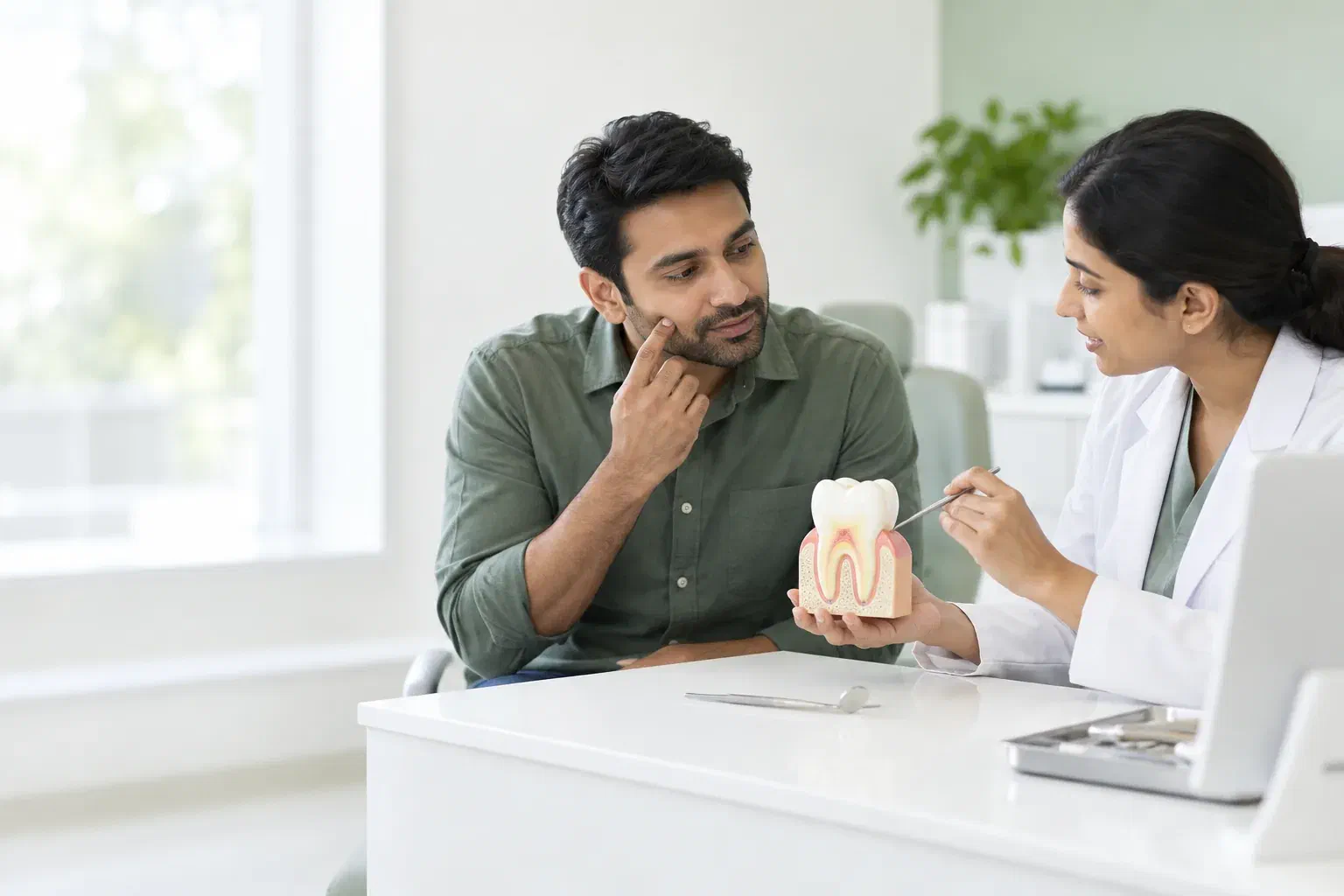
Illustrative consultation about a back tooth using a molar teaching model
Restorative Dentistry

Molar Root Canals in Rockwood

Dreading a root canal is common, especially after a hard dental visit in the past. From Rockwood, start with a calm conversation about your molar, how comfort is managed and what restoring it will involve.

For the nervous and the hesitant

Start with a conversation, not the chair

The phrase “root canal” carries a reputation, and for some people it brings back a difficult appointment years ago. It can help to know what the treatment actually is. A molar has soft pulp tissue at its centre; when that tissue is infected or so inflamed it cannot recover, removing it may let you keep the tooth.

Before any of that, the dentist has to establish two things: that the pulp is truly the source of your symptoms, and that the molar can be rebuilt with enough sound structure and healthy support. Discomfort tells us to look closer, while the exam tells us what, if anything, should be done.

Coming from Rockwood, you are welcome to treat the first visit purely as a chance to talk. Ask how numbness is checked, how breaks work, what a dental dam feels like and how long each appointment might run. Understanding the plan, including the final restoration, often makes the rest feel more manageable.

Arrange a no-pressure molar consultation
An intact molar teaching model and dental mirror on a clean tray
What to share with us

Your symptoms, and how you feel about treatment

Let us know when the trouble started, how it has changed and any history on that side. Tell us about your feelings toward dental care, too; it is useful information, not a complaint.

Avoiding food on one side

Soreness when you chew can have several causes. Notice whether the jolt comes as you bite or as you open, and whether temperature matters. Try not to keep testing it, which can make a tender tooth worse; the dentist will check gently.

Pain that will not switch off

Mention an ache that keeps going after something hot or cold, that comes on with no trigger, or that disturbs sleep. Those features help distinguish a pulp issue from brief everyday sensitivity.

Swelling or a spot on the gum

A swollen area, a small bump that recurs, or a broken edge around an old repair should be examined even if it is not very painful. Tell us about any bad taste. Putting off a visit because the pain dipped can let things progress quietly.

Phone us promptly if the pain becomes severe or your face starts to swell. If the swelling makes breathing or swallowing hard, go for emergency medical care straight away.

What keeping the molar offers

There may be a good reason to try

A natural back tooth you can chew on supports your bite. If its inner problem can be treated and enough healthy structure remains to restore, keeping it can be a reasonable goal. Cracks, gum health and the size of old fillings are all considered before a recommendation is made.

A trustworthy explanation describes the expected benefit without promising a lifespan. Ask what makes the tooth suitable, what could limit its future, and how the restoration will protect it. Treating the canals is one step; rebuilding the molar is the other half.

Patient information: AAE — understanding root canal treatment

A judgment about the entire tooth

The dentist explains whether the molar is likely to function well after treatment. You are entitled to hear the concerns as clearly as the good news, particularly if there is already a large filling.

No surprises in the sequence

Knowing in advance how many stages there are, and what each involves, can ease a lot of worry. If a specialist will see you for part of the care, ask who does each stage and how your notes will be passed on.

Comfort built into the plan

Describe what has made past visits hard, whether it was the sound, the time in the chair or a jaw that aches. Agree on a hand signal for a pause and how often breaks could happen.

Walking through it

Nothing should happen without an explanation

Visit numbers and lengths vary. Before starting, ask about the diagnosis, what the treatment covers, fees, other choices and what will restore the molar once its canals are treated.

  1. Listen, examine, image

    Your concerns and symptoms come first. The tooth and gums are then examined with suitable tests and X-rays. You will hear whether the molar looks restorable and whether its anatomy suggests referral to an endodontist.

  2. Numbness before anything else

    Local anaesthetic is given and checked before work begins. A dental dam, a thin sheet that isolates the tooth, is placed next. If you feel sharpness rather than pressure at any point, signal and the team will stop.

  3. Working inside the canals

    The clinician removes the affected pulp, then shapes, disinfects and seals the canal system. A temporary covering may go on if another session is planned. Ask what was completed and how the next visit will go.

  4. A permanent restoration and a check

    The molar is rebuilt with a suitable restoration, often one that covers its cusps. Confirm when that should be placed and what to avoid until then. A later review looks at healing rather than relying only on comfort.

Once you are home

Gentle days for the treated tooth

Hang on to the instructions for each stage. What applies after canal treatment may differ from the advice once the final restoration is in place.

Wait, then eat softly

Give the anaesthetic time to wear off so you do not bite your cheek or tongue. Until the molar is restored, chew on the other side and choose soft foods. A temporary filling can crack on anything hard or sticky.

Return for the final stage

Relief can make the next appointment feel optional, but the tooth still needs its restoration and possibly a review. If anxiety tempts you to cancel, call us instead; we can talk through what would make the next visit easier.

Keep us informed

Phone about pain that grows, any swelling, a bite that feels uneven or a temporary that has loosened or vanished. Tell us when it began and what stage you have finished. Use any medication only as advised for you.

Every option, explained

You can choose once you understand them

Ask why one treatment is recommended over another. Understanding the alternatives puts the decision back in your hands.

For a molar that can be rebuilt

Root canal followed by a restoration

This addresses the problem inside the tooth and then rebuilds it for chewing. Discuss both together, including any specialist appointments. A fee for the canal stage alone may leave out the restoration.

When the pulp is not the issue

Care for a different diagnosis

Sometimes the exam shows the pulp is healthy and the pain comes from a worn filling, inflamed gums or an uneven bite. Each of those has its own, often simpler, fix. Ask what finding supports that view, and do not assume you need a root canal just because a previous painful tooth did.

When keeping it is not suitable

Removal and replacement options

Extraction may be considered if the tooth cannot be predictably restored, or if you prefer not to keep it. Talk about how the space would affect your bite and which replacements might suit, each with its own stages and costs.

Rockwood questions

Comfort questions people often hesitate to ask

It is fine to ask about anything that worries you. Writing questions down ahead of time can make them easier to raise.

(905) 876-4488
Can I take breaks during a long molar appointment?
Yes. Agree on a signal before you start, such as raising a hand. Short pauses to rest your jaw, swallow or simply settle are a normal part of longer treatment.
What if the anaesthetic does not seem to be working?
Tell the team straight away. Inflamed molars can sometimes be harder to numb, and the clinician can check and give more anaesthetic or adjust the approach. You should not have to carry on through sharp pain.
Why do I feel pressure even though I am numb?
Local anaesthetic blocks pain, but you may still notice pressure and vibration. Some people find it reassuring to know this in advance. If pressure turns into pain, let the team know.
Can something help keep my mouth open during treatment?
A small bite block is sometimes offered so your jaw muscles do not have to hold your mouth open on their own. Ask about it if your jaw tires easily, and mention any jaw joint problems beforehand.
May I listen to music or a podcast during the visit?
Many people find it helps. Ask when booking, and plan to keep one ear free or the volume low so you can still hear the clinician’s instructions.
Can I meet the dentist and ask questions before committing to treatment?
Yes. An assessment appointment is a chance to discuss the diagnosis, the plan and your concerns. You can take time to decide, unless the dentist advises that urgent treatment is needed.
Coming in from Rockwood

Talk first, decide when you are ready

Book an unhurried assessment at our Bronte Street practice and go through the plan, from comfort measures to the final restoration. Bring your symptoms, past experiences and any questions you would like answered.

Severe pain or swelling should never wait for an email reply, so please call. Messages and the booking form are fine for everything else.

Visit Milton Dental Clinic
Unit 1, 342 Bronte St. S, Milton, ON L9T 5B7
Get directions Clinic hours
Monday–Thursday
11am–7pm
Friday–Sunday
By appointment only

Areas we serve

  • Milton
  • Oakville
  • Mississauga
  • Georgetown
  • Halton Hills
  • Acton
  • Campbellville
  • Brampton
  • Burlington
  • Puslinch
  • Rockwood
  • Erin
  • Caledon
  • Etobicoke
  • Old Milton
  • Bronte Meadows
  • Timberlea
  • Dorset Park
  • Dempsey
  • Clarke
  • Beaty
  • Coates
  • Harrison
  • Scott
  • Willmott
  • Ford
  • Bowes
  • Cobden
  • Walker
  • Mountain View
  • Milton Heights
  • Hawthorne Village
  • Valley View
  • Fallingbrook
  • Nassagaweya
  • Trafalgar
  • Esquesing
  • Nelson
  • Brookville
  • Moffat
  • Glen Williams
  • Norval
  • Limehouse
  • Stewarttown
  • Ashgrove
  • Hornby
  • Silver Creek
  • Speyside
  • Scotch Block
  • North Oakville
  • River Oaks
  • Glen Abbey
  • West Oak Trails
  • Palermo
  • Bronte Creek
  • College Park
  • Joshua Creek
  • Uptown Core
  • Preserve
  • Iroquois Ridge
  • Lisgar
  • Meadowvale
  • Meadowvale Village
  • Churchill Meadows
  • Erin Mills
  • Central Erin Mills
  • Streetsville
  • East Credit
  • Creditview
  • Heartland
  • Sheridan
  • Mount Pleasant
  • Credit Valley
  • Huttonville
  • Churchville
  • Springbrook
  • Northwest Brampton
  • Bram West
  • Fletcher's Meadow
  • Fletcher's Creek South
  • Alton Village
  • Orchard
  • Millcroft
  • Headon Forest
  • Tansley
  • Brant Hills
  • Tyandaga
  • Kilbride
  • Lowville
  • Aberfoyle
  • Morriston
  • Arkell
  • Hillsburgh
  • Freelton
  • Carlisle
  • Waterdown
  • Flamborough
  • Mountsberg

How can we help?

Milton Dental Clinic

Have a question about your smile? Choose the option that works best for you.

For urgent dental concerns, please call.
Messages are reviewed during clinic hours.