

Illustrative consultation about a removable partial denture
Restorative Dentistry

Partial Dentures in Brampton

Helping a parent, or yourself, decide on a removable partial? Households in Brampton can plan it together, covering fit, handling, appearance and a cleaning routine that someone can realistically keep up.

Planning together from Brampton

Sometimes the decision belongs to the whole family.

It is common for a son or daughter to sit in on this appointment. Perhaps a parent has lost a few teeth and stopped enjoying meals, or the appliance they own keeps ending up in a pocket instead of their mouth. Having another set of ears in the room can make the planning conversation easier for everyone.

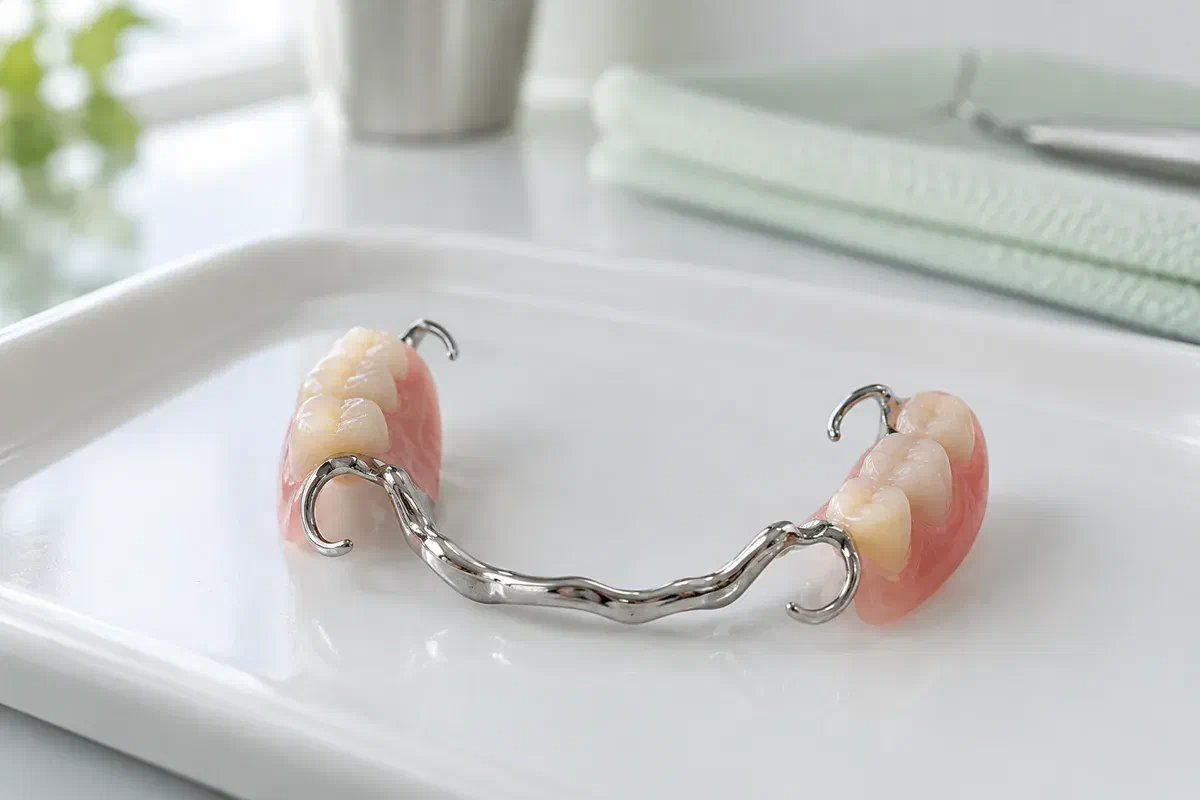
So what are you deciding on? A partial denture is a removable piece holding replacement teeth on a base or framework. It sits among the natural teeth still present in one jaw and relies on those teeth, the gums and the bite to stay in position. Each design is shaped around a particular mouth.

The person wearing it should be at the centre. Bring the current partial, if there is one, even if it rarely gets worn. Talk about what has been difficult: putting it in, cleaning it, eating with it. We can then explain whether adjusting it, making a new one or another replacement would work better, and what each choice would ask of the wearer and of whoever helps them day to day.

Talk about a partial for someone you care for
Removable lower partial denture with two tooth-bearing sections and a metal framework
What usually prompts the call

Notice how meals and conversation have changed.

The pattern of missing teeth sets the design challenge. An examination finds out which teeth could provide support and whether other treatment is needed before an appliance is made.

Spaces scattered along one jaw

One removable appliance can sometimes replace several gaps in the same arch. Point out which spaces cause the most trouble at the table or when chatting. How the remaining teeth are arranged affects how it might be connected.

A partial left in the drawer

An appliance that rocks, catches or feels sore often stops being worn. Bring it in instead of trying to bend the clasps. The problem might be the fit, a worn component, the bite or a change in a tooth it rests on.

Tooth loss on the horizon

When an extraction is planned or has just happened, ask how healing affects the timeline. A temporary appliance or later refinements may be part of it. Knowing the order of visits helps the household arrange rides and time off.

The remaining teeth deserve as much attention as the spaces. Their health and position, and their ability to help hold a partial, are assessed before the final design is chosen.

What a well-planned partial offers

Something the wearer can actually use

A removable partial can restore missing positions while keeping healthy natural teeth in place. The proposed design should make clear which teeth support it, what keeps it from slipping and what comes out for cleaning. Ask to see an example so everyone involved understands what to expect.

Getting used to it takes some time, and it won’t feel like natural teeth. Discuss how it will feel, which components could be noticed and what it can’t do. A realistic picture helps the wearer and anyone supporting them prepare for the first weeks.

Patient information: ADA — removable partial denture designs

A natural-looking set of teeth

The replacement teeth are chosen for shade, shape and position alongside the remaining ones. Share what matters when smiling in family photos or speaking, and ask when the appearance can be reviewed.

Cleaning that’s manageable

Because it comes out, the appliance and the teeth under it can both be cleaned properly. Ask us to demonstrate handling for the wearer and, if helpful, for a family member who assists. The design must suit the person using it.

A choice made with full information

A partial can be compared with suitable bridge or implant options. Look at visits, effect on remaining teeth, fees and upkeep. Then weigh them against priorities and what the exam showed.

What the appointments involve

One visit at a time, with questions welcome at each

Steps depend on the design and on any dental work required first. Ask for the planned visits so the household can coordinate, and find out when the appliance can be seen in progress.

  1. Examine and listen

    The dentist checks the spaces, remaining teeth, gums and bite, and may use imaging to judge support. Bring any previous appliance and describe problems with eating, speech, cleaning or tender spots.

  2. Plan the design and preparation

    Discuss the proposed base or framework, visible parts and any work supporting teeth might need. Ask for an estimate and about alternatives. Records of the mouth and bite then guide construction.

  3. Check the appliance as it develops

    Some designs include an interim visit to try the framework or tooth arrangement. The wearer should say what feels unusual. Ask what can still be changed before completion.

  4. Fit, practise and review

    At delivery, seating and bite are checked, and the wearer practises inserting, removing and cleaning it. Anyone who helps at home is welcome to watch. Book the follow-up, which covers pressure spots and daily wear.

Support at home in Brampton

A routine that someone can keep up every day

Instructions should name the cleaner and wearing schedule for this specific appliance. Before using a product meant for another denture material, check with us.

Handle it with care

Use the insertion and removal path that was demonstrated. The appliance shouldn’t be bitten into place, and clasps shouldn’t be bent at home. If it no longer seats as expected, call and bring it along.

Clean it over a towel or basin

Brush off food and deposits with the recommended brush and a compatible cleanser, holding it over a folded towel or water in case it slips. Avoid hot water and harsh chemicals. Ask how to store it, especially with metal parts.

Keep the natural teeth healthy

Fluoride toothpaste and daily flossing or interdental brushes still matter, especially near the teeth that support the partial. Regular exams are still needed. Mention food trapping or a supporting tooth that is hard to reach.

Patient information: Cambridge University Hospitals — looking after dentures

Which design suits the wearer?

Consider the mouth and the hands that will manage it.

Materials and designs each have strengths, and none suits everyone. Find out which are clinically reasonable here and how each would change daily handling and cleaning.

For a suitable removable plan

An acrylic partial denture

Acrylic may be considered in some interim or longer-term situations. Ask why it is a fit, what supports it and whether changes are expected later. One made while the gums heal may need review as they settle.

When a planned framework is appropriate

A framework partial denture

Metal frameworks use rests and clasps positioned on selected teeth, depending on support and bite. Ask which parts may show, whether teeth need preparation and how the appliance will be maintained.

When removing an appliance is a concern

A fixed replacement

In suitable cases, a bridge or implant restoration might be an alternative. Requirements, procedures and costs are different. Ask what the examination indicates rather than assuming one fixed solution will suit every gap.

Questions families ask

Helping someone through the decision

Eating, speaking, cleaning and taking the appliance out all affect whether a partial will be worn. Bring the questions that matter to the person wearing it.

(905) 876-4488
Can I come to my parent’s denture appointment?
Yes, with your parent’s agreement. A family member can help remember instructions and ask questions. The wearer’s own preferences and consent remain central to planning, so they should be part of every discussion.
What if my mother finds the clasps hard to grip?
Mention this during planning. Handling can be practised in the chair, and the design should be manageable for the person using it. Tell us about any difficulty with fingers or grip so it can be considered.
How can we keep a partial from getting lost or broken?
Use a proper storage case whenever it’s out, and avoid wrapping it in a tissue. Clean it over a towel or basin of water. Keep it away from pets and young children, and bring it in if it is ever damaged.
Should a partial come out every night?
Follow the wearing schedule given for the appliance. Dentures are generally removed overnight, though advice may differ right after an extraction or during a review stage. Ask how to store it safely while out.
Why does the partial sit on certain teeth?
Some designs rest on or clasp selected natural teeth for support and retention. That is why those teeth are examined carefully first. Keeping them clean and checked regularly helps protect them.
What should we bring to the first visit?
Bring the current appliance and any broken pieces, a list of medications and health conditions, and any dental records you have. Note when the fit changed and what the wearer likes or dislikes about it.
From Brampton, by appointment

Come together, leave with a clear plan.

Request a visit at our Bronte Street practice to discuss a first partial denture or one that isn’t being worn. We’ll hear from the person wearing it first, then explain what the examination shows and which replacement plan fits.

If a broken partial is causing pain or has injured the mouth, please call. Online booking is for non-urgent visits.

Visit Milton Dental Clinic
Unit 1, 342 Bronte St. S, Milton, ON L9T 5B7
Get directions Clinic hours
Monday–Thursday
11am–7pm
Friday–Sunday
By appointment only

Areas we serve

  • Milton
  • Oakville
  • Mississauga
  • Georgetown
  • Halton Hills
  • Acton
  • Campbellville
  • Brampton
  • Burlington
  • Puslinch
  • Rockwood
  • Erin
  • Caledon
  • Etobicoke
  • Old Milton
  • Bronte Meadows
  • Timberlea
  • Dorset Park
  • Dempsey
  • Clarke
  • Beaty
  • Coates
  • Harrison
  • Scott
  • Willmott
  • Ford
  • Bowes
  • Cobden
  • Walker
  • Mountain View
  • Milton Heights
  • Hawthorne Village
  • Valley View
  • Fallingbrook
  • Nassagaweya
  • Trafalgar
  • Esquesing
  • Nelson
  • Brookville
  • Moffat
  • Glen Williams
  • Norval
  • Limehouse
  • Stewarttown
  • Ashgrove
  • Hornby
  • Silver Creek
  • Speyside
  • Scotch Block
  • North Oakville
  • River Oaks
  • Glen Abbey
  • West Oak Trails
  • Palermo
  • Bronte Creek
  • College Park
  • Joshua Creek
  • Uptown Core
  • Preserve
  • Iroquois Ridge
  • Lisgar
  • Meadowvale
  • Meadowvale Village
  • Churchill Meadows
  • Erin Mills
  • Central Erin Mills
  • Streetsville
  • East Credit
  • Creditview
  • Heartland
  • Sheridan
  • Mount Pleasant
  • Credit Valley
  • Huttonville
  • Churchville
  • Springbrook
  • Northwest Brampton
  • Bram West
  • Fletcher's Meadow
  • Fletcher's Creek South
  • Alton Village
  • Orchard
  • Millcroft
  • Headon Forest
  • Tansley
  • Brant Hills
  • Tyandaga
  • Kilbride
  • Lowville
  • Aberfoyle
  • Morriston
  • Arkell
  • Hillsburgh
  • Freelton
  • Carlisle
  • Waterdown
  • Flamborough
  • Mountsberg

How can we help?

Milton Dental Clinic

Have a question about your smile? Choose the option that works best for you.

For urgent dental concerns, please call.
Messages are reviewed during clinic hours.