

Illustrative consultation about a removable partial denture
Restorative Dentistry

Partial Dentures in Georgetown

A partial that wobbles, clicks or lifts when you talk is telling you something. Coming from Georgetown, you can have it assessed and plan a better-fitting removable appliance if one is needed.

A Georgetown guide to loose partials

The wobble you keep pressing back into place

Many people learn to live with a partial that moves. They push it back with the tongue, avoid apples, and stop laughing quite so freely. It usually starts small. Yet a rocking appliance is a sign that something in the mouth or the partial itself has changed, and it is worth finding out what.

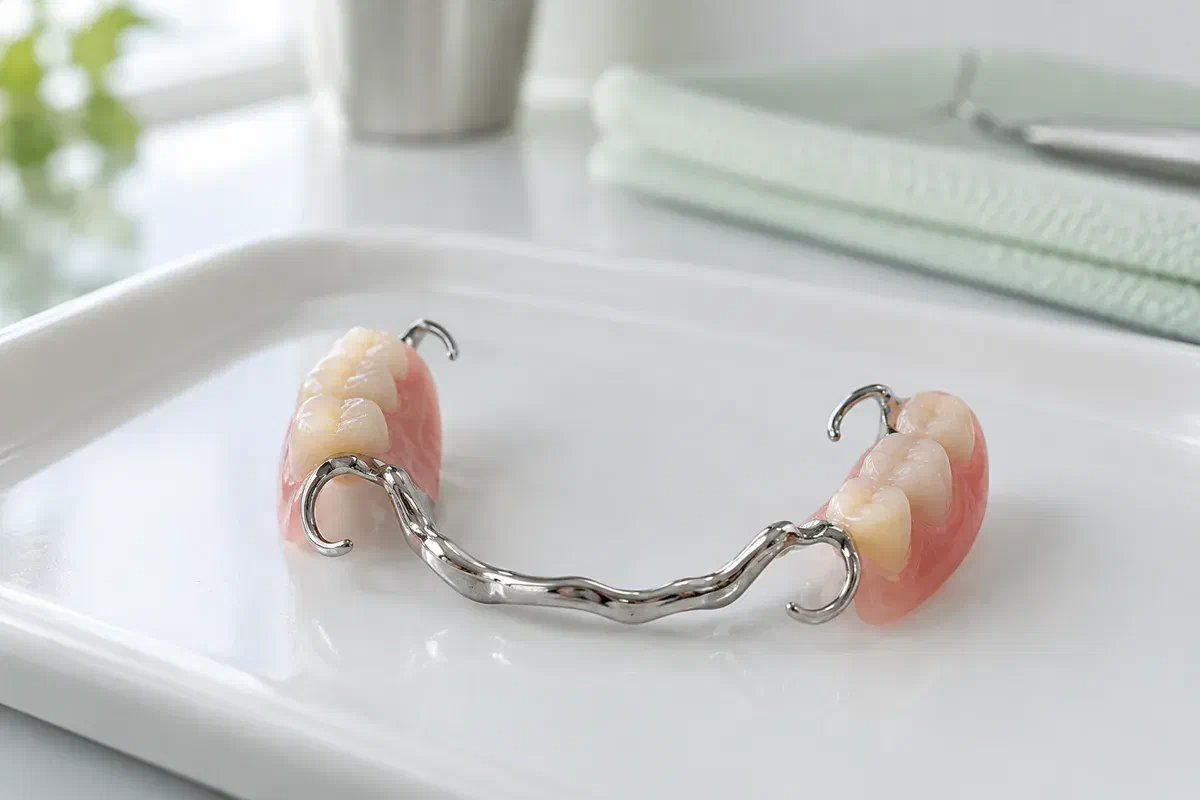
To understand why, it helps to know how one works. A partial denture is a removable base or framework holding replacement teeth, shaped to fit between the natural teeth left in an arch. Clasps and rests may rely on particular teeth, while the base sits on the gums, and the bite keeps everything in balance.

When any of those pieces shifts, the fit can suffer. So bring the appliance in rather than reshaping it at home. Tell us when the movement began, what you were eating or doing, and whether anything else has changed in your mouth. Then we can discuss an adjustment, a reline, a new partial or another way to replace the teeth.

Have your partial checked
Removable lower partial denture with two tooth-bearing sections and a metal framework
Common causes to look into

Movement rarely comes from nowhere.

The design of a partial depends on the pattern of missing teeth, and when that pattern changes, so can the fit. An examination looks at the appliance and the mouth together.

New spaces since it was made

Losing another tooth in the same arch can alter how the appliance is held. Tell us which gaps are new and which ones bother you most. The position of the teeth still standing determines what the next design could look like.

A clasp or part that feels different

Rocking, catching, clicking or a new pressure point all deserve a check. Please don’t bend a clasp to tighten it. The cause might be the fit, a worn or broken component, your bite or a change in a supporting tooth.

Changes after an extraction

Gums reshape as they heal after a tooth is removed, which can affect how a partial sits. Ask how healing fits into planning, and whether a temporary arrangement or later adjustments are likely during that time.

Supporting teeth are part of the diagnosis. Their health, position and stability are checked before deciding whether to adjust the current appliance or design a new one.

What a steadier partial can mean

Less fiddling, more confidence at the table

A partial denture that fits well can restore missing teeth while protecting the healthy natural ones around them. Whatever is proposed, you should understand which teeth support it, what keeps it from lifting and what you’ll remove to clean. Ask to see a model if it’s hard to imagine.

Even a well-fitting appliance needs some getting used to, and it will never feel exactly like your own teeth. Ask how a new design might differ from your current one, what may be visible and where its limits are. Straight answers prepare you better than promises.

Patient information: ADA — removable partial denture designs

A natural-looking arrangement

The replacement teeth are chosen for shade, shape and position to work with your own. Share what you would like to improve about your current partial, and ask when you can review the new look.

Cleaning without obstacles

Lifting it out lets you reach the appliance and the teeth beneath it. If clasps are hard to grip, ask for help practising. The design has to be workable for you, not just for the dentist.

A considered comparison

Adjusting or replacing your partial can be weighed against suitable bridge or implant options. Consider the visits, effect on remaining teeth, fees and upkeep, alongside what the exam found.

How we work out what’s wrong

Diagnose first, then decide on a fix or a new appliance.

The steps depend on what the examination finds and on any treatment needed first. Ask which visits are planned and when you can see a new appliance taking shape.

  1. Check the partial and your mouth

    We examine the appliance, the gaps, remaining teeth, gums and bite. X-rays may help assess support. Describe when the movement started and any trouble with chewing, speech, cleaning or tender spots.

  2. Explain the options

    Depending on findings, an adjustment, repair, reline or new design may be discussed. Review the proposed base or framework, visible parts and any preparation needed. Ask about the estimate and alternatives.

  3. Try-in for a new design

    When a replacement is being made, certain designs give you a chance to test the framework or tooth arrangement first. Note anything that feels loose or uneven, and find out which details are still open to change before it’s completed.

  4. Fit, practise and recheck

    At the fitting, we confirm the seating and how your teeth meet, and you practise inserting and removing it. Book a review to check pressure spots and whether it stays steady through daily meals.

Daily care in Georgetown

Small habits help a partial stay where it belongs.

Ask for instructions that apply to this appliance, including a wearing schedule and suitable cleaners. Check before using a product designed for another type of denture.

No home adjustments

Insert and remove the partial along its practised path. Biting it into place or bending clasps can distort the fit. If it begins to move again, call for advice and bring it in.

A gentle cleaning routine

Brush away food and buildup using the recommended brush and cleanser. Hot water and harsh chemicals can warp or damage materials. Ask how to store it safely out of the mouth, especially with metal parts.

Healthy supporting teeth

Your own teeth need fluoride toothpaste and daily cleaning between them, particularly those that hold the appliance. Keep up regular examinations, since changes in these teeth can affect fit.

Patient information: Cambridge University Hospitals — looking after dentures

If a new partial is needed

Choosing a design that suits the mouth you have now

No one material or appliance works for every pattern of missing teeth. Ask which approaches are clinically sound today and how each would affect daily use.

For a suitable removable plan

An acrylic partial denture

Acrylic may be considered for interim or certain longer-term needs. Ask why it’s recommended, what supports it and whether changes are expected later. An appliance made during healing may need review as the tissues settle.

When a framework is appropriate

A framework partial denture

A metal framework uses rests and clasps on selected teeth, designed around your support and bite. Ask which components might show, whether teeth need preparing and how it can be maintained.

If you’d prefer teeth that don’t move

A fixed alternative

Where circumstances suit, bridges or implants may be another route. Each involves different requirements, procedures and costs. Ask what your examination shows rather than assuming every gap has the same fixed answer.

Questions about fit

Why partials loosen, and what can be done

Movement affects eating, speaking, cleaning and confidence. Bring the questions that matter in your day.

(905) 876-4488
Why has my partial denture started to rock?
Possible causes include changes in the gums, a worn clasp, a change in a supporting tooth or a shift in your bite. The appliance and mouth need to be examined together to find the reason. Avoid adjusting it yourself in the meantime.
Can a loose partial be tightened?
Sometimes a clasp or base can be adjusted, relined or repaired, and sometimes a new design is the better option. It depends on the cause and the condition of the appliance. Bring it in so the choices can be explained.
Is denture adhesive a good fix for a loose partial?
Adhesive isn’t a substitute for a proper fit, and a partial that has become loose should be assessed. Ask the dentist whether any adhesive is appropriate for your appliance and how it should be used, if at all.
What if a tooth holding my partial needs treatment?
Treatment on a supporting tooth can affect how the appliance fits. Mention your partial before any dental work so the plan can account for it. In some cases, an adjustment or a new design may be needed afterward.
Will a clasp on a new partial be more visible than my old one?
It depends on which teeth will provide support and where components need to sit. Tell the dentist which areas show in your smile and ask to review clasp positions before the design is finalized.
How should I store my partial while it’s out?
Ask what storage method suits your appliance’s materials. Keep it in a proper case, away from pets and children, and follow the cleaning and soaking advice you’ve been given. Avoid hot water.
Travelling from Georgetown

Bring the partial that’s bothering you.

Request an appointment at our Bronte Street practice and we’ll examine the appliance and the teeth that hold it. We’ll explain what’s causing the movement and talk about whether an adjustment or a new design makes sense.

Phone if a broken or loose partial is causing pain or injury. Online requests are for non-urgent visits.

Visit Milton Dental Clinic
Unit 1, 342 Bronte St. S, Milton, ON L9T 5B7
Get directions Clinic hours
Monday–Thursday
11am–7pm
Friday–Sunday
By appointment only

Areas we serve

  • Milton
  • Oakville
  • Mississauga
  • Georgetown
  • Halton Hills
  • Acton
  • Campbellville
  • Brampton
  • Burlington
  • Puslinch
  • Rockwood
  • Erin
  • Caledon
  • Etobicoke
  • Old Milton
  • Bronte Meadows
  • Timberlea
  • Dorset Park
  • Dempsey
  • Clarke
  • Beaty
  • Coates
  • Harrison
  • Scott
  • Willmott
  • Ford
  • Bowes
  • Cobden
  • Walker
  • Mountain View
  • Milton Heights
  • Hawthorne Village
  • Valley View
  • Fallingbrook
  • Nassagaweya
  • Trafalgar
  • Esquesing
  • Nelson
  • Brookville
  • Moffat
  • Glen Williams
  • Norval
  • Limehouse
  • Stewarttown
  • Ashgrove
  • Hornby
  • Silver Creek
  • Speyside
  • Scotch Block
  • North Oakville
  • River Oaks
  • Glen Abbey
  • West Oak Trails
  • Palermo
  • Bronte Creek
  • College Park
  • Joshua Creek
  • Uptown Core
  • Preserve
  • Iroquois Ridge
  • Lisgar
  • Meadowvale
  • Meadowvale Village
  • Churchill Meadows
  • Erin Mills
  • Central Erin Mills
  • Streetsville
  • East Credit
  • Creditview
  • Heartland
  • Sheridan
  • Mount Pleasant
  • Credit Valley
  • Huttonville
  • Churchville
  • Springbrook
  • Northwest Brampton
  • Bram West
  • Fletcher's Meadow
  • Fletcher's Creek South
  • Alton Village
  • Orchard
  • Millcroft
  • Headon Forest
  • Tansley
  • Brant Hills
  • Tyandaga
  • Kilbride
  • Lowville
  • Aberfoyle
  • Morriston
  • Arkell
  • Hillsburgh
  • Freelton
  • Carlisle
  • Waterdown
  • Flamborough
  • Mountsberg

How can we help?

Milton Dental Clinic

Have a question about your smile? Choose the option that works best for you.

For urgent dental concerns, please call.
Messages are reviewed during clinic hours.