

Illustrative consultation about a removable partial denture
Restorative Dentistry

Partial Dentures in Old Milton

Worn the same partial for years? From Old Milton, you can talk through a refit, a remake or a new design, looking at how it sits, how it shows when you smile and how it fits your cleaning habits.

When the old appliance has had its day

A familiar partial, a changing mouth

Plenty of people in Milton’s historic downtown have worn one removable appliance for a long time, and it has quietly become part of the morning. Then something shifts. A clasp loosens, a tooth it relied on is lost, or chewing on one side starts to feel uncertain, and the question becomes whether to fix it or start again.

Either way, the starting point is the same. A partial denture is a removable set of replacement teeth mounted on a base or framework, built to sit among the natural teeth left in one jaw. What holds it steady is a combination of those teeth, the gum ridges, and the way your upper and lower teeth meet.

That is why your current appliance is so useful to us. Please bring it, along with any pieces that have broken off. Tell us what you liked about it over the years and what has started to annoy you. Those details point us toward a repair, a refit, a new partial or another kind of replacement.

Ask about your current partial
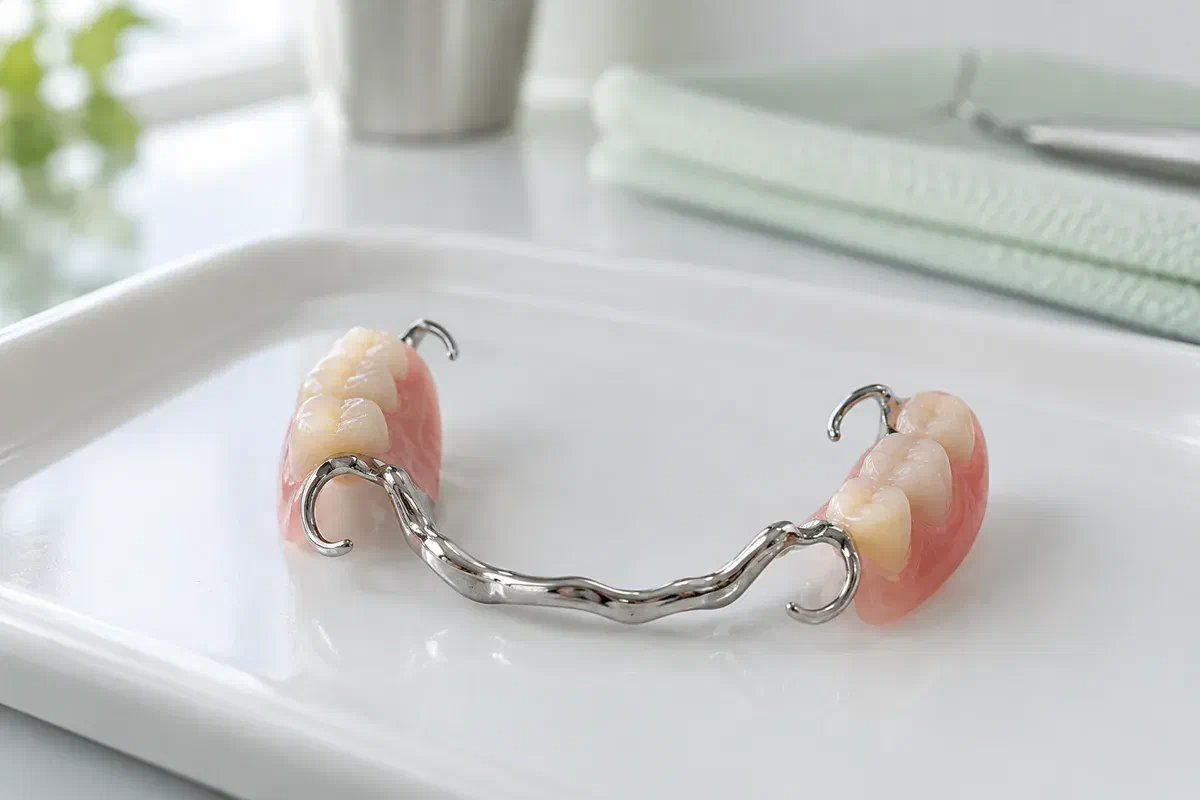
Removable lower partial denture with two tooth-bearing sections and a metal framework
Why Old Milton denture wearers call

Small changes in an old partial are worth mentioning.

A long-worn appliance can drift out of step with the mouth around it. An examination helps sort out whether the teeth, the gums or the appliance itself has changed.

Gaps spread across one jaw

Missing teeth in several places along the same arch can sometimes be handled with a single appliance. Let us know which spaces cause the most trouble at the table or in conversation. The teeth left between them shape how it could connect.

A rock, a catch or a new pressure point

When a partial you know well begins to tip, snag on the cheek or press somewhere new, it deserves a look. Leave the clasps alone rather than bending them. The fit, a worn component, your bite or a supporting tooth could be responsible.

A tooth that is going, or just gone

Losing another tooth can change the whole picture. Ask how the healing period fits into planning and whether an addition, a temporary option or later fine-tuning would be needed. Understanding the order helps you get through the weeks in between.

Every remaining tooth matters to the design. We check its health, its position and whether it can carry part of the load before deciding what the new or adjusted partial should look like.

What a fresh design can change

Steadier chewing, clearer conversation, simpler cleaning.

A well-considered partial can restore the missing positions in your smile while you keep the natural teeth that are still healthy. Before you agree to anything, you should know which teeth will hold it, what keeps it from lifting and exactly what comes out at night. A sample appliance can make that much easier to picture.

A new partial still needs breaking in, even for someone who has worn one before, and it will not feel like your own teeth. Ask how the new design may differ from your old one, what might show and where its limits lie. Plain talk at this stage is worth more than reassurance.

Patient information: ADA — removable partial denture designs

Teeth that suit the rest of your smile

Shade, shape and position are chosen with your remaining teeth in mind. If your old partial looked too bright or too bulky, say so. Ask when you can see the arrangement and comment before it is finalized.

Every surface within reach

Taking it out lets you brush the appliance and the natural teeth it touches. If arthritis or stiff fingers make small parts awkward, tell us and ask for a hands-on demonstration. A design you can manage yourself matters.

Room to compare

A partial can be set beside suitable bridge or implant choices. Look at the visits involved, the effect on your other teeth, the fees and long-term care. That comparison, together with your exam findings, helps you choose.

How a replacement partial is made

Check, design, try, then fit

How many visits you need depends on the design and on whether other dental work should happen first. Ask for the planned sequence and when you will be able to see the appliance taking shape.

  1. Review your mouth and your old partial

    We look at the spaces, the teeth that remain, your gums and your bite, and imaging may help show what support is available. Your current appliance tells us a lot, so describe any trouble with eating, speaking, cleaning or sore spots.

  2. Choose the design and any preparation

    Talk about the proposed base or framework, which parts might be seen, and whether supporting teeth need work beforehand. Ask about the estimate and the alternatives. Impressions and bite records then guide the lab.

  3. Check progress along the way

    Some designs allow a try-in of the framework or the tooth setup before completion. Speak up about anything that feels unusual compared with your old partial. Ask what can still be altered at this point.

  4. Take it home and return for review

    On fitting day, we check how it seats and how your teeth meet, then you practise inserting, removing and cleaning it. Confirm your follow-up date. That visit covers sore spots and how it is behaving in daily life.

Back home in Old Milton

Old habits may need a small update.

Instructions for one partial may not suit the next. Ask which cleaner and wearing schedule apply to this appliance, and check before reusing a product you bought for your previous denture.

Follow its own path in and out

A new appliance may seat along a slightly different line than the old one. Use the path you were shown and never bite it down into position or bend a clasp. If it stops going in smoothly, call and bring it with you.

Wash it apart from your mouth

Clear food and deposits with the brush and cleanser recommended for its material. Hot water and strong chemicals can damage it. Ask about the right way to store it out of the mouth, especially when it has metal parts.

Keep up with your natural teeth

Brush with fluoride toothpaste and clean between your teeth, giving extra attention to the ones that hold the partial. Regular examinations remain important. Let us know if food collects in one place or a supporting tooth is hard to reach.

Patient information: Cambridge University Hospitals — looking after dentures

Repair, remake or replace?

Your next appliance need not copy the last one.

The right choice depends on which teeth are left and what you need from them. Ask which approaches are clinically reasonable now and how each would change your routine.

For a suitable removable role

An acrylic partial denture

Acrylic may be used for an interim appliance or, in some cases, a longer-term one. Ask why it is being suggested, what supports it and whether more changes are likely. If it is made during healing, expect a review as the gums settle.

When a metal framework is appropriate

A framework partial denture

This design uses rests and clasps placed on particular teeth. Its shape depends on the support you have and how you bite. Ask which parts may show, whether teeth need preparation and what maintenance looks like over time.

If you would like something that stays put

Fixed replacement teeth

A bridge or an implant restoration may suit some situations. They come with different requirements, procedures and costs. Ask what your examination supports instead of assuming the same fixed answer fits every space.

Questions about replacing a partial

Asked often by long-time denture wearers

Comfort, appearance, cleaning and handling all matter when you replace something you have relied on. Bring the questions that come up in your own day.

(905) 876-4488
Can my old partial be relined instead of replaced?
Sometimes the base of an existing appliance can be adjusted or relined, and sometimes the design no longer suits the mouth. The answer depends on its condition, the supporting teeth and your gums. Bring it in so the options can be explained.
Will a new partial feel strange even though I’ve worn one for years?
It may, because a new appliance can sit, grip or feel slightly different. Allow some time to adapt and mention anything that rubs or moves. Experience with an old partial often helps, but each design brings its own learning period.
Is there anything I can keep from my old denture?
Tell us what you liked, such as the look of certain teeth or how easy it was to take out. Those preferences can guide the new design where it is clinically reasonable. The old appliance itself may also serve as a useful reference.
If I lose another tooth later, can my current partial be changed?
Adding a tooth is possible with some designs but cannot be promised. It depends on where the tooth was and whether it helped hold the appliance. Raise any tooth with an uncertain future during planning.
My clasp looks loose. Can I tighten it myself?
Please don’t. Bending a clasp at home can weaken or break it and may change how the partial loads the tooth. Bring the appliance in so the cause can be found and the fit checked properly.
What should I tell the dentist about my current partial?
Mention when the fit first changed, any repairs or adjustments it has had, and any dental work done since it was made. Bring the appliance, broken pieces and any records you have. Describe what you would most like to improve.
From Old Milton to Bronte Street

Let’s look at what your partial is telling us.

Arrange a visit at our Bronte Street practice to have an existing partial denture reviewed or to discuss a new one. We’ll listen to your experience first and explain what the examination shows.

Call if a broken appliance is causing pain or injury. Please use online requests for non-urgent visits only.

Visit Milton Dental Clinic
Unit 1, 342 Bronte St. S, Milton, ON L9T 5B7
Get directions Clinic hours
Monday–Thursday
11am–7pm
Friday–Sunday
By appointment only

Areas we serve

  • Milton
  • Oakville
  • Mississauga
  • Georgetown
  • Halton Hills
  • Acton
  • Campbellville
  • Brampton
  • Burlington
  • Puslinch
  • Rockwood
  • Erin
  • Caledon
  • Etobicoke
  • Old Milton
  • Bronte Meadows
  • Timberlea
  • Dorset Park
  • Dempsey
  • Clarke
  • Beaty
  • Coates
  • Harrison
  • Scott
  • Willmott
  • Ford
  • Bowes
  • Cobden
  • Walker
  • Mountain View
  • Milton Heights
  • Hawthorne Village
  • Valley View
  • Fallingbrook
  • Nassagaweya
  • Trafalgar
  • Esquesing
  • Nelson
  • Brookville
  • Moffat
  • Glen Williams
  • Norval
  • Limehouse
  • Stewarttown
  • Ashgrove
  • Hornby
  • Silver Creek
  • Speyside
  • Scotch Block
  • North Oakville
  • River Oaks
  • Glen Abbey
  • West Oak Trails
  • Palermo
  • Bronte Creek
  • College Park
  • Joshua Creek
  • Uptown Core
  • Preserve
  • Iroquois Ridge
  • Lisgar
  • Meadowvale
  • Meadowvale Village
  • Churchill Meadows
  • Erin Mills
  • Central Erin Mills
  • Streetsville
  • East Credit
  • Creditview
  • Heartland
  • Sheridan
  • Mount Pleasant
  • Credit Valley
  • Huttonville
  • Churchville
  • Springbrook
  • Northwest Brampton
  • Bram West
  • Fletcher's Meadow
  • Fletcher's Creek South
  • Alton Village
  • Orchard
  • Millcroft
  • Headon Forest
  • Tansley
  • Brant Hills
  • Tyandaga
  • Kilbride
  • Lowville
  • Aberfoyle
  • Morriston
  • Arkell
  • Hillsburgh
  • Freelton
  • Carlisle
  • Waterdown
  • Flamborough
  • Mountsberg

How can we help?

Milton Dental Clinic

Have a question about your smile? Choose the option that works best for you.

For urgent dental concerns, please call.
Messages are reviewed during clinic hours.