

Illustrative discussion of restoring a root-treated tooth before crown placement
Restorative Dentistry

Post-and-Core Restorations in Burlington

The root canal is done and the tooth feels calm, but the work is not finished. From Burlington, you can plan the next stage with us: whether the tooth needs a core, a post as well, and the crown that seals it all.

After the root canal

The canal is sealed. Now the tooth needs rebuilding.

Root canal treatment clears and seals the inside of a tooth, yet it leaves the outside to be dealt with. A tooth that needed a root canal has often lost a good deal of structure to decay, old fillings or a break. Before a crown can go on, the missing bulk usually has to be rebuilt with a core.

Here is where a post may come in. In some root-treated teeth there is not enough wall left to keep a core attached, so a post is placed a short way into the treated canal to anchor it. That is its whole job. It does not replace the root, and it cannot make up for a weak or cracked one.

If your root canal was done by a specialist, bring their report and any x-rays they sent. Dr. Anjum will review the root filling, the tooth above the gum, and your bite, then explain whether a core alone, a post-retained core, or another plan suits the tooth best.

Plan the next stage after a root canal
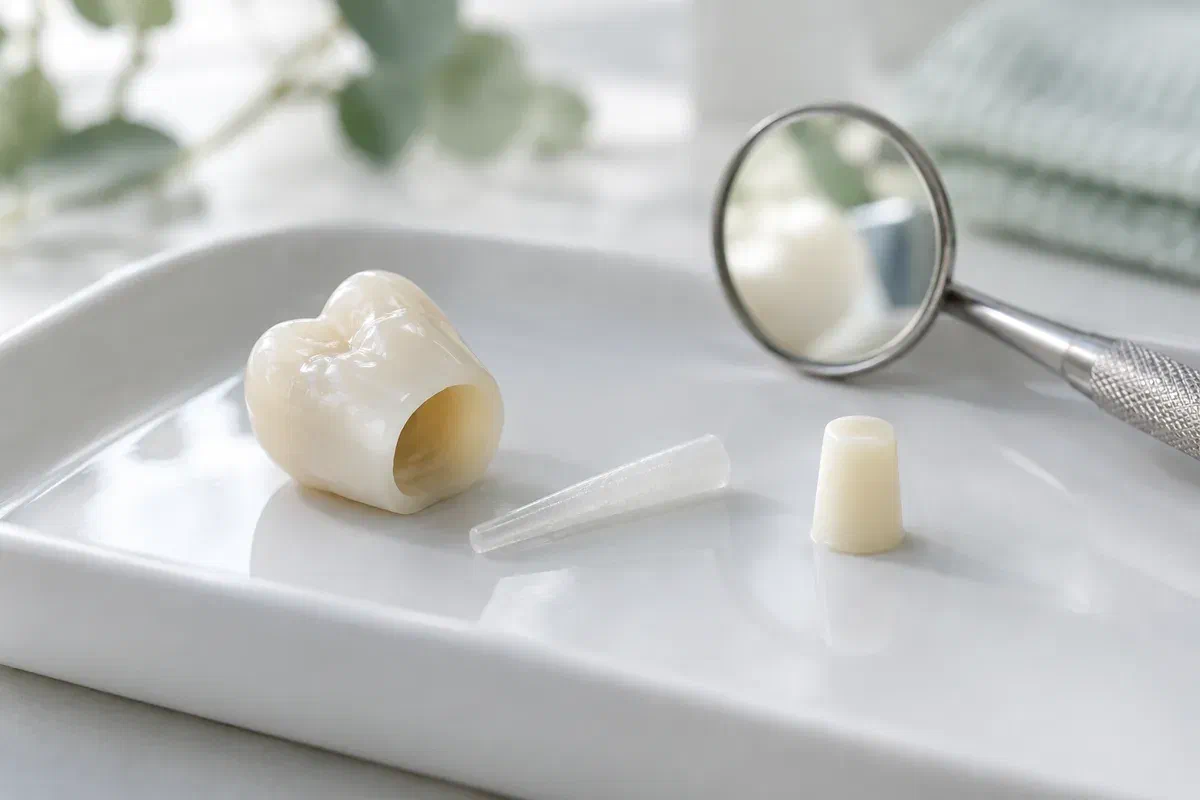
Illustrative crown, fibre post, and restorative material samples on a tray
What to sort out next

Three situations that bring people in

A post recommendation should come with a clear reason. You can ask what will retain the build-up and which findings point to that choice.

A large part of the tooth is missing

Decay and access for the root canal can leave a thin shell. The dentist assesses the root, gum and bone support as well as the visible part. A post is considered only when restoring the tooth still looks like a sound decision.

The temporary filling has cracked or dropped out

Root canal visits often end with a temporary seal. If it wears down, breaks or falls out, call so the canal is not left open for long. Bring anything that came away and describe when it happened.

Months have passed without a crown

Life gets busy and the crown appointment slides. Ask whether the tooth still looks suitable for a core alone, whether more retention is now needed, and how to protect it until the final restoration is in place.

Root canal treatment and a post are separate decisions. Many treated teeth are rebuilt without one, and a post is added only when the core needs the extra hold.

Finishing what was started

Turn a treated root into a working tooth

For a suitable tooth, a secure core lets the crown fit properly and share chewing forces with its neighbours. The aim is to bring the tooth back into everyday use while conserving the structure that is left. Each part of the plan should connect clearly to that.

A careful plan looks at the tooth as a whole, not just the post material. A post cannot overcome a significant crack or a root with very thin walls. Weigh the root’s condition, the support around it, and how heavily that tooth is used.

Patient information: AAE — assessing whether a tooth can be restored

Untangle the terms

Root canal, post, core and crown are four different things. Knowing which is which makes the plan and the bill much easier to follow. Ask for a drawing if the vocabulary is unfamiliar.

Keep healthy tooth in view

Ask how much sound structure remains and how the preparation will protect it. The best plan is the one your findings justify, which may mean fewer parts rather than more.

Design the crown and foundation together

The core is shaped for the crown that will sit on it, including its fit, outline and bite. Discuss the finished tooth first so the steps underneath have a clear target.

From sealed canal to final crown

What the remaining appointments cover

Sequence and timing depend on the tooth and the crown design. When you book from Burlington, ask how many visits are expected and when the permanent crown will be fitted.

  1. Review the root canal result

    Dr. Anjum checks the root filling on x-ray, the tooth structure left, the surrounding gum and your bite. Specialist reports help. Mention any lingering tenderness so it is assessed before the foundation is built.

  2. Agree the foundation and the estimate

    You will hear whether a post is advised, which material is proposed and what it can and cannot do. Ask for a complete estimate including the core, any temporary crown and the final crown, and whether a further opinion is wise.

  3. Rebuild the core

    When a post is needed, part of the root filling is removed to create space, with enough left behind to keep the canal sealed. Next the post is cemented or bonded and the core added on top. Some designs need more than one visit.

  4. Seat the crown and confirm follow-up

    Your crown is made and fitted, then checked against the neighbouring teeth and your bite. Confirm home care and the review date. If a temporary stays on in the meantime, know how to protect it and when you are due back.

Protecting the work

Small habits for a tooth in progress

Guidance changes once the final crown is on. If any advice is hard to follow, tell us and the team will help you find a practical way through.

Chew elsewhere for now

With a temporary in place, steer clear of hard, sticky or crunchy foods on that side. A core can feel strong without being ready to go uncovered, so keep the crown visit. Call early if it needs moving.

Brush and floss the margin

Clean daily around the restored tooth and between it and its neighbours. Ask for a demonstration if reaching the spot is awkward. A crown protects the top, but the edges still need your attention.

Tell us when something feels off

Phone if the crown loosens, the bite feels high or uneven, or a chip breaks off. Do not lever it with a fingernail. Save any loose piece and let us know what you were doing when it happened.

Foundation choices

What holds the crown depends on what is left.

Ask what each realistic option adds and what it involves. The recommendation should be about your tooth, not a default system.

When the tooth’s walls can retain it

Build-up on its own

If enough structure survived the root canal, a core may stay secure without a post. Ask whether this applies to you. Avoiding a post you do not need preserves more of the root.

When more hold is genuinely needed

Build-up anchored by a post

A post may be advised when the core would not otherwise be retained well. What it is made of, and its shape, are matched to the tooth and crown. Talk through the benefits and risks for your situation.

When the outlook is in doubt

Reconsider the plan

If the tooth may not support a lasting repair, further assessment, other treatment to improve the situation, or removal may come up. Weigh what each would mean for you against the result you could reasonably expect.

After-root-canal questions

What to know before the crown

These steps are easy to blur together. A short walk through your own x-ray usually makes the plan click.

(905) 876-4488
How soon after a root canal should the crown go on?
Your dentist will suggest timing based on the tooth, but leaving a back tooth without its final restoration for a long stretch can raise the risk of fracture or leakage. Ask what interval suits your tooth and book the next step before you leave.
Can my specialist and general dentist share the plan?
Yes, and it is common. The specialist treats the canal, and the restoring dentist plans the core and crown. Bring the specialist’s report or ask us to request it so both sides of the work line up.
Does every tooth that had a root canal get a post?
No. Many are restored with a core and crown alone. A post is used only when the remaining tooth cannot hold the core well enough by itself.
Will the post stop the root from cracking?
A post retains the core; it is not designed to reinforce the root. Creating space for it removes some material from inside the canal. Ask why retention is needed and how the dentist has weighed that against risk to the root.
Is a post anything like an implant?
They are quite different. A post sits inside your own root-treated tooth, whereas an implant is a fixture set into the jawbone where a tooth used to be. If a note mentions a post, ask which type is meant.
What if the temporary falls out on a weekend?
Keep the area clean, avoid chewing on it and save any pieces. Call the clinic when we are next available, and seek urgent care sooner if you have significant pain or swelling. Our weekend appointments are by arrangement only.
Burlington post-and-core planning

Ready for the step after your root canal?

Book a visit at our Bronte Street practice to plan the core, any post and the crown for a root-treated tooth. Bring the specialist’s report, x-rays and any questions about the order of appointments.

Please phone if a temporary or crown has come out and the tooth hurts or the gum is swelling. Online requests are for routine bookings.

Visit Milton Dental Clinic
Unit 1, 342 Bronte St. S, Milton, ON L9T 5B7
Get directions Clinic hours
Monday–Thursday
11am–7pm
Friday–Sunday
By appointment only

Areas we serve

  • Milton
  • Oakville
  • Mississauga
  • Georgetown
  • Halton Hills
  • Acton
  • Campbellville
  • Brampton
  • Burlington
  • Puslinch
  • Rockwood
  • Erin
  • Caledon
  • Etobicoke
  • Old Milton
  • Bronte Meadows
  • Timberlea
  • Dorset Park
  • Dempsey
  • Clarke
  • Beaty
  • Coates
  • Harrison
  • Scott
  • Willmott
  • Ford
  • Bowes
  • Cobden
  • Walker
  • Mountain View
  • Milton Heights
  • Hawthorne Village
  • Valley View
  • Fallingbrook
  • Nassagaweya
  • Trafalgar
  • Esquesing
  • Nelson
  • Brookville
  • Moffat
  • Glen Williams
  • Norval
  • Limehouse
  • Stewarttown
  • Ashgrove
  • Hornby
  • Silver Creek
  • Speyside
  • Scotch Block
  • North Oakville
  • River Oaks
  • Glen Abbey
  • West Oak Trails
  • Palermo
  • Bronte Creek
  • College Park
  • Joshua Creek
  • Uptown Core
  • Preserve
  • Iroquois Ridge
  • Lisgar
  • Meadowvale
  • Meadowvale Village
  • Churchill Meadows
  • Erin Mills
  • Central Erin Mills
  • Streetsville
  • East Credit
  • Creditview
  • Heartland
  • Sheridan
  • Mount Pleasant
  • Credit Valley
  • Huttonville
  • Churchville
  • Springbrook
  • Northwest Brampton
  • Bram West
  • Fletcher's Meadow
  • Fletcher's Creek South
  • Alton Village
  • Orchard
  • Millcroft
  • Headon Forest
  • Tansley
  • Brant Hills
  • Tyandaga
  • Kilbride
  • Lowville
  • Aberfoyle
  • Morriston
  • Arkell
  • Hillsburgh
  • Freelton
  • Carlisle
  • Waterdown
  • Flamborough
  • Mountsberg

How can we help?

Milton Dental Clinic

Have a question about your smile? Choose the option that works best for you.

For urgent dental concerns, please call.
Messages are reviewed during clinic hours.