

Illustrative discussion of restoring a root-treated tooth before crown placement
Restorative Dentistry

Post-and-Core Restorations in Caledon

Helping a parent or partner decide about a broken, root-treated tooth brings its own questions. For families in Caledon, we explain post-and-core options in a way everyone can follow, with time to consider health history and practical needs.

Deciding together

When you are the one helping someone else decide

Often it is an adult child who calls. A parent’s old crown has come off, or a tooth that had a root canal years ago has crumbled, and someone has mentioned a post. You want to understand enough to help them choose well, and they want to know what it will involve for them.

Put simply, a core rebuilds the lost part of the tooth so a new crown can fit over it. If the tooth has been root-treated and very little wall remains to hold the core, a post may be placed into part of the canal as an anchor. That post is purely for retention. It is not a new root, and it cannot fix a cracked one or replace natural tooth that is gone.

At the first visit, Dr. Anjum will examine the tooth, the root, the gum and bite, and review medical history and medications, since these can affect planning. Please bring a medication list, any dental records, and the crown or pieces if they came out. You are welcome to come in together and ask questions.

Arrange a visit together
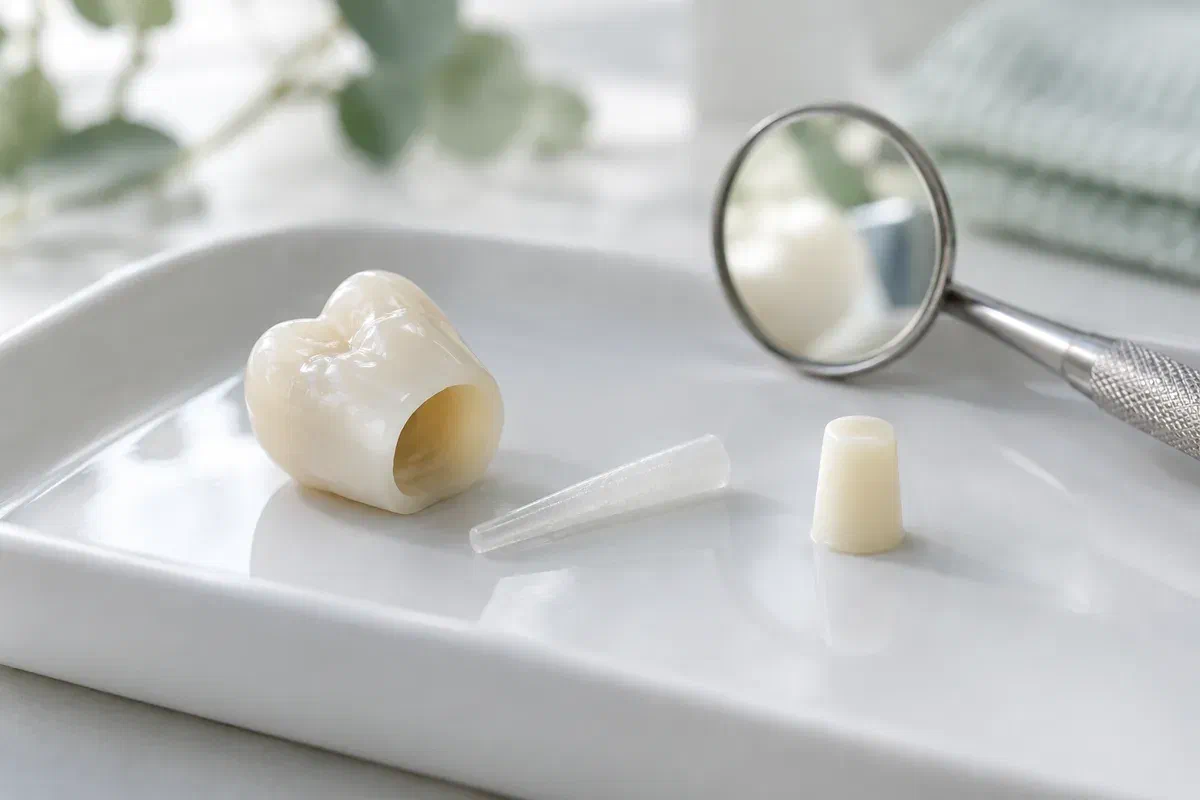
Illustrative crown, fibre post, and restorative material samples on a tray
Common starting points

How the subject usually comes up

If a post is suggested, the reason should be easy to explain to everyone involved. Ask what will hold the core and which findings support it.

A tooth that has worn or broken down

Years of fillings, decay or a fracture can leave little above the gum. The dentist assesses the root, the gum and the bone too. A post is considered only if a reliable crown is still a sensible goal for that tooth.

A crown that has come out

Older crowns sometimes come away with their core or post still attached. Keep everything in a container. The exam shows what gave way and whether the tooth can take a new foundation, rather than assuming it can go straight back.

Root canal treatment, then a long pause

Sometimes a crown was recommended after a root canal but never placed. Ask whether a core alone would suffice now, whether more retention is needed, and how to protect the tooth until the next step.

A root-treated tooth does not automatically need a post. One is used only when the core needs help to stay, and the effect on the root is part of the decision.

Making the decision

Keeping a tooth, if it is the right choice

When the tooth is suitable, a well-retained core gives the crown a stable shape so it can be used comfortably for chewing. For many people, keeping a natural tooth matters. The plan should aim for a working tooth while respecting the structure that remains.

Overall health, other dental work and what the person wants from treatment all play a part. A post cannot overcome a cracked root or very little remaining tooth, and the number of visits should feel manageable. Ask how each of these factors shaped the advice.

Patient information: AAE — assessing whether a tooth can be restored

Use simple explanations

Ask the dentist to show the post, core and crown on a model or x-ray. When everyone in the room can follow it, the estimate and visits are easier to plan.

Respect the tooth that is left

Ask how much sound structure remains and how the preparation keeps it. A plan with fewer parts may be preferable if the findings support it.

Picture the crown, and the comfort

The foundation is designed around the crown, its fit and how it meets other teeth or any partial denture. Discuss that end result before agreeing to the steps underneath.

What the appointments involve

A plan everyone can follow

The number of visits depends on the tooth and the crown. If you are driving someone in from Caledon, ask how long each appointment will take and which steps can be grouped.

  1. Assess the tooth and health history

    The dentist reviews the remaining tooth, the existing root treatment, the gums, bite and medical history. X-rays help. Mention any blood thinners, recent hospital stays or conditions that affect healing.

  2. Explain the choices clearly

    Everyone present should come away knowing whether a post is planned and why, the material, its limitations and a full estimate including the core, temporary and final crown. If a physician or specialist needs to be consulted, that will be explained.

  3. Build the foundation

    When a post is needed, a small channel is created in the treated canal, with some root filling left at the tip to keep the seal. The core is then built or fitted, and a temporary crown placed if needed.

  4. Fit the crown and confirm care

    The crown is fitted and adjusted for comfort, contacts and bite. Confirm home care, especially if someone helps with brushing, and when to return. If a temporary stays on, ask how to protect it.

At home afterwards

Care that fits daily routines

There is different advice for a temporary and a final crown. If brushing is difficult or someone needs help with care, tell us and we will suggest options.

Soft foods on that side for now

With a temporary in place, choose softer foods and chew on the other side. A firm-feeling core still needs its crown, so keep the completion visit or call to rebook.

Make cleaning manageable

Daily brushing and flossing around the crown matter. If dexterity is limited, ask about larger-handled brushes, floss holders or small interdental brushes.

Watch for looseness or soreness

Call if the crown moves, the bite feels different, or the gum near it is sore or swollen. Do not try to pull it out. Keep any piece that comes off.

Choosing a path

Options matched to the person, not just the tooth

Ask what each option involves in time, visits and effect on the tooth. The best choice depends on the tooth and on the person.

When enough tooth remains to retain it

A core on its own

If the remaining walls are sufficient, a core may hold without entering the canal. That can mean a simpler procedure and less effect on the root. Ask whether it is possible here.

When the core needs anchoring

A core secured with a post

A post may be recommended if the core would otherwise loosen. Its design and material depend on the root and crown. Ask about benefits and risks in this case.

When rebuilding may not be worthwhile

A simpler or different plan

If the tooth’s outlook is poor or the treatment would be burdensome, removal or other options may be discussed. Ask what each involves and what would suit the person best.

Questions families ask

Helping someone through the decision

These are common questions when relatives are involved. The person receiving treatment always has the final say.

(905) 876-4488
Can I come into the appointment with my parent?
Yes, with their agreement. Having someone there to listen, take notes and ask questions can help, particularly when several options are on the table. Let us know when booking so we can allow time for discussion.
Do blood thinners affect post-and-core treatment?
They can matter for some dental procedures. Bring an up-to-date medication list. The dentist will tell you if anything needs to be coordinated with a physician; do not stop any medication without medical advice.
Is the treatment suitable at an older age?
Age alone does not rule it out. The decision depends on the tooth, overall health, and how the person feels about multiple visits and time in the chair. Ask for the full range of options, including simpler ones, so the choice reflects what matters most to them.
What if the crown sits next to a partial denture?
The new crown may need to be shaped to work with the denture, for example to support a clasp. Bring the denture to the appointment so the dentist can check how it fits and plan the crown around it.
Can the work be spread out to make visits shorter?
Often, yes. Ask whether stages can be split to make appointments shorter and more comfortable, and how to protect the tooth between them. The trade-off is usually an extra visit, so weigh that against the benefit of shorter sessions.
How do we plan around the drive from Caledon?
Ask at the first visit how many appointments are expected and how long each will take. Booking at times that suit your household, and calling ahead if the temporary loosens, can save wasted trips.
Caledon post-and-core consultations

Come in together. We’ll explain it clearly.

Whether the appointment is for a parent, a partner or yourself, our Bronte Street team can help. Bring a medication list, dental records and any pieces of a crown or post, and we will go through the options at a comfortable pace.

If a crown or tooth breaks and there is significant pain or swelling, please call the clinic. Online requests are for non-urgent bookings.

Visit Milton Dental Clinic
Unit 1, 342 Bronte St. S, Milton, ON L9T 5B7
Get directions Clinic hours
Monday–Thursday
11am–7pm
Friday–Sunday
By appointment only

Areas we serve

  • Milton
  • Oakville
  • Mississauga
  • Georgetown
  • Halton Hills
  • Acton
  • Campbellville
  • Brampton
  • Burlington
  • Puslinch
  • Rockwood
  • Erin
  • Caledon
  • Etobicoke
  • Old Milton
  • Bronte Meadows
  • Timberlea
  • Dorset Park
  • Dempsey
  • Clarke
  • Beaty
  • Coates
  • Harrison
  • Scott
  • Willmott
  • Ford
  • Bowes
  • Cobden
  • Walker
  • Mountain View
  • Milton Heights
  • Hawthorne Village
  • Valley View
  • Fallingbrook
  • Nassagaweya
  • Trafalgar
  • Esquesing
  • Nelson
  • Brookville
  • Moffat
  • Glen Williams
  • Norval
  • Limehouse
  • Stewarttown
  • Ashgrove
  • Hornby
  • Silver Creek
  • Speyside
  • Scotch Block
  • North Oakville
  • River Oaks
  • Glen Abbey
  • West Oak Trails
  • Palermo
  • Bronte Creek
  • College Park
  • Joshua Creek
  • Uptown Core
  • Preserve
  • Iroquois Ridge
  • Lisgar
  • Meadowvale
  • Meadowvale Village
  • Churchill Meadows
  • Erin Mills
  • Central Erin Mills
  • Streetsville
  • East Credit
  • Creditview
  • Heartland
  • Sheridan
  • Mount Pleasant
  • Credit Valley
  • Huttonville
  • Churchville
  • Springbrook
  • Northwest Brampton
  • Bram West
  • Fletcher's Meadow
  • Fletcher's Creek South
  • Alton Village
  • Orchard
  • Millcroft
  • Headon Forest
  • Tansley
  • Brant Hills
  • Tyandaga
  • Kilbride
  • Lowville
  • Aberfoyle
  • Morriston
  • Arkell
  • Hillsburgh
  • Freelton
  • Carlisle
  • Waterdown
  • Flamborough
  • Mountsberg

How can we help?

Milton Dental Clinic

Have a question about your smile? Choose the option that works best for you.

For urgent dental concerns, please call.
Messages are reviewed during clinic hours.