

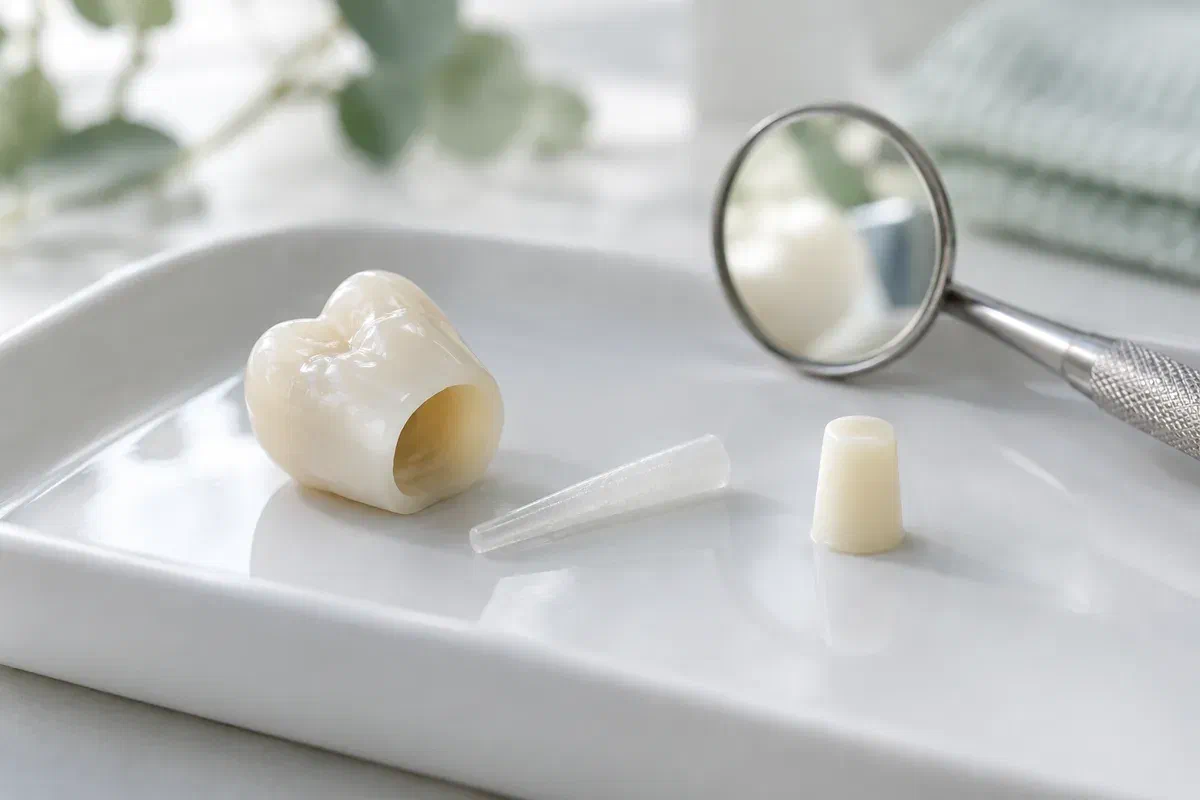
Illustrative discussion of restoring a root-treated tooth before crown placement
Restorative Dentistry

Post-and-Core Restorations in Erin

Before investing in a post, core and crown, it is fair to ask how the tooth is likely to fare in the years ahead. For households in Erin and Hillsburgh, we talk honestly about the outlook, what affects it, and what a post can and cannot do.

Thinking long term

Will it last? A realistic conversation

Most people facing several appointments for one tooth want a sense of the payoff. How many years will it give me? Nobody can promise a figure, but the dentist can explain which features of your tooth tend to help a rebuild and which ones work against it. That conversation is worth having before treatment starts.

First, the parts. A core is built to replace lost tooth so a crown can be fitted over it. In a root-treated tooth with too few remaining walls, a post placed partway down the canal can help keep that core secure. The post is a retainer and nothing else. It cannot hold a cracked root together or replace the natural tooth that gives a crown its best grip.

Dr. Anjum will look at the root and its support, the tooth above the gum, your bite and habits, and the crown proposed. Bring records of the root canal or any crown that has come away. You will hear what favours your tooth, what concerns her, and the alternatives, so you can weigh the investment with clear eyes.

Discuss your tooth’s outlook
Illustrative crown, fibre post, and restorative material samples on a tray
Factors that shape the outlook

Some teeth start with an advantage.

Any post proposal should come with an explanation of the tooth’s prospects. Ask what holds the core and what might limit how long it serves.

How much natural tooth remains

More sound structure above the gum generally means a better base. When very little remains, the dentist looks closely at the root and surrounding bone. A post is considered only if the overall picture still supports a lasting restoration.

Whether the old foundation failed

A crown that came off with its core or post can reveal why it failed. Keep the pieces. Understanding whether cement, core, or tooth gave way guides the new plan and gives a sense of the risks.

How the root canal is doing

The health of the root treatment matters. Ask whether the existing root filling looks sound, whether a core alone is enough, and how the tooth should be protected while the crown is arranged.

A post is not an insurance policy for the tooth. It retains a core when needed, and the root that holds it is still the limiting factor.

What the investment buys

A working tooth, with honest expectations

When a tooth is suitable, a secure core gives the crown the shape and support it needs to function in your bite. Keeping a natural tooth has value, and a well-planned rebuild aims to make the most of the structure that remains.

The outlook depends on more than the post. Cracks, thin root walls, limited bone support and heavy grinding can all shorten the life of a restoration. Ask how each of these applies to you, and how the plan accounts for them.

Patient information: AAE — assessing whether a tooth can be restored

Understand every component

Knowing the separate roles of post, core and crown makes the estimate easier to weigh. Ask to see a diagram so you know which part addresses which problem.

Value the sound tooth

Natural tooth around the crown edge is one of the strongest factors in its favour. Ask how the plan keeps as much as possible, and whether fewer components would serve.

Consider the whole crown

The core is designed for the crown it supports, including fit, form and how it meets your other teeth. Discuss the finished crown before deciding on its foundation.

The road to a finished tooth

Assessment, foundation, crown, then upkeep

The visits depend on the tooth and the crown chosen. If you are coming from Erin, ask how many trips to expect and which steps might be completed together.

  1. Weigh up the tooth’s prospects

    The dentist assesses the remaining tooth, the state of the root canal, the gum and bone around the tooth, and how you bite and clench. X-rays help. Share past breaks, pain or crowns that loosened.

  2. Talk through risks and costs

    This is the time to hear the case for or against a post, the proposed material, and what it cannot fix. Ask for a complete estimate including the core, any temporary and the crown, and whether a specialist view would help.

  3. Rebuild with care

    If a post is needed, space is created in the treated canal while a portion of root filling remains to seal the tip. The core is then built or fitted to match the planned crown.

  4. Crown and long-term follow-up

    The crown is fitted and adjusted for bite and contacts. Ask how often the tooth should be checked and x-rayed in future. If a temporary is on for a while, know how to protect it until your next visit.

Helping it last

What you do at home counts too

Your role changes once the final crown is on, but it does not end. If anything we suggest is hard to keep up, say so and we will help you adjust.

Get through the temporary stage safely

Keep hard and sticky foods off a temporarily restored tooth. A core that feels strong still relies on its crown, so attend the final visit or call ahead to reschedule.

Clean the crown margin for years

The edge where crown meets tooth is where trouble often begins. Brush and floss there daily, and ask about tools if it is hard to reach.

Book regular checks

Root-treated teeth may not hurt when something goes wrong. Regular exams and x-rays help catch problems early. Call between visits if the crown loosens or your bite changes.

Weighing the paths

Different routes, different long-term trade-offs

For each option, ask what it offers over time and what it requires now. The best fit depends on your tooth and your priorities.

When remaining walls offer enough retention

A core without a post

If the tooth can hold a build-up on its own, avoiding a post keeps the root intact. Ask whether that is realistic for you, and how it affects the outlook.

When retention needs extra help

A post-retained core

A post may be advised when the core would otherwise not stay. Design and material are chosen for the root and crown. Ask how the post affects the tooth’s long-term risks.

When the prospects look limited

Comparing against replacement

If the outlook for the tooth is poor, further assessment or removal followed by a replacement option may be discussed. Ask how each path compares in visits, maintenance and expected result.

Outlook questions

What to expect in the years ahead

Nobody can predict exactly how long a restoration will serve, but these answers explain what tends to matter.

(905) 876-4488
How long does a post and core usually last?
There is no fixed lifespan. It depends on the root, how much natural tooth remains, your bite, your oral hygiene and how well the crown fits. Ask your dentist which factors are most relevant to your tooth.
What are the warning signs of a failing post?
A crown that feels loose, a change in bite, gum swelling or tenderness near the tooth, or a bad taste can all be signs. Call promptly if you notice any of these.
Can a root crack years after a post is placed?
It can happen, especially in teeth with thin walls or heavy biting forces. A post does not prevent this. Regular checks help catch problems, and a night guard may be suggested if you grind.
Would an implant be a longer-lasting choice?
Not necessarily. Both a restored natural tooth and an implant have their own risks and maintenance needs, and an implant involves surgery and healing time. Ask the dentist to compare them honestly for your mouth, including the number of visits and the care each needs.
Do I need extra checkups after this treatment?
Your usual recall may be enough, but the dentist might suggest periodic x-rays of the tooth to keep an eye on the root and the crown edge. Because a root-treated tooth may not warn you with pain, these images can matter. Ask what schedule makes sense for you.
Can my checkups be lined up with the rest of the household from Erin?
Often they can. Mention it when booking, and we will try to group appointments so fewer trips are needed. Rural households often find a single longer visit easier than several short ones, and the front desk can help you plan around the clinic’s hours.
Erin post-and-core consultations

An honest view before you commit.

Arrange a consultation at our Bronte Street practice for a root-treated tooth that needs rebuilding. Bring records and any pieces of a crown or post, and we will talk through the outlook, the options and what matters most to you.

If a crown comes off and the tooth hurts or swells, please call the clinic. Online requests are for non-urgent bookings.

Visit Milton Dental Clinic
Unit 1, 342 Bronte St. S, Milton, ON L9T 5B7
Get directions Clinic hours
Monday–Thursday
11am–7pm
Friday–Sunday
By appointment only

Areas we serve

  • Milton
  • Oakville
  • Mississauga
  • Georgetown
  • Halton Hills
  • Acton
  • Campbellville
  • Brampton
  • Burlington
  • Puslinch
  • Rockwood
  • Erin
  • Caledon
  • Etobicoke
  • Old Milton
  • Bronte Meadows
  • Timberlea
  • Dorset Park
  • Dempsey
  • Clarke
  • Beaty
  • Coates
  • Harrison
  • Scott
  • Willmott
  • Ford
  • Bowes
  • Cobden
  • Walker
  • Mountain View
  • Milton Heights
  • Hawthorne Village
  • Valley View
  • Fallingbrook
  • Nassagaweya
  • Trafalgar
  • Esquesing
  • Nelson
  • Brookville
  • Moffat
  • Glen Williams
  • Norval
  • Limehouse
  • Stewarttown
  • Ashgrove
  • Hornby
  • Silver Creek
  • Speyside
  • Scotch Block
  • North Oakville
  • River Oaks
  • Glen Abbey
  • West Oak Trails
  • Palermo
  • Bronte Creek
  • College Park
  • Joshua Creek
  • Uptown Core
  • Preserve
  • Iroquois Ridge
  • Lisgar
  • Meadowvale
  • Meadowvale Village
  • Churchill Meadows
  • Erin Mills
  • Central Erin Mills
  • Streetsville
  • East Credit
  • Creditview
  • Heartland
  • Sheridan
  • Mount Pleasant
  • Credit Valley
  • Huttonville
  • Churchville
  • Springbrook
  • Northwest Brampton
  • Bram West
  • Fletcher's Meadow
  • Fletcher's Creek South
  • Alton Village
  • Orchard
  • Millcroft
  • Headon Forest
  • Tansley
  • Brant Hills
  • Tyandaga
  • Kilbride
  • Lowville
  • Aberfoyle
  • Morriston
  • Arkell
  • Hillsburgh
  • Freelton
  • Carlisle
  • Waterdown
  • Flamborough
  • Mountsberg

How can we help?

Milton Dental Clinic

Have a question about your smile? Choose the option that works best for you.

For urgent dental concerns, please call.
Messages are reviewed during clinic hours.