

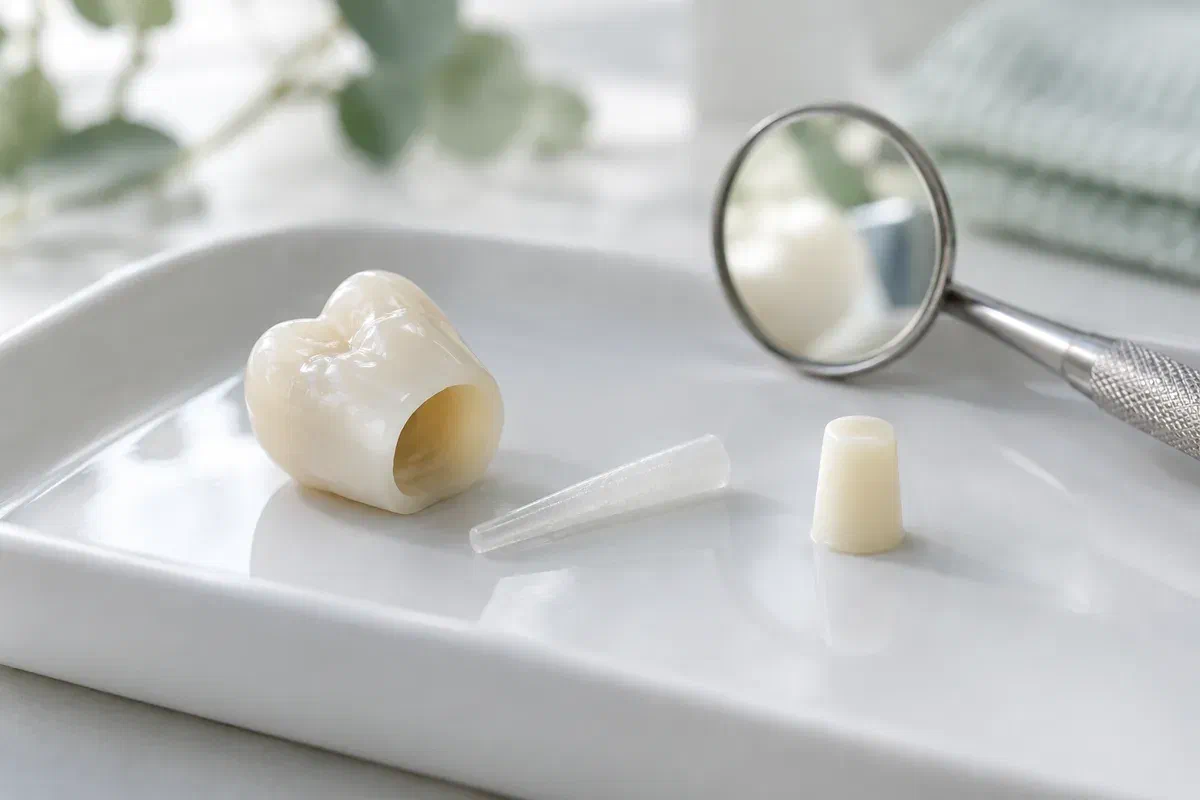
Illustrative discussion of restoring a root-treated tooth before crown placement
Restorative Dentistry

Post-and-Core Restorations in Milton

Your crown came off and something was still stuck inside it. In Milton, we look at what separated, what is left of the tooth, and whether a post and core can give a new crown something to hold.

The piece left in your hand

What was holding that crown in place?

Many people first hear the word post when a crown pops off and a small rod or lump of filling material comes with it. That material is often the core, the build-up that gives a crown its shape to grip. In some root-treated teeth, a post sits partway down the canal to anchor that core when too little natural tooth is left to do it alone.

Each part has its own role. The crown covers and protects, the core fills in missing bulk, and the post, when one is used, helps keep the core attached. None of them recreates a healthy root. How much tooth stands above the gum, what condition the root is in, and what the final crown must do all shape whether this route makes sense.

Our first job is to judge what can sensibly be rebuilt. Bring the crown and any pieces in a clean container, along with notes from earlier root canal treatment if you have them. Dr. Anjum will explain what she sees and outline the choices before anything further is booked.

Ask about rebuilding the tooth
Illustrative crown, fibre post, and restorative material samples on a tray
Signs the base matters

When the problem sits under the crown

A post should be suggested for a reason you can understand. It is fair to ask what will keep the build-up in place and what the dentist found that points toward this plan.

The tooth is mostly gone above the gum

When decay or fracture has taken most of the crown of the tooth, there may be little left to bond a build-up to. The assessment looks below the surface too, at the root and the bone and gum around it. A post only enters the picture if a lasting restoration is still realistic.

The old crown came away with its base

Keep every fragment that came out with the crown, even ones that look like debris. They may include a former core or post. The exam shows what failed and whether the tooth can take a new foundation, instead of assuming the old pieces can be cemented straight back.

A root canal was finished, the crown was not

Some people complete root canal treatment and then the crown appointment slips. If that sounds familiar, ask whether a core on its own will do or whether extra retention is needed, what order the steps go in, and how to protect the tooth until it is covered.

Plenty of root-treated teeth are restored without a post. One is used only when a core needs help staying put, and preparing for it affects the tooth, so it should be weighed carefully.

Why a foundation is used

Something solid for the crown to sit on

In the right tooth, a well-retained core gives the crown the height and outline it needs to fit and function. The aim is a tooth that works in your bite again while keeping as much of your own structure as possible. Every part of the proposal should tie back to that aim.

Material is only one question. Ask about the outlook for the tooth as a whole, because no post can make up for a deep crack or a root with very little wall left. A good decision weighs root health, the support around it, and how hard that tooth works when you chew.

Patient information: AAE — assessing whether a tooth can be restored

Know the three pieces

It helps to know which line on the plan is the post, which is the core, and which is the crown. That makes the estimate and the appointments easier to follow. A diagram or model on the chairside screen can make the terms clear.

Ask what is being kept

Find out how much healthy tooth is left and how the preparation will protect it. More components do not mean better care. The right restoration is simply the one your tooth’s findings support.

Picture the crown first

The foundation is shaped around the crown it will carry, including its fit, contour and place in your bite. Talk through the finished result before agreeing to a post, so each stage makes sense in context.

How the visits unfold

From the first exam to a fitted crown

Most people in Milton can reach us easily between steps, but the number of visits still depends on your tooth and the restoration chosen. Ask what happens at each appointment and when the tooth will be fully covered.

  1. Examine the tooth and its history

    Dr. Anjum checks the remaining tooth, the existing root filling, the gums and your bite. X-rays or older records may help. Mention any ache, past breaks or a crown that keeps coming loose so these are part of the plan.

  2. Talk through the plan and other routes

    You should hear why a post is suggested, which material is in mind and what it cannot do. Ask for the full estimate covering the core, any temporary crown and the final crown. Sometimes more assessment or a specialist’s view comes first.

  3. Place the build-up

    When a post is needed, a channel is shaped inside the treated canal while leaving enough root filling in place to keep it sealed. The post and core are then placed or fitted to the chosen design. Some methods take one visit, others more.

  4. Fit the crown and follow up

    The crown is made and seated, then checked for contact with neighbouring teeth and your bite. Confirm how to care for it and when to come back. If a temporary stays on for a while, know your return date and how to look after it.

Caring for it afterwards

Protect the rebuild until the job is done

What you should do depends on whether a temporary or final crown is on the tooth. If any instruction is hard to manage, tell us and we will help you work out the next step.

Go easy on the temporary

Chew on the other side and skip hard or sticky foods while a temporary is in place. A core can feel firm and still need its crown, so do not let the final visit drift. Call if you need to move that appointment.

Clean right to the edge

Brush and floss around the crowned tooth every day, including the gaps on each side. Ask us to show you an angle that works if it is hard to reach. Covered teeth can still decay at the margin or develop gum trouble.

Notice wobbles or bite changes

Get in touch if the crown moves, your teeth meet differently, or a piece chips off. Try not to wiggle it to find out what is wrong. Keep anything that comes away and tell us what happened when you call.

Ways to rebuild

How much tooth is left shapes the choice

For each sensible option, ask what it offers and what it involves. The advice should fit your tooth, not a habit of always using one system.

When enough tooth remains to hold it

A core without a post

Sometimes the remaining walls can keep a build-up in place without reaching into the canal. Ask whether that applies to you. Skipping a post you do not need leaves more root intact while still giving the crown a base.

When the core needs extra anchorage

A core held by a post

A post may be recommended when a build-up would not otherwise stay secure. The design and material depend on the tooth and the planned crown. Ask about the trade-offs rather than assuming all posts are alike.

When the outlook is uncertain

Rethinking the plan

If the tooth may not hold a dependable repair, the conversation can include further assessment, treatment to improve the situation, or taking the tooth out. Ask what each path involves and whether the likely benefit is worth the full course of care.

Common questions

Your post-and-core questions, answered plainly

The vocabulary here overlaps with other treatments, which can be confusing. Starting with a simple explanation of your own tooth usually helps most.

(905) 876-4488
What should I do with a crown that just fell off?
Rinse it gently, keep it in a small container and bring it with you. Check whether a rod or chunk of material is stuck inside, since that may be a post or core. Avoid chewing on the exposed tooth, and call sooner if there is pain or swelling.
Is a core just a large filling?
It is made from similar restorative materials, but its job is different. A core rebuilds missing tooth bulk so a crown has something to fit over. It is not usually meant to be the final chewing surface on its own, which is why a crown normally follows.
Will a post show through my crown?
Usually it is hidden inside the tooth and covered by the core and crown. Under some very thin or translucent front crowns, material colour can matter, which is one reason the choice of post is discussed. Ask how the material might affect the look of your tooth.
Is a post the same as an implant post?
No. A dental post goes inside a natural tooth that has had root canal treatment and helps hold a core. An implant replaces a missing root in the jawbone. If a treatment note uses the word post, ask which of the two it means.
Does a post make my root stronger?
It is there to hold the core, not to reinforce the root. Making room for it can mean removing some tooth from inside the canal. Ask why retention is needed in your case and how the risks to the root were weighed.
Can I book this at the same time as a checkup?
Often the first assessment can be paired with another visit, depending on time and what the tooth needs. When you call, mention the crown or post concern so the booking allows enough time. Treatment itself is usually scheduled once the plan is agreed.
Post-and-core care in Milton

Bring the tooth, the pieces and your questions.

Book a visit at our Bronte Street practice to talk about a root-treated tooth that has broken down or a crown that needs a new foundation. Bring any old records and the pieces that came out, and we will go through the options together.

If a crown or post has come loose and it hurts, or the area is swelling, please phone the clinic. Online forms are for routine requests.

Visit Milton Dental Clinic
Unit 1, 342 Bronte St. S, Milton, ON L9T 5B7
Get directions Clinic hours
Monday–Thursday
11am–7pm
Friday–Sunday
By appointment only

Areas we serve

  • Milton
  • Oakville
  • Mississauga
  • Georgetown
  • Halton Hills
  • Acton
  • Campbellville
  • Brampton
  • Burlington
  • Puslinch
  • Rockwood
  • Erin
  • Caledon
  • Etobicoke
  • Old Milton
  • Bronte Meadows
  • Timberlea
  • Dorset Park
  • Dempsey
  • Clarke
  • Beaty
  • Coates
  • Harrison
  • Scott
  • Willmott
  • Ford
  • Bowes
  • Cobden
  • Walker
  • Mountain View
  • Milton Heights
  • Hawthorne Village
  • Valley View
  • Fallingbrook
  • Nassagaweya
  • Trafalgar
  • Esquesing
  • Nelson
  • Brookville
  • Moffat
  • Glen Williams
  • Norval
  • Limehouse
  • Stewarttown
  • Ashgrove
  • Hornby
  • Silver Creek
  • Speyside
  • Scotch Block
  • North Oakville
  • River Oaks
  • Glen Abbey
  • West Oak Trails
  • Palermo
  • Bronte Creek
  • College Park
  • Joshua Creek
  • Uptown Core
  • Preserve
  • Iroquois Ridge
  • Lisgar
  • Meadowvale
  • Meadowvale Village
  • Churchill Meadows
  • Erin Mills
  • Central Erin Mills
  • Streetsville
  • East Credit
  • Creditview
  • Heartland
  • Sheridan
  • Mount Pleasant
  • Credit Valley
  • Huttonville
  • Churchville
  • Springbrook
  • Northwest Brampton
  • Bram West
  • Fletcher's Meadow
  • Fletcher's Creek South
  • Alton Village
  • Orchard
  • Millcroft
  • Headon Forest
  • Tansley
  • Brant Hills
  • Tyandaga
  • Kilbride
  • Lowville
  • Aberfoyle
  • Morriston
  • Arkell
  • Hillsburgh
  • Freelton
  • Carlisle
  • Waterdown
  • Flamborough
  • Mountsberg

How can we help?

Milton Dental Clinic

Have a question about your smile? Choose the option that works best for you.

For urgent dental concerns, please call.
Messages are reviewed during clinic hours.