

Illustrative discussion of restoring a root-treated tooth before crown placement
Restorative Dentistry

Post-and-Core Restorations in Oakville

A treatment plan that lists a post, a core and a crown can feel like a lot to take in. For visitors from Oakville, we explain each line in plain terms and how it connects to the tooth you still have.

Reading your treatment plan

Three line items, one tooth

You were told a tooth needs a crown, and then the estimate arrived with extra entries on it. Seeing post, core and crown listed separately raises a fair question: are all three really necessary? The answer depends on how much of your tooth is left and how it was treated before.

Think of the crown as the roof, the core as the walls rebuilt beneath it, and the post as an anchor that sometimes holds those walls in a root-treated tooth. A post does not act as a new root, and it cannot repair a tooth that is badly cracked. Remaining height above the gum, root health and the job the crown must do all decide whether it belongs in the plan.

Our approach is to show you the evidence first. Bring the estimate you received, any x-rays and notes about earlier root canal work. Dr. Anjum will go through what she finds, explain the reasoning behind each component, and set out alternatives before you commit.

Get each stage explained
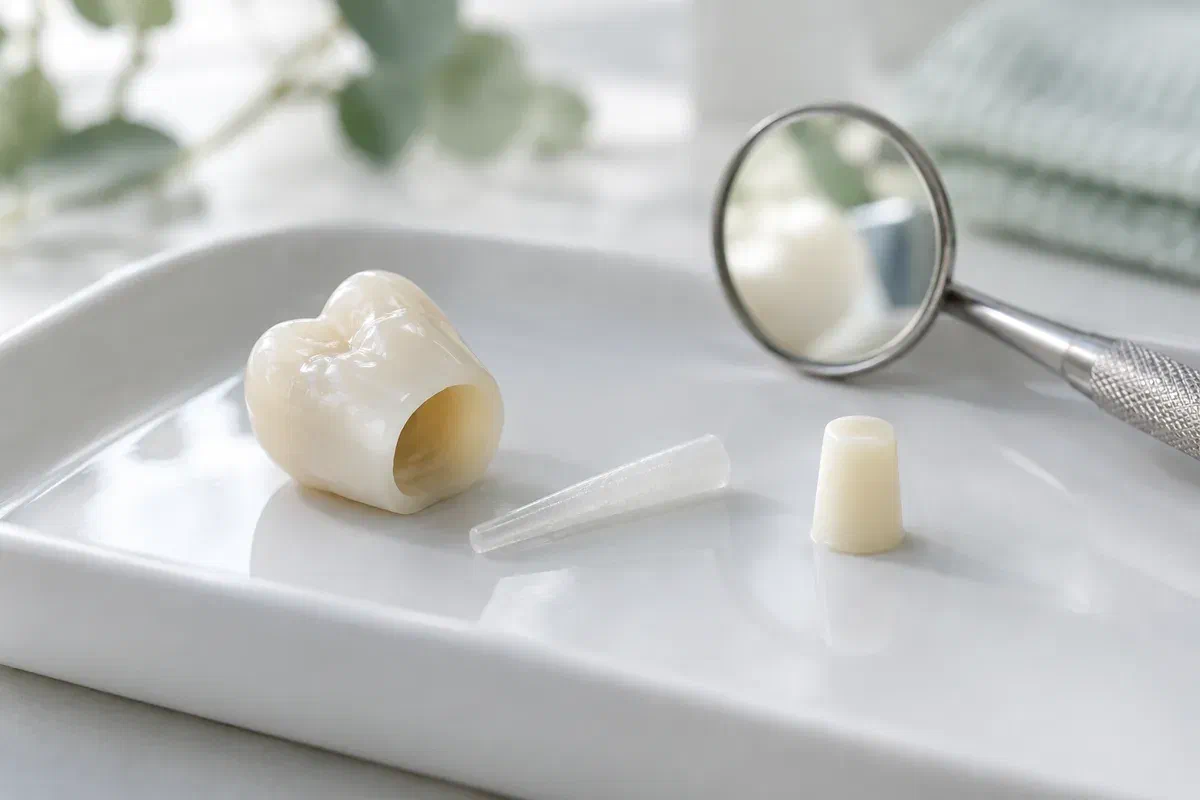
Illustrative crown, fibre post, and restorative material samples on a tray
What a plan should explain

Questions worth asking before you agree

Every component in a proposal should have a stated purpose. Ask what is meant to hold the core in place and which findings point to that choice.

How much tooth is above the gum?

When a tooth has broken down heavily, there may be little to rebuild on. The dentist should assess the root and its surrounding support as well as what you can see. A post makes sense only if restoring the tooth remains a reasonable plan overall.

Why did the last crown come off?

If an earlier crown fell out carrying material inside it, keep all the pieces. Some may be part of an old core or post. Understanding what separated, and why, guides whether the tooth can take a new foundation or needs a different approach.

What happens after the root canal?

Root canal treatment is often followed by a recommendation for a crown. Ask whether a core alone would be enough, or whether extra retention is justified, and what temporary protection the tooth needs while the next steps are arranged.

A root canal does not always lead to a post. The post exists to keep a core in place when that is genuinely needed, and preparing for one affects the tooth structure.

The purpose behind it

Each layer should earn its place.

In a suitable tooth, a secure core gives the crown the shape it needs to fit and to handle chewing. The point is a working tooth that keeps as much of its own structure as it can. If a component on your plan cannot be linked to that point, ask about it.

Look beyond material names. Ask about the tooth’s long-term outlook, since no post can offset a deep fracture or very little natural tooth. Root condition, surrounding support and the forces on that tooth should all inform the decision.

Patient information: AAE — assessing whether a tooth can be restored

Match each line to a job

Once you know which charge is the post, which is the core and which is the crown, the estimate and schedule become easier to follow. A sketch or model can help when the words are new.

Ask what is being preserved

Find out how much sound tooth remains and how the preparation will protect it. A longer list of parts is not automatically better care. What counts is whether the findings support each step.

Start with the crown in mind

The foundation is designed around the crown it supports, including its fit, profile and place in your bite. Agree on the finished restoration before deciding on what goes underneath.

What each visit involves

Following the plan from root to crown

Appointment numbers vary with the tooth and the restoration design. If you are coming from Oakville, ask which steps can be combined and when the tooth will have its permanent cover.

  1. Assess the tooth and past care

    The dentist checks the remaining structure, the existing root filling, the gums and your bite. X-rays and earlier records may add detail. Mention discomfort, earlier fractures or crowns that keep loosening so they shape the plan.

  2. Explain the reasoning and the costs

    Each charge on the plan should come with a reason, including the post, the material in mind and its limits. Ask for a full estimate that includes the core, any temporary and the final crown. Further tests or a specialist referral may be advised first.

  3. Build the foundation

    If a post is needed, a space is prepared in the treated canal while keeping enough root filling to maintain the seal. Depending on the design, the foundation is built directly at that appointment or made to measure and fitted at a later one.

  4. Fit and review the crown

    The crown is made and seated, with its contacts and bite checked. Confirm the home care and when to return. If a temporary will stay on for some time, know your next date and how to look after it.

Between and after visits

Looking after a tooth mid-rebuild

Care is different with a temporary than with a final crown. If any instruction does not fit your routine, tell the team and we will help you work through it.

Spare the temporary

Keep hard, sticky or very chewy foods away from a temporarily restored tooth. Feeling solid does not mean the core can go without its crown for long. Let us know early if the completion appointment no longer works.

Clean where crown meets tooth

Daily brushing and flossing around the tooth and its neighbours still matter once the crown is on. Ask for help with technique if the spot is tricky. The natural tooth underneath can still decay or develop gum problems.

Report any shift

Call if the crown feels loose, your teeth meet differently, or a fragment breaks off. Avoid rocking it to check. Keep any piece that comes away and explain what happened when you call.

Comparing approaches

Different teeth, different foundations

For each reasonable option, ask what it adds and what it requires. The advice should suit your tooth rather than reflect one routine system.

When the remaining walls give enough grip

Core only

A build-up can sometimes be held by the existing tooth without entering the canal. Ask whether that fits your situation. Leaving out a post you do not need keeps more of the root intact.

When retention needs reinforcing

Core retained by a post

A post may be part of the plan when a core would otherwise not stay secure. Which kind is used comes down to the root’s shape and the crown planned. Ask about benefits and risks rather than treating all posts as interchangeable.

When the tooth’s future is doubtful

A different restorative path

If the tooth may not support a lasting repair, further assessment, treatment to improve its condition, or extraction may be discussed. Ask what each would involve and whether the benefit justifies the full course of care.

Plan and estimate questions

Making sense of the proposal

Restorative terms are easy to mix up. Having someone walk you through your own tooth is often the quickest route to clarity.

(905) 876-4488
Why are the post, core and crown billed separately?
Each is a distinct procedure with its own materials and time. Not every tooth needs all three. Ask which items apply to you, which are optional, and whether earlier root treatment or temporaries appear as separate entries.
Could a core be enough without the post?
Yes, when the remaining tooth can hold a build-up securely. The dentist judges that from the height and thickness of the walls. Ask what was measured and why extra retention was or was not recommended.
Is the word post referring to an implant here?
In this context, no. A post goes inside a natural tooth that already had root canal treatment. Implants are placed in bone only after a tooth has been lost. If a plan is unclear, ask which one is meant.
Is it reasonable to want a second opinion on a post?
You are welcome to. Ask for copies of your x-rays and the written plan so another dentist can review them. A clear explanation of the findings is a reasonable expectation either way.
Why might two dentists suggest different materials?
Post and core materials have different properties, and choice can depend on the tooth, the crown and clinical judgement. Ask each dentist to explain their reasoning for your specific tooth rather than assuming one system is always right.
How do I plan the visits from Oakville?
Ask at the first appointment how many stages are expected and which might be combined. Booking the crown visit before you leave can help you avoid gaps. Call ahead if anything changes with the temporary before you set out.
Post-and-core restorations for Oakville

Bring the plan. We’ll walk you through it.

Book time at our Bronte Street practice to go over a proposed post, core and crown, or a root-treated tooth that has broken down. Bring the estimate, any x-rays and your list of questions.

If a crown or post has loosened and you are in pain, please phone us rather than booking online. Online requests suit non-urgent questions.

Visit Milton Dental Clinic
Unit 1, 342 Bronte St. S, Milton, ON L9T 5B7
Get directions Clinic hours
Monday–Thursday
11am–7pm
Friday–Sunday
By appointment only

Areas we serve

  • Milton
  • Oakville
  • Mississauga
  • Georgetown
  • Halton Hills
  • Acton
  • Campbellville
  • Brampton
  • Burlington
  • Puslinch
  • Rockwood
  • Erin
  • Caledon
  • Etobicoke
  • Old Milton
  • Bronte Meadows
  • Timberlea
  • Dorset Park
  • Dempsey
  • Clarke
  • Beaty
  • Coates
  • Harrison
  • Scott
  • Willmott
  • Ford
  • Bowes
  • Cobden
  • Walker
  • Mountain View
  • Milton Heights
  • Hawthorne Village
  • Valley View
  • Fallingbrook
  • Nassagaweya
  • Trafalgar
  • Esquesing
  • Nelson
  • Brookville
  • Moffat
  • Glen Williams
  • Norval
  • Limehouse
  • Stewarttown
  • Ashgrove
  • Hornby
  • Silver Creek
  • Speyside
  • Scotch Block
  • North Oakville
  • River Oaks
  • Glen Abbey
  • West Oak Trails
  • Palermo
  • Bronte Creek
  • College Park
  • Joshua Creek
  • Uptown Core
  • Preserve
  • Iroquois Ridge
  • Lisgar
  • Meadowvale
  • Meadowvale Village
  • Churchill Meadows
  • Erin Mills
  • Central Erin Mills
  • Streetsville
  • East Credit
  • Creditview
  • Heartland
  • Sheridan
  • Mount Pleasant
  • Credit Valley
  • Huttonville
  • Churchville
  • Springbrook
  • Northwest Brampton
  • Bram West
  • Fletcher's Meadow
  • Fletcher's Creek South
  • Alton Village
  • Orchard
  • Millcroft
  • Headon Forest
  • Tansley
  • Brant Hills
  • Tyandaga
  • Kilbride
  • Lowville
  • Aberfoyle
  • Morriston
  • Arkell
  • Hillsburgh
  • Freelton
  • Carlisle
  • Waterdown
  • Flamborough
  • Mountsberg

How can we help?

Milton Dental Clinic

Have a question about your smile? Choose the option that works best for you.

For urgent dental concerns, please call.
Messages are reviewed during clinic hours.