Thin, short walls after decay
Heavy decay or a large old filling can leave little to bond a core to. The dentist checks the root, the gum and the bone too. A post is considered only if the tooth is still a good candidate for a lasting crown.


Sometimes the most protective plan for a root-treated tooth is the simplest one. If you are coming from Rockwood, we look first at whether a core alone can do the job, and add a post only when the tooth genuinely calls for it.
It is easy to assume that a tooth needing a crown after a root canal will also need a post. In practice, many such teeth do well with a core and crown alone. Every bit of root left untouched is structure that keeps working for you, which is why the question of whether a post is needed deserves a careful answer.
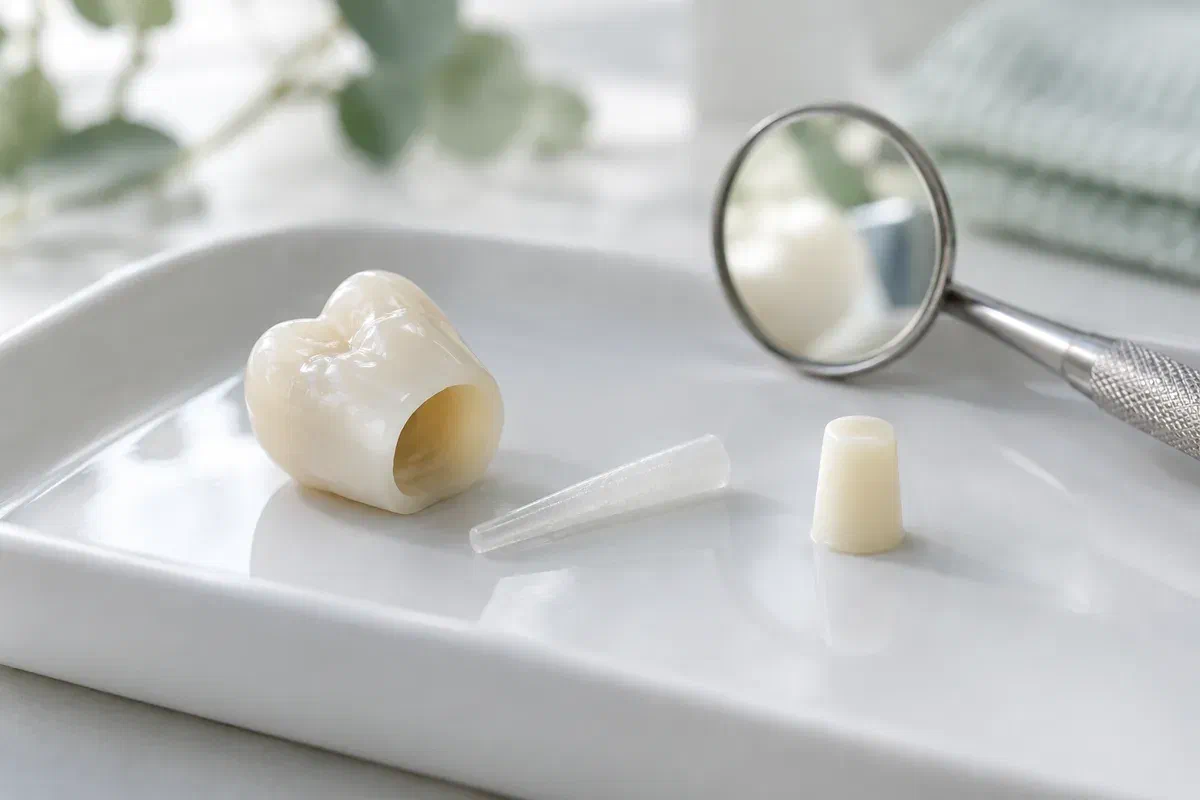
Here is the distinction. A core replaces lost tooth so the crown has a solid shape to sit on. A post, set partway into the treated canal, is only there to keep that core from coming loose when the remaining walls are too few or too short. Making room for a post means removing some material inside the root, and it does nothing to strengthen it. A cracked or very thin root is not improved by one.
Dr. Anjum will look at what is left above the gum, the root and its support, and the crown planned, and then explain the least invasive approach that still offers a dependable result. Bring root canal records or a crown that has come off, and ask as many questions as you need.
Any recommendation for a post should explain why a core alone is not enough. Ask what was found and how it was measured.
Heavy decay or a large old filling can leave little to bond a core to. The dentist checks the root, the gum and the bone too. A post is considered only if the tooth is still a good candidate for a lasting crown.
If a crown comes off with something attached, it might be the old core or a post. Keep the pieces. Looking at what separated, and why, helps determine whether a simpler rebuild could work this time.
This is the ideal time to ask whether a core by itself will be enough. Ask, too, about the order of treatment and how to protect the tooth until the crown is fitted.
A post is a tool for retention, not a default step. Placing one when it is not needed takes away root structure without a clear benefit.
Keeping the plan as simple as the tooth allows has real advantages. A well-bonded core on sound walls can give the crown the base it needs while leaving the root intact. The goal is a functioning tooth that keeps as much of itself as possible, for as long as possible.
Conservative does not mean ignoring problems, though. If there truly is too little tooth to hold a core, skipping the post could lead to failure. Ask how the root, the support around it and your bite were considered in deciding.
Patient information: AAE — assessing whether a tooth can be restored
Ask the dentist to show you, on a model or your x-ray, what the post, core and crown would each do. Then it is easier to see whether all three are needed.
Ask how much healthy tooth remains and how the preparation will keep it. A plan with fewer parts is often the right one, provided the findings support it.
The core is shaped for the crown, including its fit, form and place in your bite. Agreeing on the crown first helps show how much foundation is really required.
The visits depend on whether a post is used and the type of crown. When you travel in from Rockwood, ask what each appointment covers and when the crown will be finished.
The dentist examines the walls that remain, the condition of the earlier root canal, the surrounding gum and bone, and how your teeth meet. X-rays help. Share any discomfort or history of loose crowns.
You should hear whether a core alone is expected to hold, or why a post is advised, with the material and its limits. Ask for an estimate covering the core, any temporary and the final crown.
Where possible, the core is bonded to the existing walls. If a post is required, only as much canal space is prepared as needed, leaving a sealing portion of root filling near the tip.
The crown is fitted and its contacts and bite are checked. Confirm daily care and the review plan. If a temporary is in place for a time, know how to protect it and when to come back.
There is slightly different advice with a temporary than with the final crown. Tell us if any instruction is a struggle, and the team will help.
Skip hard, chewy and sticky foods on that side until the final crown is on. A core that feels secure is still waiting for its protection. Keep the next appointment or call to move it.
Brush and floss daily where the crown meets the tooth and between it and the next tooth. If it is hard to reach, ask for a different technique.
Call if the crown loosens, the bite shifts or a piece breaks off. Avoid testing it by pushing. Save anything that comes away for the dentist to see.
These questions often come up when people learn a post may not be needed. Your own x-ray is the best place to see why.
Arrange an appointment at our Bronte Street practice to talk about a root-treated tooth or a proposed post. Bring records and any loose pieces, and we will explain the most conservative option that suits your tooth.
Please phone if a crown has come off and the tooth hurts, or you notice swelling. Online booking is for routine requests.
