

Illustrative dental consultation about a newly rough or broken filling
Restorative Dentistry

Replacement of Broken Fillings in Etobicoke

Coming from Etobicoke, the aim is to make each trip count. We help you prepare by phone, examine the broken filling carefully, and plan the repair so you know how many visits to expect.

Making the trip worthwhile

One well-planned visit beats three rushed ones

Travelling a fair way for dental care changes how you approach a broken filling. Rather than coming in simply to have it looked at, it makes sense to arrive with the right amount of time booked and a good idea of what may happen. That starts with understanding the break: material only, enamel alongside it, or something more serious that has been hidden until now.

We cannot confirm the answer until the tooth is examined, but a clear phone description helps us prepare. A limited fault may be repairable; a fractured restoration might need full replacement; a tooth missing significant structure may need a different, sometimes multi-step, restoration. A small fragment can still belong to a larger problem.

Before you set out from Etobicoke, call and tell us when it broke, whether the tooth aches, reacts to cold or sweet, or hurts to bite on. Store any piece in a little container rather than refitting it. With that, we can suggest an appointment length and talk you through the findings on the day.

Plan your broken filling visit
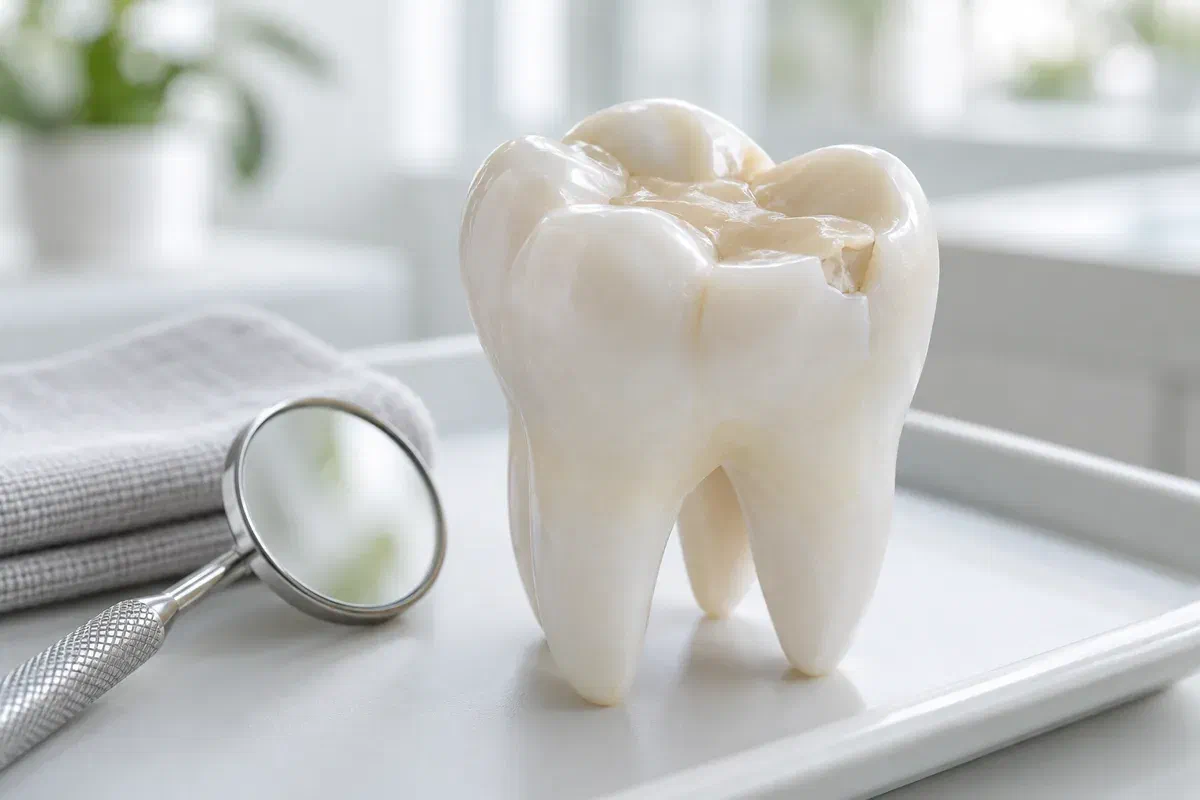
Illustrative molar model showing a small defect in a tooth-coloured filling
Before you travel

Signs to describe, and signs to act on quickly

Some symptoms simply help us plan; others mean you should be seen promptly, possibly closer to home. Tell us what you notice, including any sharp area catching your tongue or cheek.

A rough or cutting edge

A sharp patch may be exposed filling or a broken piece of enamel. Try not to file or pick at it. If it is slicing your cheek, tearing floss, or trapping food, mention it so we can advise on timing and how to protect the area until you arrive.

Sensitivity, aching, or tenderness

Describe what triggers it and whether it fades quickly or keeps going. A lingering or throbbing ache, especially one that disturbs sleep, may need prompt attention. If it worsens and the trip is not practical, seeking care closer to home is reasonable.

A history of breaks

Repeated failures on the same tooth may change the type of repair we plan, and possibly the number of visits. Share when earlier work was done. Copying the same restoration again without looking at the bite and tooth may not solve the problem.

Even if it does not hurt, plan to have it checked. A comfortable tooth may still have a weakened restoration or enamel left behind by the break.

What a good repair delivers

Fewer surprises, now and later

When the trip is longer, a durable result matters even more. The repair should be shaped to the remaining tooth, restore a chewing surface that meets the teeth opposite, make firm contact with neighbouring teeth, and leave smooth edges for cleaning. The dentist will explain whether a direct filling suits or a larger restoration should be considered.

Understanding the reason for the break reduces the chance of an unexpected return. A wide older filling, decay, a cracked cusp, or forceful biting can each change what is recommended. That context helps you choose a plan with realistic expectations, rather than one focused only on the visible gap.

Patient information: Cleveland Clinic — dental filling care and complications

A plain explanation of scope

Ask which part has failed and what can be kept. A limited fix and a complete replacement differ in time and intervention, and knowing why one is recommended helps you plan around it.

A tooth ready for daily meals

Tell the dentist where food has been catching and how the tooth felt before. Restoring the correct contour and contact helps with chewing and cleaning, so your next visit can be a routine one.

Thinking about the cause

Mention grinding, clenching, chewing ice, or a recent bite change. These details do not establish a cause by themselves, but they can guide the repair and any steps to protect it between visits.

How we organise your appointment

Prepared by phone, planned in the chair

Some repairs are finished in one visit, while others start with a temporary and need a second appointment. Ask which is likely so you can plan your travel.

  1. A thorough examination

    The dentist inspects the filling and tooth, discusses symptoms, and takes an X-ray if it would add information. The goal is to understand the whole picture so the plan does not change later. Mention any earlier symptoms.

  2. A plan you can schedule around

    You will hear the options, the material, the expected fee, and any uncertainty until the old filling is out. Ask how many appointments the plan may involve and what would change if more damage is found.

  3. The repair itself

    Freezing and isolation are used as appropriate. Failing material and affected tooth are removed, then the new restoration is placed, or a temporary protects the tooth until a further visit. The approach depends on the defect and support.

  4. A final check before you head home

    Your bite and the contours of the repair are reviewed. Ask about eating, cleaning, and follow-up, especially for a temporary. If the tooth feels high or sharp once the numbness fades, call us so we can arrange a review.

Looking after it between visits

Small precautions protect a long trip

Follow the instructions for your material and stage of care. If a symptom changes while you are waiting, call us; if it becomes urgent and the trip is not practical, seek care closer to home.

Keep the tooth out of harm's way

Avoid biting hard foods on the broken side, and choose temperatures that do not trigger sensitivity. Leave the area alone rather than probing it, and do not try to pull away pieces that still seem attached.

Take care with a temporary

Wait for the numbness to pass before eating, and follow any limits for an interim restoration. Ask when normal chewing can resume. If a temporary feels loose, call us to discuss what to do.

Report changes promptly

Keep up brushing and cleaning between teeth as advised. Contact the clinic if your bite seems uneven, floss catches, or soreness is rising. A clear description helps us decide whether you need to come in sooner.

Patient information: NHS Wales — care while awaiting restoration assessment

Repair options and visit count

Each option, and what it means for your schedule

Ask why a given option fits your tooth, and how many appointments it is likely to need. The material you had before is not always the best answer now.

If the existing filling is sound

Repair the broken area

A localized repair may be possible when the surrounding restoration and tooth are in good condition. The dentist judges whether that will address the defect properly. Ask what would be retained and what renewed.

If the tooth can support it

Replace with a new filling

A direct filling can often be placed in a single visit when enough healthy tooth remains. Discuss material in relation to the cavity size, moisture control, and biting load. The aim is a repair suited to the tooth today.

If strength or the nerve is affected

Plan a larger restoration

Onlays, crowns, and root canal treatment are typically planned over more than one appointment. If the tooth needs that kind of care, ask why, what would be done at each visit, and how a temporary would protect it between appointments.

Planning questions

Answers for a longer trip

Not sure if the piece you found is tooth or filling material? That is fine. Call, explain what happened, and we will help you plan from there.

(905) 876-4488
Can I combine the broken filling repair with my checkup?
Sometimes it is possible to arrange both around the same time, depending on availability and the work needed. Ask when you call. The priority is assessing the broken filling, and the team can tell you whether combining appointments is practical.
What if my temporary filling comes loose before I can return?
Call the clinic to describe what happened. Avoid chewing on that side and keep the area clean. If you have severe pain or swelling and cannot travel, seek dental care closer to home. Do not use household glue to reattach it.
Should I see a closer dentist if the tooth becomes very painful?
If pain is severe, swelling develops, or the trip is not realistic, getting prompt care nearer to you is the sensible choice. Trouble breathing or swallowing is a reason for emergency medical care. You can come back to us for ongoing treatment afterwards.
Will I know in advance how many visits the repair needs?
A phone description gives a rough idea, but the examination decides. If the dentist expects more than one appointment, ask what each visit involves and how the tooth will be protected in between.
Is there a risk in leaving a broken filling for a few weeks?
A broken filling can trap food, allow the tooth to weaken further, or break more under chewing pressure. That does not mean every case is urgent, but it is better to arrange an assessment than to wait and see. Call if symptoms change.
How do I schedule a visit from Etobicoke that fits a workday?
Mention your timing when you call. Weekday hours run Monday to Thursday, 11am to 7pm, with Friday to Sunday by appointment only. Describing the break also helps the team suggest an appointment length that suits the likely repair.
From Etobicoke to Bronte Street

Make the trip once, and make it count.

Our Bronte Street practice can assess a broken filling and plan a repair around your schedule. Bring details of the break, any piece you kept, and your questions about how many visits the tooth may need.

For heavy pain, facial swelling, or an edge cutting your mouth, call us or seek closer urgent care. Online requests are for non-urgent visits.

Visit Milton Dental Clinic
Unit 1, 342 Bronte St. S, Milton, ON L9T 5B7
Get directions Clinic hours
Monday–Thursday
11am–7pm
Friday–Sunday
By appointment only

Areas we serve

  • Milton
  • Oakville
  • Mississauga
  • Georgetown
  • Halton Hills
  • Acton
  • Campbellville
  • Brampton
  • Burlington
  • Puslinch
  • Rockwood
  • Erin
  • Caledon
  • Etobicoke
  • Old Milton
  • Bronte Meadows
  • Timberlea
  • Dorset Park
  • Dempsey
  • Clarke
  • Beaty
  • Coates
  • Harrison
  • Scott
  • Willmott
  • Ford
  • Bowes
  • Cobden
  • Walker
  • Mountain View
  • Milton Heights
  • Hawthorne Village
  • Valley View
  • Fallingbrook
  • Nassagaweya
  • Trafalgar
  • Esquesing
  • Nelson
  • Brookville
  • Moffat
  • Glen Williams
  • Norval
  • Limehouse
  • Stewarttown
  • Ashgrove
  • Hornby
  • Silver Creek
  • Speyside
  • Scotch Block
  • North Oakville
  • River Oaks
  • Glen Abbey
  • West Oak Trails
  • Palermo
  • Bronte Creek
  • College Park
  • Joshua Creek
  • Uptown Core
  • Preserve
  • Iroquois Ridge
  • Lisgar
  • Meadowvale
  • Meadowvale Village
  • Churchill Meadows
  • Erin Mills
  • Central Erin Mills
  • Streetsville
  • East Credit
  • Creditview
  • Heartland
  • Sheridan
  • Mount Pleasant
  • Credit Valley
  • Huttonville
  • Churchville
  • Springbrook
  • Northwest Brampton
  • Bram West
  • Fletcher's Meadow
  • Fletcher's Creek South
  • Alton Village
  • Orchard
  • Millcroft
  • Headon Forest
  • Tansley
  • Brant Hills
  • Tyandaga
  • Kilbride
  • Lowville
  • Aberfoyle
  • Morriston
  • Arkell
  • Hillsburgh
  • Freelton
  • Carlisle
  • Waterdown
  • Flamborough
  • Mountsberg

How can we help?

Milton Dental Clinic

Have a question about your smile? Choose the option that works best for you.

For urgent dental concerns, please call.
Messages are reviewed during clinic hours.