

Illustrative dental consultation about a newly rough or broken filling
Restorative Dentistry

Replacement of Broken Fillings in Milton

Your tongue found a gap at dinner and now it keeps going back. Our Milton team can examine what broke, shield the tooth that remains, and talk you through a repair that fits what we find.

When a filling gives way

The gap you can feel is only part of the story

Most people discover it in an ordinary moment: a bite of toast, a hard crunch, then a gritty bit on the tongue and a ledge that was smooth yesterday. The obvious question is what came away. It might be filling material, a sliver of enamel next to it, or a sign that something underneath has been weakening for a while.

That is why the visit starts with looking rather than drilling. Some small defects can be patched. A filling that is cracked through may need to come out and be redone. When the tooth itself has lost strength, a different kind of restoration can enter the discussion. A tiny missing piece can still hide a bigger issue.

Since you are already in Milton, getting seen soon is usually simple. When you call, say when it happened and whether the tooth now hurts, reacts to cold or sweets, or feels awkward to chew on. Keep any piece you found, but leave it out of your mouth, and we will go over the findings with you before anything is decided.

Book a check of a broken filling
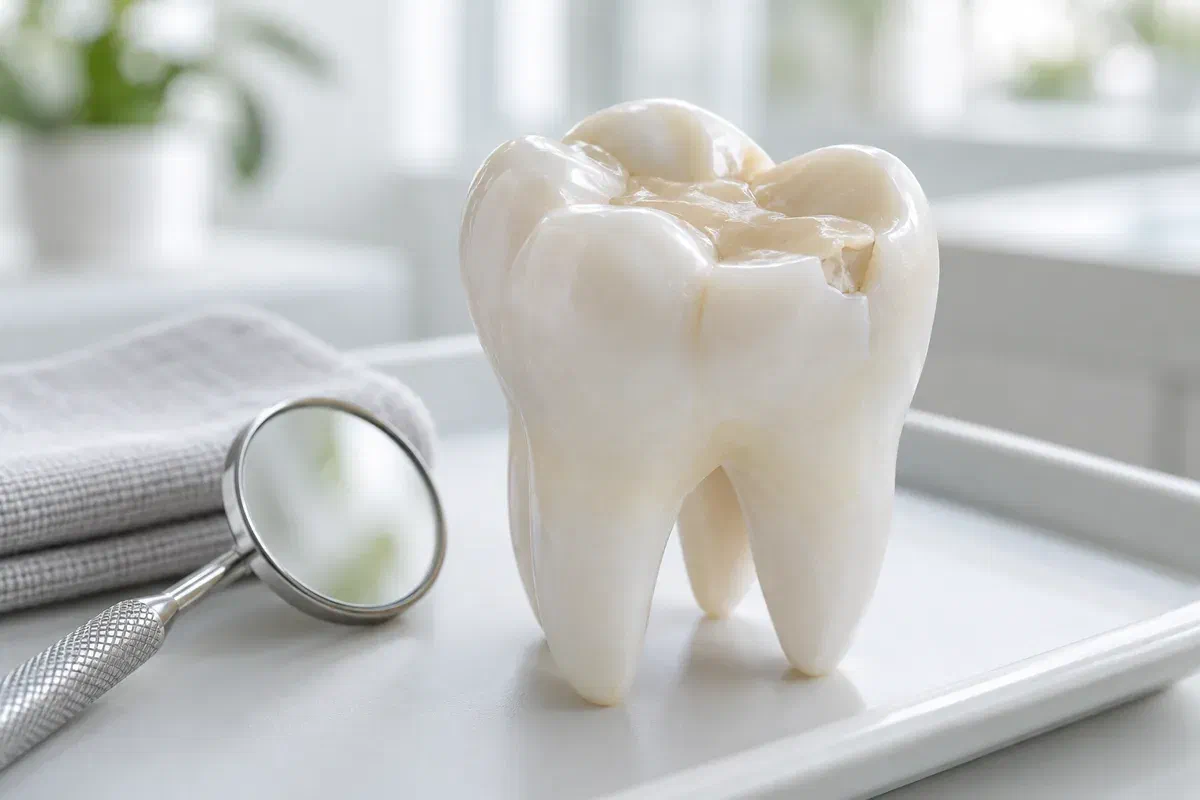
Illustrative molar model showing a small defect in a tooth-coloured filling
Signs worth describing

Three changes we ask about on the phone

Breaks vary, and so do the symptoms that come with them. Tell us what you are feeling and whether a sharp spot is scraping your tongue or cheek, so we can judge how soon to see you.

An edge that snags

A jagged spot may be the margin of the old filling or enamel that cracked off beside it. Resist the urge to smooth it with a nail file or pick. Let us know if it shreds floss, traps food, or rubs the inside of your cheek, because that shapes the advice we give.

Sensitivity that is new

Note whether cold, heat, sugar, or biting down sets it off, and how long the feeling lingers once the trigger has gone. A brief zing and an ache that hangs on point in different directions, and both help the dentist understand the state of the tooth and its nerve.

The same tooth, again

When one filling keeps breaking, the tooth, the material and your bite all deserve a closer look. Tell us roughly when the earlier repairs were done. Rebuilding the same shape a third time without asking why it failed may simply repeat the problem.

Feeling fine is not the same as being fine. A tooth with a broken filling can be comfortable while the remaining restoration or enamel around it is poorly supported.

The goal of the repair

A surface that works, and a reason for the break

A good replacement rebuilds the tooth to suit what is left of it. That means a chewing surface that meets the opposite teeth properly, a tight contact with the neighbours, and edges you can keep clean. The dentist will explain whether a direct filling makes sense or whether something larger should be weighed.

The appointment is also the right time to ask why it happened. An old, wide restoration, new decay, a cracked cusp, or strong biting forces can each change what is advised. Knowing those findings lets you pick a plan with honest expectations, instead of treating the visible hole as the whole job.

Patient information: Cleveland Clinic — dental filling care and complications

Clarity on how much is redone

Ask which section is failing and whether intact material can stay. Patching a corner and replacing a whole filling are very different amounts of work, and you deserve a clear reason for the extent being proposed.

A shape built for real meals

Talk about the contour and contact that need restoring, especially if food has started packing in beside the tooth. Mention how the tooth felt before it broke, so the dentist can account for changes beyond the missing fragment.

A look at what may have contributed

Share habits such as night grinding, clenching at your desk, or crunching ice, along with any recent shift in how your teeth meet. None of these proves the cause by itself, yet each can inform the repair and the protective advice that follows.

How the appointment unfolds

Four steps from broken to rebuilt

Depending on what is found and how much time the booking allows, you may leave with a finished repair or a temporary one. It is fair to ask which it will be before you sit down.

  1. Find the extent of the damage

    The dentist looks at the filling and the tooth around it, asks about your symptoms, and may take an X-ray if it would help. The goal is to see past the missing corner. Mention any twinges you had before it actually broke.

  2. Talk through the plan

    You will hear the options, the material suggested, the expected fee, and any uncertainty about what lies beneath. Ask what happens if more care is needed once the old filling is out. Nothing should start until the plan makes sense to you.

  3. Clean out and rebuild

    Freezing and isolation are used as needed. The failing material and any affected tooth structure are removed, and then the chosen restoration is placed, or the tooth is covered temporarily. The technique depends on the size of the defect and how much support remains.

  4. Confirm the bite and contours

    Before you leave, the dentist checks how your teeth come together and how the new surface is shaped. Ask about chewing, cleaning, and follow-up, especially if the repair is interim. If anything feels high or sharp later, tell us rather than living with it.

Looking after the tooth

Go easy on it while it waits, and after

Instructions depend on the material and on whether the repair is temporary or final. If a symptom changes while you are waiting to be seen, call and ask.

Chew on the other side for now

Keep hard or crunchy food away from the broken tooth until it is treated. Pick drink and food temperatures that do not set off sensitivity. Try not to explore the gap with your tongue or fingers, and leave any loose-looking but attached material alone.

Follow what you are told afterwards

Let the freezing wear off before eating, and stick to any extra limits that come with a temporary filling. Ask when normal chewing can resume. Your new restoration may come with different guidance than the one it replaced.

Tell us if something is off

Carry on brushing and cleaning between your teeth as advised. Get in touch if your bite seems uneven, floss keeps catching, or soreness is building. Describe exactly what you notice rather than waiting for another piece to come away.

Patient information: NHS Wales — care while awaiting restoration assessment

Repair options

What remains of the tooth guides the choice

Ask why a particular option fits your damage. The material you had before is not automatically the right answer once a tooth has changed.

If the rest is still sound

Patch a small defect

A targeted repair may be possible when the surrounding filling and tooth are in good enough shape. The dentist judges whether that will deal with the defect properly. Ask which parts would stay and which would be renewed.

If there is enough healthy tooth

Place a new filling

A fresh direct filling can work when sound tooth remains to hold it. Discuss materials in light of the cavity size, how dry the area can be kept, and the forces it will face. The aim is a repair that suits the tooth as it is now.

If support or the nerve is involved

Consider a larger restoration

A weakened tooth may be better served by a crown or partial-coverage restoration. If the pulp needs treatment, a new filling on its own will not be enough. Ask which finding changes the plan and in what order the steps would happen.

Questions we hear across Milton

Answers for the days after a filling breaks

You do not need to know whether the fragment was filling or tooth before you book. Start with what happened and how the tooth feels now.

(905) 876-4488
Is it safe to wait for my next routine cleaning?
It is usually better not to. A broken filling leaves an edge or opening that can trap food and let the tooth weaken further, even if it feels comfortable. Call to describe the break, and the team can suggest how soon you should be seen.
How can I keep the area clean until my appointment?
Brush gently as usual and clean between your teeth with care, guiding floss out sideways if it catches rather than snapping it up. Rinsing with water after meals can help clear food. Avoid poking at the gap with toothpicks or other tools.
Will I need freezing for the replacement?
Often, yes, because removing old material and preparing the tooth can be uncomfortable without it. The dentist will discuss local anaesthetic based on the size and depth of the repair. Mention any past reactions or worries about freezing when you book.
My metal filling broke. Will the new one be tooth-coloured?
It may be, but material choice depends on the size of the cavity, where the tooth sits, how dry it can be kept, and the biting forces involved. Ask the dentist to explain the options that suit this particular tooth and why one may be preferred.
Is a chipped filling really something to book for?
Yes. Even a small chip deserves a look, though it does not always mean the whole filling has to go. The decision depends on the remaining restoration and the tooth around it, so ask why a small repair is or is not suitable in your case.
What should I do if the new filling makes my bite feel uneven?
Give us a call and explain what you notice, particularly if that tooth meets first when you close. A short review can check the bite and look for other reasons for discomfort. There is no need to wait for your next checkup or keep testing it.
Broken filling care here in Milton

Come in and let us take a look.

Stop by our Bronte Street practice to have the damaged filling assessed. Bring what you remember about the moment it broke, any piece you saved, and the questions you have about getting back to everyday chewing.

For pain, swelling, or a sharp edge that is injuring your mouth, please phone us. Online requests are best for non-urgent visits.

Visit Milton Dental Clinic
Unit 1, 342 Bronte St. S, Milton, ON L9T 5B7
Get directions Clinic hours
Monday–Thursday
11am–7pm
Friday–Sunday
By appointment only

Areas we serve

  • Milton
  • Oakville
  • Mississauga
  • Georgetown
  • Halton Hills
  • Acton
  • Campbellville
  • Brampton
  • Burlington
  • Puslinch
  • Rockwood
  • Erin
  • Caledon
  • Etobicoke
  • Old Milton
  • Bronte Meadows
  • Timberlea
  • Dorset Park
  • Dempsey
  • Clarke
  • Beaty
  • Coates
  • Harrison
  • Scott
  • Willmott
  • Ford
  • Bowes
  • Cobden
  • Walker
  • Mountain View
  • Milton Heights
  • Hawthorne Village
  • Valley View
  • Fallingbrook
  • Nassagaweya
  • Trafalgar
  • Esquesing
  • Nelson
  • Brookville
  • Moffat
  • Glen Williams
  • Norval
  • Limehouse
  • Stewarttown
  • Ashgrove
  • Hornby
  • Silver Creek
  • Speyside
  • Scotch Block
  • North Oakville
  • River Oaks
  • Glen Abbey
  • West Oak Trails
  • Palermo
  • Bronte Creek
  • College Park
  • Joshua Creek
  • Uptown Core
  • Preserve
  • Iroquois Ridge
  • Lisgar
  • Meadowvale
  • Meadowvale Village
  • Churchill Meadows
  • Erin Mills
  • Central Erin Mills
  • Streetsville
  • East Credit
  • Creditview
  • Heartland
  • Sheridan
  • Mount Pleasant
  • Credit Valley
  • Huttonville
  • Churchville
  • Springbrook
  • Northwest Brampton
  • Bram West
  • Fletcher's Meadow
  • Fletcher's Creek South
  • Alton Village
  • Orchard
  • Millcroft
  • Headon Forest
  • Tansley
  • Brant Hills
  • Tyandaga
  • Kilbride
  • Lowville
  • Aberfoyle
  • Morriston
  • Arkell
  • Hillsburgh
  • Freelton
  • Carlisle
  • Waterdown
  • Flamborough
  • Mountsberg

How can we help?

Milton Dental Clinic

Have a question about your smile? Choose the option that works best for you.

For urgent dental concerns, please call.
Messages are reviewed during clinic hours.