

Illustrative dental consultation about a newly rough or broken filling
Restorative Dentistry

Replacement of Broken Fillings in Mississauga

Patch the broken part, or start over with a new filling? Coming in from Mississauga, you get a clear look at the damage first, and an explanation of why one repair fits your tooth better than another.

Repair or replace

How much of the old filling can stay?

Once the surprise of a broken filling wears off, the practical question tends to be about scope. Will the dentist fix just the corner, or does everything need to come out? The honest answer depends on what fractured. A chip confined to the material is one situation; a break that takes enamel with it, or reveals trouble beneath, is another.

That decision rests on an examination. Where the remaining restoration is solid and well sealed, a limited repair might be reasonable. Where it is cracked or leaking, full replacement is usually more sensible. And if the tooth has lost significant support, the discussion can move toward a different type of restoration altogether. The piece you lost is a weak clue to which applies.

If you are travelling from Mississauga, a few details on the phone help us plan the right length of visit: when the break happened, whether it hurts, and whether hot, cold, or chewing bothers it. Keep any fragment in a small container, and please do not try to set it back in place. We will walk you through what we find before treatment is agreed.

Book an assessment of the damage
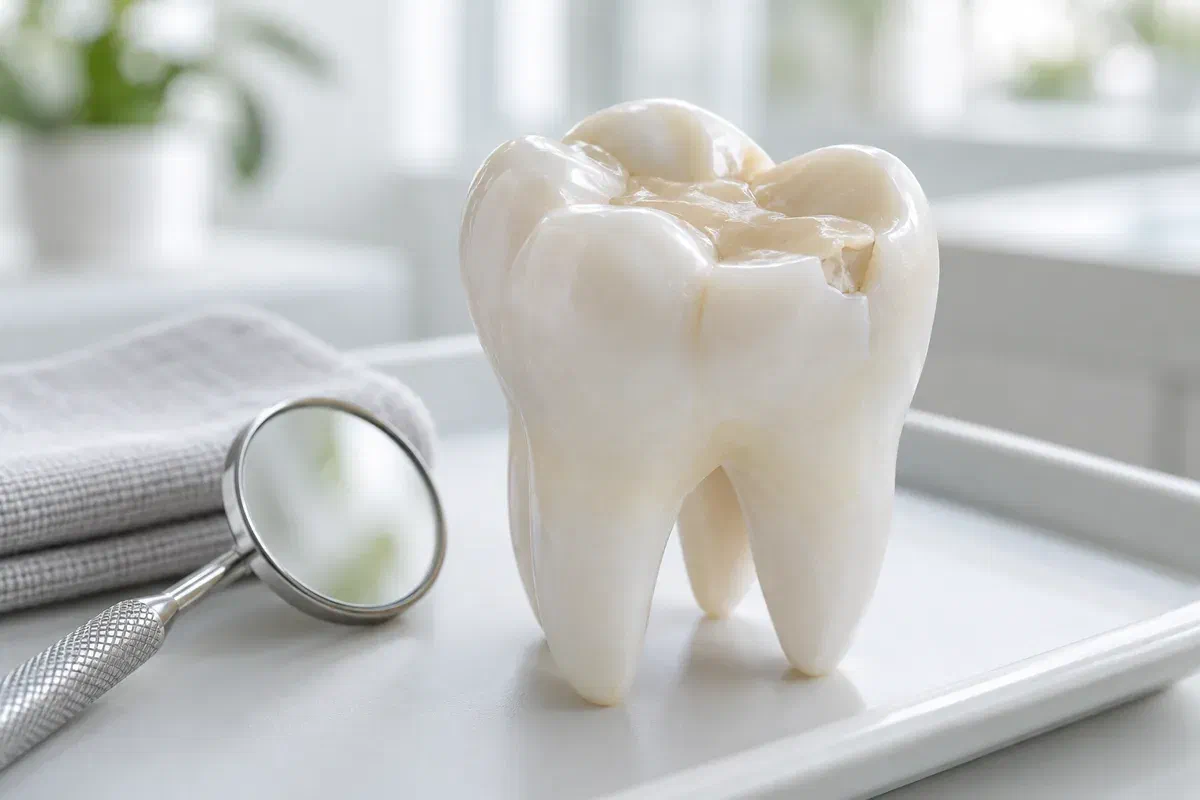
Illustrative molar model showing a small defect in a tooth-coloured filling
Details that shape the decision

What you notice says something about the scope

Symptoms after a break vary from none at all to a sharp, catching edge. Let us know what is happening, especially if your tongue or cheek is being scraped.

Where the roughness is

A rough patch on top of the tooth, at the side, or between teeth can suggest different kinds of damage. Avoid poking it with tools. Say whether it snags floss, holds food, or rubs soft tissue, because location and behaviour help the dentist plan the repair.

How the tooth reacts

Describe any sensitivity to cold, heat, sugar, or pressure and how long it lasts. Fleeting sensitivity and lingering ache point the assessment in different directions and can influence whether a simple repair is enough.

Whether it has broken before

A filling that keeps breaking suggests the tooth, the material, or the bite needs a fresh look. Share what you remember of earlier repairs. Reproducing the same restoration again may not deal with the reason it fails.

Even without discomfort, the tooth needs checking. Feeling normal does not reveal whether the restoration left behind, or the enamel around it, is properly supported.

Getting the scope right

Do enough, but not more than the tooth needs

A well-chosen repair restores the damaged area without removing more than necessary. It gives you a workable chewing surface, a good contact with the teeth on either side, and margins that are easy to clean. Your dentist will explain whether a direct filling is the right tool or whether something larger makes sense.

Understanding the cause sharpens that choice. A broad older filling, decay at its edges, a cracked cusp, or strong biting forces can each tip the decision toward more or less treatment. With that information, you can weigh options with realistic expectations rather than focusing on the visible gap alone.

Patient information: Cleveland Clinic — dental filling care and complications

A reasoned extent

Ask which portion is compromised and why any sound material can or cannot be kept. A small repair and full replacement involve different amounts of intervention, and the explanation should make the choice understandable.

Function after the repair

Talk about the shape and contact that need restoring, especially if food has started to collect. Tell the dentist how the tooth felt before the break, so changes beyond the missing piece are part of the assessment.

Factors behind the failure

Mention grinding, clenching, crunching ice, or a change in your bite. None of these confirms the cause by itself, but they help explain the decision and may lead to advice on protecting the repair.

How the repair is planned

Four stages, with your input at each

Whether the day ends with a final repair or temporary protection depends on what is found and how much time was booked. Asking beforehand helps you plan.

  1. Assessment

    Your dentist examines the broken area and the tooth around it, reviews symptoms, and decides whether an X-ray would help. This is where the scope of the damage becomes clearer than a missing corner suggests.

  2. Recommendation

    You will hear what is proposed and why: a partial repair, a new filling, or something more. The material, fee, and any uncertainty about hidden damage are part of the conversation. Ask what would happen if more is found once work starts.

  3. Restoration

    Freezing and isolation are used where appropriate. Compromised material and tooth structure are removed, then the chosen repair is placed, or a temporary restoration protects the tooth. The details depend on the defect and the support available.

  4. Review

    The bite and contours are checked before you leave. Ask about eating and cleaning, and whether a follow-up is needed. If the tooth later feels high, sharp, or sore when you bite, let us know rather than assuming it will settle.

Protecting your tooth

A little caution goes a long way

Your instructions depend on the material and on whether the repair is permanent or interim. If something changes while you wait for an appointment, phone for advice.

Ease off the damaged tooth

Avoid crunchy or chewy foods on that side until it is repaired. Keep food and drink temperatures comfortable. Leave the area alone rather than prodding it, and do not pull at any piece that still seems attached.

Give the new repair time

Wait for numbness to wear off before you eat, and follow any limits for a temporary. Ask when the tooth can return to normal chewing. A partial repair and a full replacement may come with slightly different advice.

Report what does not feel right

Your usual brushing and flossing routine should continue unless you are told otherwise. Call if your bite seems uneven, floss catches, or discomfort grows instead of easing. A specific description helps us decide what to check.

Patient information: NHS Wales — care while awaiting restoration assessment

Weighing the options

From a small patch to fuller coverage

Ask why one approach suits your situation. Matching the old filling is not the only consideration once the tooth itself has changed.

Most of the filling is still sound

Partial repair

Repairing only the defect may be reasonable when the surrounding restoration and tooth are in good condition. The dentist decides whether that will hold up. Ask which parts would remain untouched.

The tooth can support a new filling

Complete replacement

Removing the old filling and placing a new one may suit a tooth with enough healthy structure. Talk through materials in terms of size, moisture control, and the biting load. The repair should fit the tooth as it is now.

Strength or the nerve is compromised

Broader treatment

For a tooth that has been significantly weakened, an onlay, crown, or similar coverage may be discussed. When the pulp is involved, it needs its own treatment before a final restoration. Ask what finding led there and how the steps fit together.

Scope and choices

Questions about how much work is needed

There is no need to work out whether the fragment was tooth or filling before you call. Tell us what happened and what feels different.

(905) 876-4488
What is the difference between repairing and replacing a filling?
A repair adds new material to fix a localized defect while keeping the rest of the existing filling. A replacement removes the old restoration and places a new one. Which is appropriate depends on the condition of the remaining filling and tooth.
Does a partial repair last as long as a new filling?
It depends on the size and location of the defect, the condition of what is kept, and the forces on the tooth. The dentist can explain why a repair is or is not expected to serve well in your case. Ask about the trade-offs.
Why might the dentist recommend more than I expected?
Sometimes the examination or an X-ray shows decay, a crack, or thin tooth walls that were not visible to you. If the plan is larger than expected, ask to see or have explained the findings that changed it, and what the alternatives are.
Is it possible to see the damage myself and still misjudge it?
Yes. Tooth-coloured materials can be hard to tell apart from enamel, and the most important damage may not be visible. Avoid widening the gap or pulling at edges. Bring any fragment you have and let the examination sort out what has broken.
Could my bite be the reason the filling broke?
Heavy forces from grinding or clenching can contribute, but a break during normal eating can also happen when a restoration or tooth was already weakened. Tell the dentist about your history so the assessment considers the bigger picture.
How should I fit this repair into a trip from Mississauga?
When you call, describe the break and symptoms so the team can suggest an appointment of the right length. Ask whether the visit is likely to finish the repair or start with a temporary step, so you know whether a return trip may be needed.
Mississauga to Bronte Street

A clear answer on what your tooth needs.

Our Bronte Street practice can assess a broken filling and explain whether a repair or full replacement fits. Bring the details of how it broke, any fragment you saved, and your questions about the options.

For pain, swelling, or an edge that is injuring your mouth, please call us. Online booking requests are for non-urgent visits.

Visit Milton Dental Clinic
Unit 1, 342 Bronte St. S, Milton, ON L9T 5B7
Get directions Clinic hours
Monday–Thursday
11am–7pm
Friday–Sunday
By appointment only

Areas we serve

  • Milton
  • Oakville
  • Mississauga
  • Georgetown
  • Halton Hills
  • Acton
  • Campbellville
  • Brampton
  • Burlington
  • Puslinch
  • Rockwood
  • Erin
  • Caledon
  • Etobicoke
  • Old Milton
  • Bronte Meadows
  • Timberlea
  • Dorset Park
  • Dempsey
  • Clarke
  • Beaty
  • Coates
  • Harrison
  • Scott
  • Willmott
  • Ford
  • Bowes
  • Cobden
  • Walker
  • Mountain View
  • Milton Heights
  • Hawthorne Village
  • Valley View
  • Fallingbrook
  • Nassagaweya
  • Trafalgar
  • Esquesing
  • Nelson
  • Brookville
  • Moffat
  • Glen Williams
  • Norval
  • Limehouse
  • Stewarttown
  • Ashgrove
  • Hornby
  • Silver Creek
  • Speyside
  • Scotch Block
  • North Oakville
  • River Oaks
  • Glen Abbey
  • West Oak Trails
  • Palermo
  • Bronte Creek
  • College Park
  • Joshua Creek
  • Uptown Core
  • Preserve
  • Iroquois Ridge
  • Lisgar
  • Meadowvale
  • Meadowvale Village
  • Churchill Meadows
  • Erin Mills
  • Central Erin Mills
  • Streetsville
  • East Credit
  • Creditview
  • Heartland
  • Sheridan
  • Mount Pleasant
  • Credit Valley
  • Huttonville
  • Churchville
  • Springbrook
  • Northwest Brampton
  • Bram West
  • Fletcher's Meadow
  • Fletcher's Creek South
  • Alton Village
  • Orchard
  • Millcroft
  • Headon Forest
  • Tansley
  • Brant Hills
  • Tyandaga
  • Kilbride
  • Lowville
  • Aberfoyle
  • Morriston
  • Arkell
  • Hillsburgh
  • Freelton
  • Carlisle
  • Waterdown
  • Flamborough
  • Mountsberg

How can we help?

Milton Dental Clinic

Have a question about your smile? Choose the option that works best for you.

For urgent dental concerns, please call.
Messages are reviewed during clinic hours.