
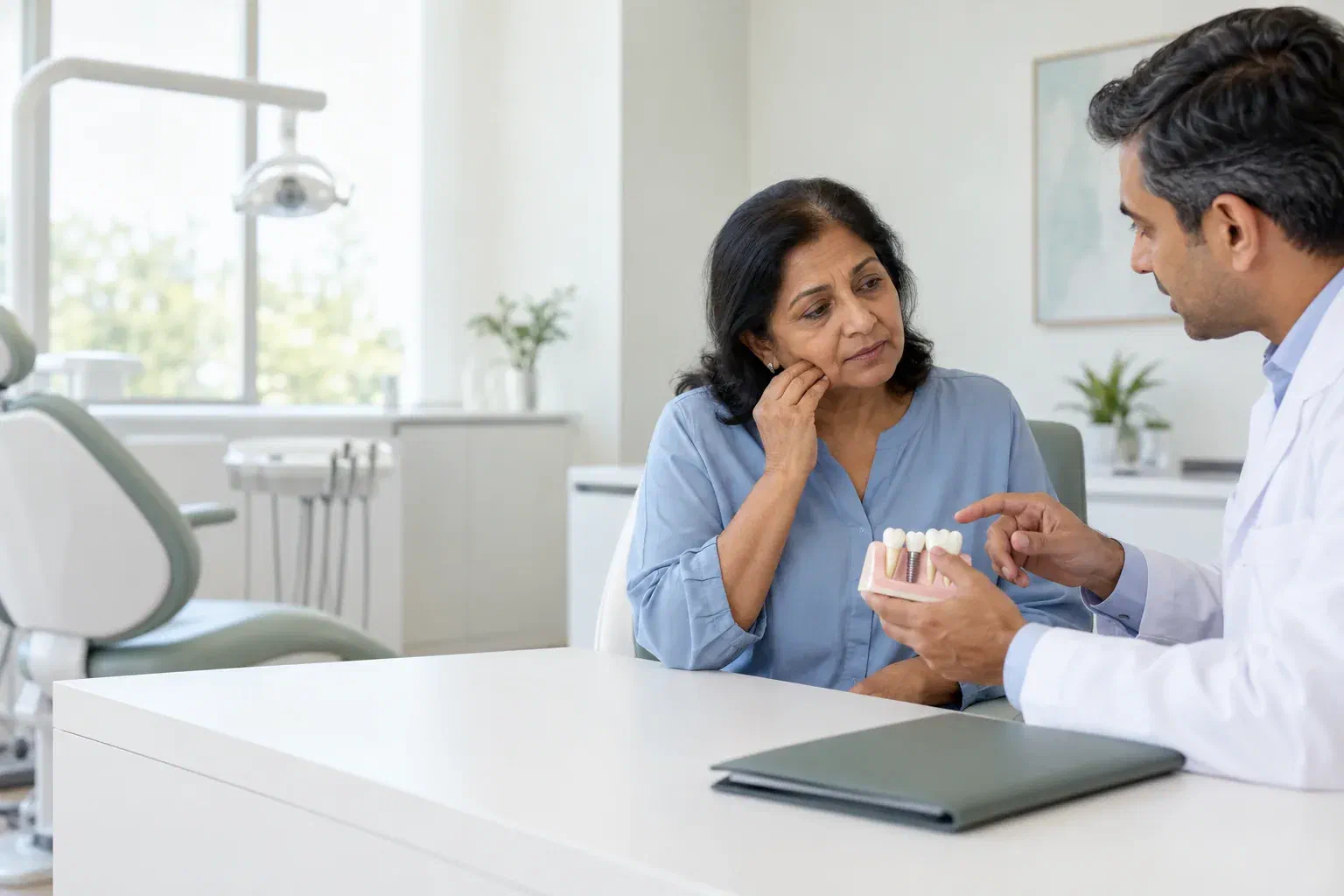
Illustrative consultation about concerns with an existing dental implant
Restorative Dentistry

Replacement of Failing Dental Implants in Burlington

Gums that bleed around an implant are worth acting on early. If you are travelling from Burlington, a review can show whether the tissue can be treated and the implant kept, or whether replacement deserves a closer look.

It often starts at the gumline

Pink on the floss, pause on the panic.

You floss beside your implant and see blood, or the gum there looks puffy and darker than the rest. Inflammation around an implant is common and can be mild or more involved. It is one of several possible problems, alongside a loosened crown, a damaged connecting part and loss of bone support, and each one leads to a different conversation.

Swapping the implant for a new one only comes up when the assessment shows that keeping it is not a reasonable option. Even at that point, removal and replacement stay separate questions. The reason for the problem, the bone and gum still present, the tooth planned for the site and your own priorities all count.

For anyone coming from Burlington, the first appointment is about understanding. We examine the gum and the implant, check stability, look at suitable imaging and ask about your history. We explain what we see, whether a specialist opinion would help, and what each option would involve, so that nothing is decided before you understand it.

Have the implant gum checked
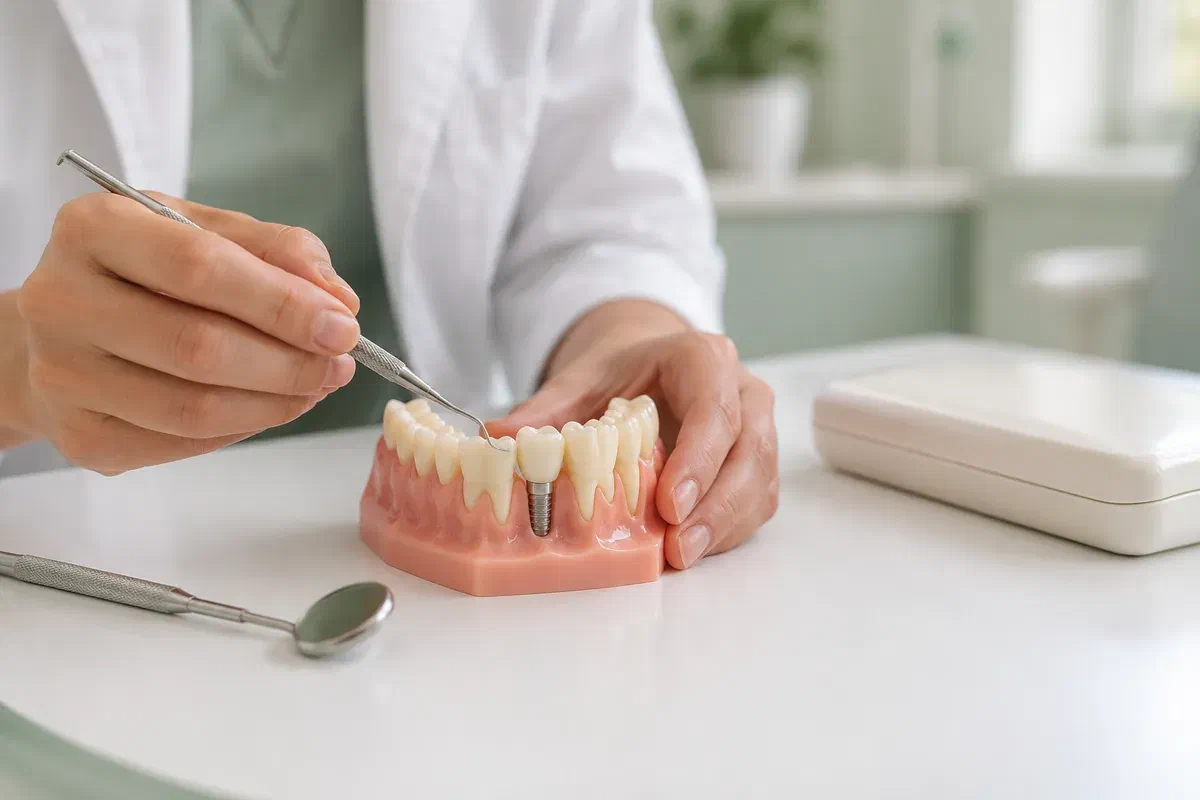
A dentist examining an illustrative jaw teaching model with an implant crown
Changes to point out

Notice it, note it, and let us look.

It helps to know when the implant was placed, when its crown went on, and what you have noticed lately. Bring previous X-rays if you have access to them.

A crown with a little give

If the tooth feels like it shifts, the cause could be the crown, the piece underneath or the implant's support in bone. Leave it alone rather than testing it. Phone us and explain whether it appeared suddenly, after a knock, or slowly over time.

Bleeding, puffiness or a sour taste

Changes in the gum around an implant need attention even when the tooth is firm. Describe what you see while cleaning, any tenderness, and any discharge. The exam tells us how healthy the soft tissue is and whether bone is involved.

A change flagged by a dentist

Sometimes the concern is raised from a probe reading or X-ray rather than symptoms. Ask what was measured, what it means and how it compares with earlier records. Understanding the change helps you see why treatment is being proposed.

Inflamed gum or a loose crown is not automatically a reason to remove the implant. The structure involved must be identified first.

Getting to the cause

Treat what caused it, or the next implant inherits it.

The purpose of a careful review is to work out whether the current implant can be brought back to health or whether removal is the more sensible route. If a replacement is planned, it must take into account why the problem developed in the first place, since a new implant is not automatically protected from the same factors.

You will also want a plan for the space while treatment is happening. Before anything starts, ask about appearance, chewing and whether a removable tooth will fill the gap. Seeing the temporary phase, any extra steps and the final crown together makes it easier to decide whether another implant is for you.

Patient information: ITI — assessing implant complications and removal

A straightforward diagnosis

Ask if the issue is in the tissues, the parts, the implant's position or a mixture. Technical terms are not required. You should simply understand which part needs care and what the findings show.

Care for the surrounding tissue

The health of the bone and gum shapes any replacement plan. Ask whether tissue treatment, grafting or a healing period would be needed and how that affects timing. The site is part of the treatment, not just the space left behind.

A side-by-side view

Compare the replacement pathway with realistic alternatives, factoring in upkeep, temporary teeth, costs and the chance that plans shift. That comparison is the basis for a decision you are comfortable with.

Step by step

Each stage is explained before it begins.

You may see more than one clinician over several visits. Ask who handles each step and when the plan will be reviewed as new information comes in.

  1. Assess the gum, implant and history

    The visit covers symptoms, the crown, gum health, stability and relevant imaging. Implant details and earlier X-rays help. Let us know about changes in your health, smoking, grinding, any previous treatment there and how easy the area is to clean.

  2. Decide if the implant can be kept

    Treating the inflamed tissue or repairing a part may solve the problem, and that is considered first. If removal is recommended, ask for the reasons and the alternatives. Specialist input can help with more complex biological or surgical questions.

  3. Remove it and care for the site

    If removal is chosen, you will hear about the procedure, its risks, aftercare and any graft or healing time. A replacement may be placed when the site is ready, but same-day replacement is not assumed. Your temporary tooth arrangement is settled in advance.

  4. Re-evaluate before the final crown

    A new implant and crown get their own assessment and follow-up. Healing may change the plan. Ask when you can bite normally on the new tooth and how long-term maintenance will work.

At home between visits

Care that fits each phase of treatment.

Instructions after an assessment, removal, graft and new implant each differ. Keep them in writing, with the contact details of the clinician managing your current stage.

Spare the loose tooth

Until the area is checked, avoid chewing on it and do not attempt to tighten or remove anything. If a piece has fallen out, keep it safe and bring it to your appointment.

Keep cleaning, gently and as advised

Inflamed gum still needs careful cleaning, using the method you were shown. After a procedure, follow the instructions for eating and any temporary appliance, and check before wearing an older denture over the area. Tell us if the routine is hard to manage.

Return for every review

Follow-up visits track the gum, the parts and the healing site. If bleeding increases or movement, discharge or soreness appears, call rather than waiting for the next booking. Mention cleaning problems so the plan can be adjusted.

Patient information: Cambridge University Hospitals — implant care and complications

Weighing your choices

Is saving the implant still possible?

Ask what each route is designed to achieve and what is still uncertain. One implant in the past does not mean you must choose another.

If the implant can be maintained

Treat the tissue and keep it

Professional treatment of peri-implant inflammation, or repair of the crown or components, may be suitable in some situations. Results depend on the findings and how the tissue responds. Ask what will be monitored and what would change the recommendation.

If it should not stay

Remove and plan a new implant

Removal may be discussed when an implant cannot reasonably be kept. A new implant depends on the site and the plan as a whole. Ask about additional procedures, healing, a changed position and the replacement tooth.

If you would prefer another approach

Consider a bridge or partial denture

Depending on the missing teeth and support available, a bridge, removable partial denture or other arrangement may suit you. Discuss how each affects nearby teeth, cleaning, appearance and comfort so you can compare them.

Patient information: EFP — treatment of peri-implant disease

Gum and implant questions

Before you decide, ask.

You can request the diagnosis and treatment sequence in writing, which is useful if your care is being coordinated between clinicians.

(905) 876-4488
Does bleeding around an implant mean it is failing?
Not by itself. Bleeding usually signals inflammation, which may be limited to the gum or may involve bone. Assessment shows which. Early inflammation can often be managed, so it is better to book a review than to wait and see.
Can peri-implant disease be treated without removing the implant?
In some cases, yes. Professional cleaning, changes to home care and other treatment may help, depending on how advanced it is. The response is monitored. If bone loss is significant or treatment does not help, removal may then be discussed.
What cleaning tools work best around an implant?
It varies with the shape of the crown and the space around it. Soft brushes, small interdental brushes and floss designed for implants are often used. Bring what you use now and ask to be shown a method that suits your implant.
Does smoking affect whether a new implant will do well?
Smoking is recognised as a risk factor for implant problems and can affect healing. Your dentist will ask about it when planning. Being open about it helps produce a realistic plan, and you may be offered information on support to cut down or quit.
Will my existing crown work on a new implant?
Possibly not. A replacement implant may differ in position or connection. Ask whether the crown can be reused, modified or needs remaking, and ask for an estimate that separates the implant work, the crown and any temporary tooth.
How many visits should I expect if I am coming from Burlington?
It depends on what the assessment finds and whether a specialist is involved. Once the plan is clear, we can outline the appointments so you can arrange them around work and family. Ask which visits can be grouped and which need healing time between them.
Burlington implant reviews

Find out what the gum is telling you.

Book an assessment at our Bronte Street practice. Bring your implant history and questions, and we will discuss the problem, any further testing and your options for the site and the tooth.

Please call for a loose implant, strong pain or swelling. Online booking is best kept for non-urgent questions.

Visit Milton Dental Clinic
Unit 1, 342 Bronte St. S, Milton, ON L9T 5B7
Get directions Clinic hours
Monday–Thursday
11am–7pm
Friday–Sunday
By appointment only

Areas we serve

  • Milton
  • Oakville
  • Mississauga
  • Georgetown
  • Halton Hills
  • Acton
  • Campbellville
  • Brampton
  • Burlington
  • Puslinch
  • Rockwood
  • Erin
  • Caledon
  • Etobicoke
  • Old Milton
  • Bronte Meadows
  • Timberlea
  • Dorset Park
  • Dempsey
  • Clarke
  • Beaty
  • Coates
  • Harrison
  • Scott
  • Willmott
  • Ford
  • Bowes
  • Cobden
  • Walker
  • Mountain View
  • Milton Heights
  • Hawthorne Village
  • Valley View
  • Fallingbrook
  • Nassagaweya
  • Trafalgar
  • Esquesing
  • Nelson
  • Brookville
  • Moffat
  • Glen Williams
  • Norval
  • Limehouse
  • Stewarttown
  • Ashgrove
  • Hornby
  • Silver Creek
  • Speyside
  • Scotch Block
  • North Oakville
  • River Oaks
  • Glen Abbey
  • West Oak Trails
  • Palermo
  • Bronte Creek
  • College Park
  • Joshua Creek
  • Uptown Core
  • Preserve
  • Iroquois Ridge
  • Lisgar
  • Meadowvale
  • Meadowvale Village
  • Churchill Meadows
  • Erin Mills
  • Central Erin Mills
  • Streetsville
  • East Credit
  • Creditview
  • Heartland
  • Sheridan
  • Mount Pleasant
  • Credit Valley
  • Huttonville
  • Churchville
  • Springbrook
  • Northwest Brampton
  • Bram West
  • Fletcher's Meadow
  • Fletcher's Creek South
  • Alton Village
  • Orchard
  • Millcroft
  • Headon Forest
  • Tansley
  • Brant Hills
  • Tyandaga
  • Kilbride
  • Lowville
  • Aberfoyle
  • Morriston
  • Arkell
  • Hillsburgh
  • Freelton
  • Carlisle
  • Waterdown
  • Flamborough
  • Mountsberg

How can we help?

Milton Dental Clinic

Have a question about your smile? Choose the option that works best for you.

For urgent dental concerns, please call.
Messages are reviewed during clinic hours.