
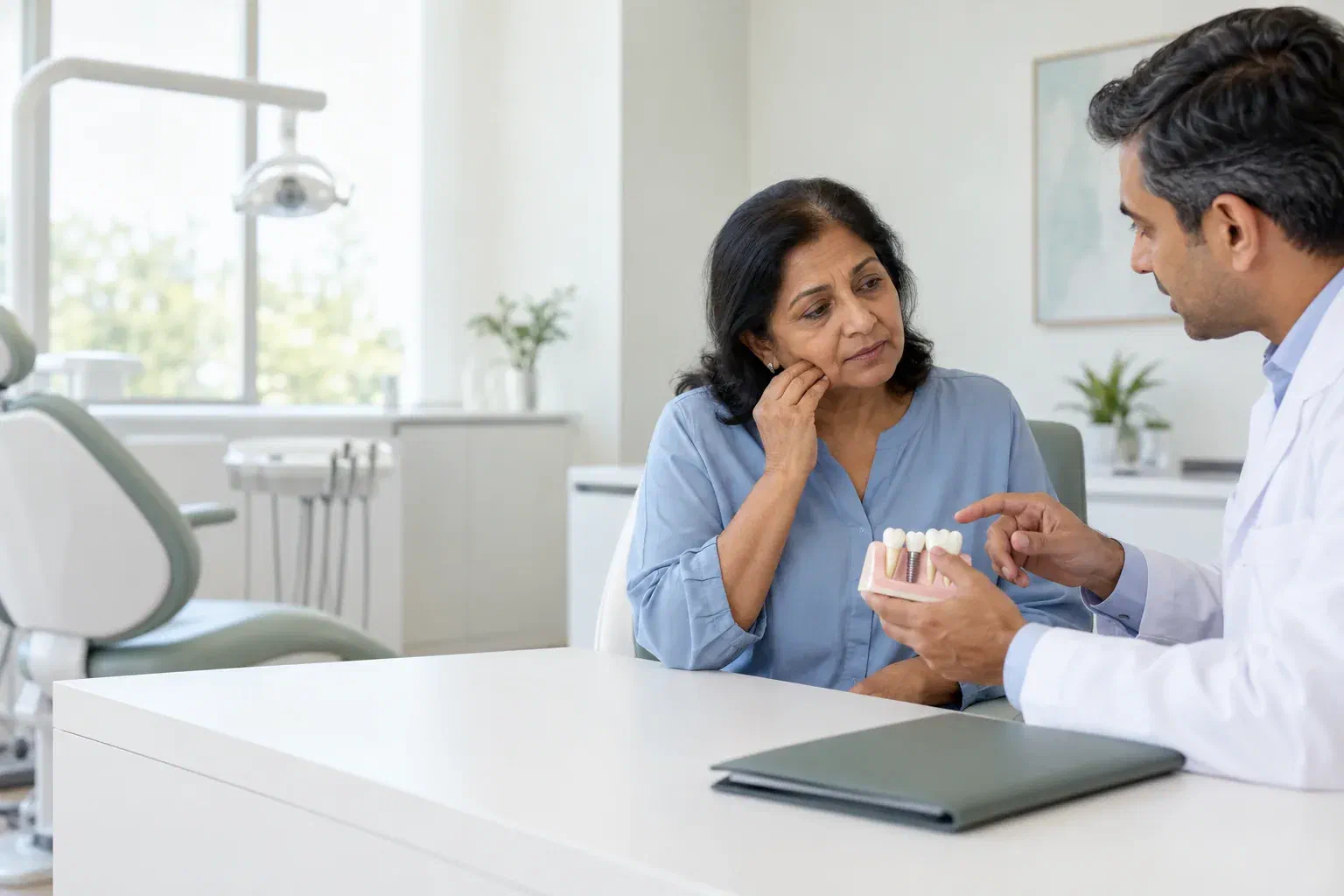
Illustrative consultation about concerns with an existing dental implant
Restorative Dentistry

Replacement of Failing Dental Implants in Etobicoke

Treating a failing implant can take several stages, so the trip matters. Coming from Etobicoke, you get a diagnosis first, then a schedule built around fewer, well-planned visits and clear guidance on urgent care.

Planning care from farther away

Fewer trips, each one with a purpose.

Implant problems rarely resolve in a single appointment, and that matters when the drive is part of every visit. The good news is that much of the uncertainty can be cleared up at the first review. What we need to learn is whether the trouble lies with a loosened crown, a damaged component, inflamed gum, or bone that no longer supports the implant well.

Each of those leads somewhere different. Only when an assessment shows the implant should not be kept does replacement become a real question, and even then removal and a new implant are planned as separate steps. The reason it failed, the bone and gum left, the tooth to be fitted and your wishes shape the decision.

For people travelling in from Etobicoke, we try to make that first visit count: a thorough examination, appropriate imaging, a look at any records, and a frank discussion of what we see. If a specialist opinion would help, we explain why. You leave knowing the options and how many visits each would likely involve.

Book a well-planned first review
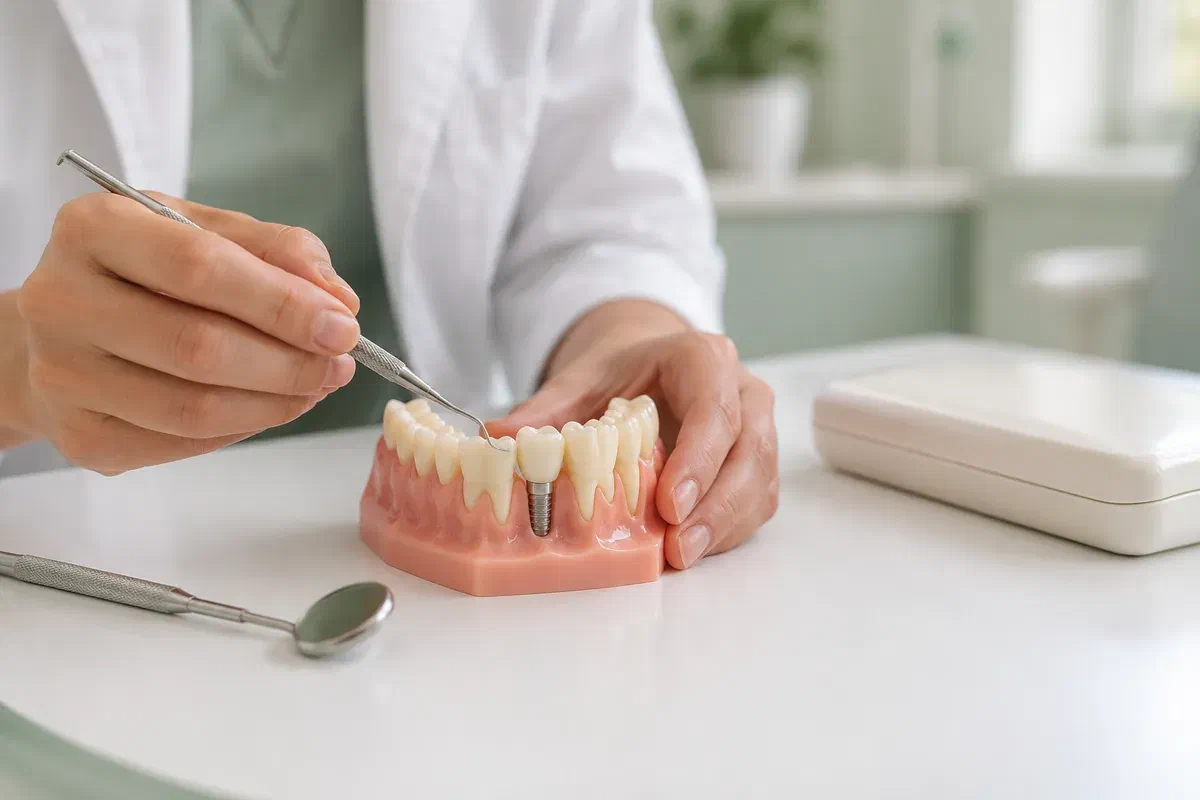
A dentist examining an illustrative jaw teaching model with an implant crown
Before you set out

Call ahead with what you are noticing.

A quick call lets us judge how soon you should be seen. Mention when the implant and crown were placed, what has changed, and whether you can send X-rays beforehand.

The implant tooth feels unstable

The crown, its connection or the implant's anchorage could be involved. Avoid pressing on it to check. When you call, say whether it came on suddenly, after an impact, or gradually, which helps us decide how quickly to book you.

Gum changes around the implant

Bleeding, puffiness, tenderness or a bad taste near an implant should be seen, even if the tooth is solid. Tell us what you notice when cleaning and whether there is discharge. The exam shows how the gum and bone are holding up.

A concern from another dentist

If a dentist closer to home has raised a problem, ask for copies of the images and notes. Comparing them with older records, where available, helps us understand the change and saves repeating what has already been done.

A crown problem is not the same as an implant failure. We confirm which part is affected before any talk of replacement.

Addressing what went wrong

A second implant only makes sense if the cause is dealt with.

The assessment's job is to decide between keeping the current implant healthy and removing it. If a replacement is planned, it must account for whatever led to the original problem. A new implant is not a reset button, and the same conditions could affect it.

With a longer trip each time, the in-between stage deserves planning too. Ask early how the space will look, what you will be able to eat and whether a removable tooth will be used. Mapping the interim phase, any extra procedures and the final tooth also shows how many trips each route needs.

Patient information: ITI — assessing implant complications and removal

A diagnosis in plain terms

Find out whether the problem involves the tissue, the hardware, the implant's position or more than one of these. Jargon is not required, but you should know which part needs work and what evidence points there.

A plan that respects the site

The condition of bone and gum affects every option. Ask whether grafting or a healing period is needed and how that changes the number and spacing of appointments.

Options with their visit counts

Compare the replacement route with alternatives, including temporary teeth, maintenance, fees and the chance of changes. Knowing roughly how many visits each involves is a fair part of that comparison.

How we organise the stages

Grouped where possible, spaced where healing needs it.

Some stages can be combined and others need time between them. Ask who handles each one, whether a specialist will be involved, and when the plan will be reviewed.

  1. A thorough first assessment

    We cover symptoms, the crown, gum health, stability and suitable imaging in one visit where we can. Bring implant details and old X-rays. Tell us about health changes, smoking, grinding, earlier treatment in the area and any cleaning difficulty.

  2. Deciding on retention

    If repair of a component or treatment of the tissues could solve the problem, that is discussed first. When removal is recommended, you will hear why and what else is available. Specialist assessment may be suggested for complex questions.

  3. Removal and site management

    If removal goes ahead, the procedure, risks, aftercare and any graft or healing time are explained in advance, along with the temporary tooth. A new implant may follow later, but placing it the same day is not assumed.

  4. Final checks before the new tooth

    Any new implant and crown are assessed and followed up separately. Healing can change the timeline. Ask when normal chewing can resume and how maintenance visits will be spaced for someone travelling in.

Managing at home

Know what to do, and who to call, between visits.

Instructions vary after assessment, removal, grafting and a new implant. Keep each one in writing with the treating clinician's number, and know where you would go for urgent care closer to home.

Do not chew on a loose implant tooth

Until it is assessed, use the other side and avoid touching the tooth. Do not try to tighten or remove parts. If something has already come off, store it safely and bring it with you.

Follow the guidance for your stage

After a procedure, stick to the advice for cleaning, eating and any temporary appliance. Check before wearing an older denture over the site. If anything is unclear once you are home, call rather than guessing.

Report changes promptly

Follow-up visits monitor the tissues, parts and new tooth. New movement, discharge or increasing soreness should be reported by phone straight away; we can advise whether you need to come in or seek care nearer to you.

Patient information: Cambridge University Hospitals — implant care and complications

Your possible routes

Treat it, replace it, or choose another tooth replacement.

For each, ask about the goal, the uncertainties and the likely number of visits. Having had one implant does not oblige you to choose another.

When the problem is treatable

Manage the existing implant

Professional care for peri-implant disease, or repair of the crown or components, may be appropriate in selected cases. How well it works depends on the findings and the response. Ask how progress will be checked and what might change the advice.

When retaining it is unwise

Remove it and consider a new one

Removal may be advised for an implant that cannot reasonably stay. A replacement implant depends on the site and the overall plan. Ask about any extra procedures, healing, a different position and the final tooth.

When another implant is not your preference

Choose a bridge or removable option

Depending on the gap and the support available, a bridge, a removable partial denture or another arrangement may be suitable. Consider effects on nearby teeth, cleaning, appearance and comfort, as well as the number of visits.

Patient information: EFP — treatment of peri-implant disease

Planning questions

Making staged treatment work from a distance.

Ask for the diagnosis and treatment order in writing; it helps when care involves more than one clinician.

(905) 876-4488
Can the first assessment and imaging happen on the same day?
Often they can, depending on what imaging is needed and what you already have. Sending earlier X-rays in advance can help. Ask when you book what to bring so the first appointment covers as much as possible.
Where should I go if my implant becomes urgent at night?
Phone the team treating you for advice where possible. Swelling that affects breathing or swallowing, or rapidly spreading swelling, needs the nearest emergency department. Do not delay urgent care to make the trip to a dental office.
Do healing stages mean many separate trips?
Some stages need time between them, so a few separate visits are usually unavoidable. Others can sometimes be grouped. Once the plan is set, ask for an outline of the likely appointments and which ones have flexibility.
Could a dentist near Etobicoke handle some of the follow-up?
Sometimes routine checks can be shared with another dentist, as long as everyone knows who is responsible for what. Ask how records would be passed on and who you should contact about a problem at each stage.
Is there a reason a failed implant cannot simply be swapped out?
Removal can leave a defect in the bone, and the cause of the original problem may still be present. Both need attention before a new implant is considered, which is why immediate replacement is not always possible. Ask what your site needs.
What should I ask about long-term upkeep?
Ask how often maintenance visits are recommended, what they involve, how to clean around the new tooth, and what signs should prompt a call. Knowing this in advance helps you judge whether the plan suits your routine.
Implant reviews from Etobicoke

Make the first trip the most useful one.

Call or book a review at our Bronte Street practice. Send or bring any X-rays and records, list your questions, and we will cover the diagnosis, further assessment and a realistic visit plan for each option.

For a moving implant, severe pain or swelling, phone us first. Online requests are only for non-urgent questions.

Visit Milton Dental Clinic
Unit 1, 342 Bronte St. S, Milton, ON L9T 5B7
Get directions Clinic hours
Monday–Thursday
11am–7pm
Friday–Sunday
By appointment only

Areas we serve

  • Milton
  • Oakville
  • Mississauga
  • Georgetown
  • Halton Hills
  • Acton
  • Campbellville
  • Brampton
  • Burlington
  • Puslinch
  • Rockwood
  • Erin
  • Caledon
  • Etobicoke
  • Old Milton
  • Bronte Meadows
  • Timberlea
  • Dorset Park
  • Dempsey
  • Clarke
  • Beaty
  • Coates
  • Harrison
  • Scott
  • Willmott
  • Ford
  • Bowes
  • Cobden
  • Walker
  • Mountain View
  • Milton Heights
  • Hawthorne Village
  • Valley View
  • Fallingbrook
  • Nassagaweya
  • Trafalgar
  • Esquesing
  • Nelson
  • Brookville
  • Moffat
  • Glen Williams
  • Norval
  • Limehouse
  • Stewarttown
  • Ashgrove
  • Hornby
  • Silver Creek
  • Speyside
  • Scotch Block
  • North Oakville
  • River Oaks
  • Glen Abbey
  • West Oak Trails
  • Palermo
  • Bronte Creek
  • College Park
  • Joshua Creek
  • Uptown Core
  • Preserve
  • Iroquois Ridge
  • Lisgar
  • Meadowvale
  • Meadowvale Village
  • Churchill Meadows
  • Erin Mills
  • Central Erin Mills
  • Streetsville
  • East Credit
  • Creditview
  • Heartland
  • Sheridan
  • Mount Pleasant
  • Credit Valley
  • Huttonville
  • Churchville
  • Springbrook
  • Northwest Brampton
  • Bram West
  • Fletcher's Meadow
  • Fletcher's Creek South
  • Alton Village
  • Orchard
  • Millcroft
  • Headon Forest
  • Tansley
  • Brant Hills
  • Tyandaga
  • Kilbride
  • Lowville
  • Aberfoyle
  • Morriston
  • Arkell
  • Hillsburgh
  • Freelton
  • Carlisle
  • Waterdown
  • Flamborough
  • Mountsberg

How can we help?

Milton Dental Clinic

Have a question about your smile? Choose the option that works best for you.

For urgent dental concerns, please call.
Messages are reviewed during clinic hours.