
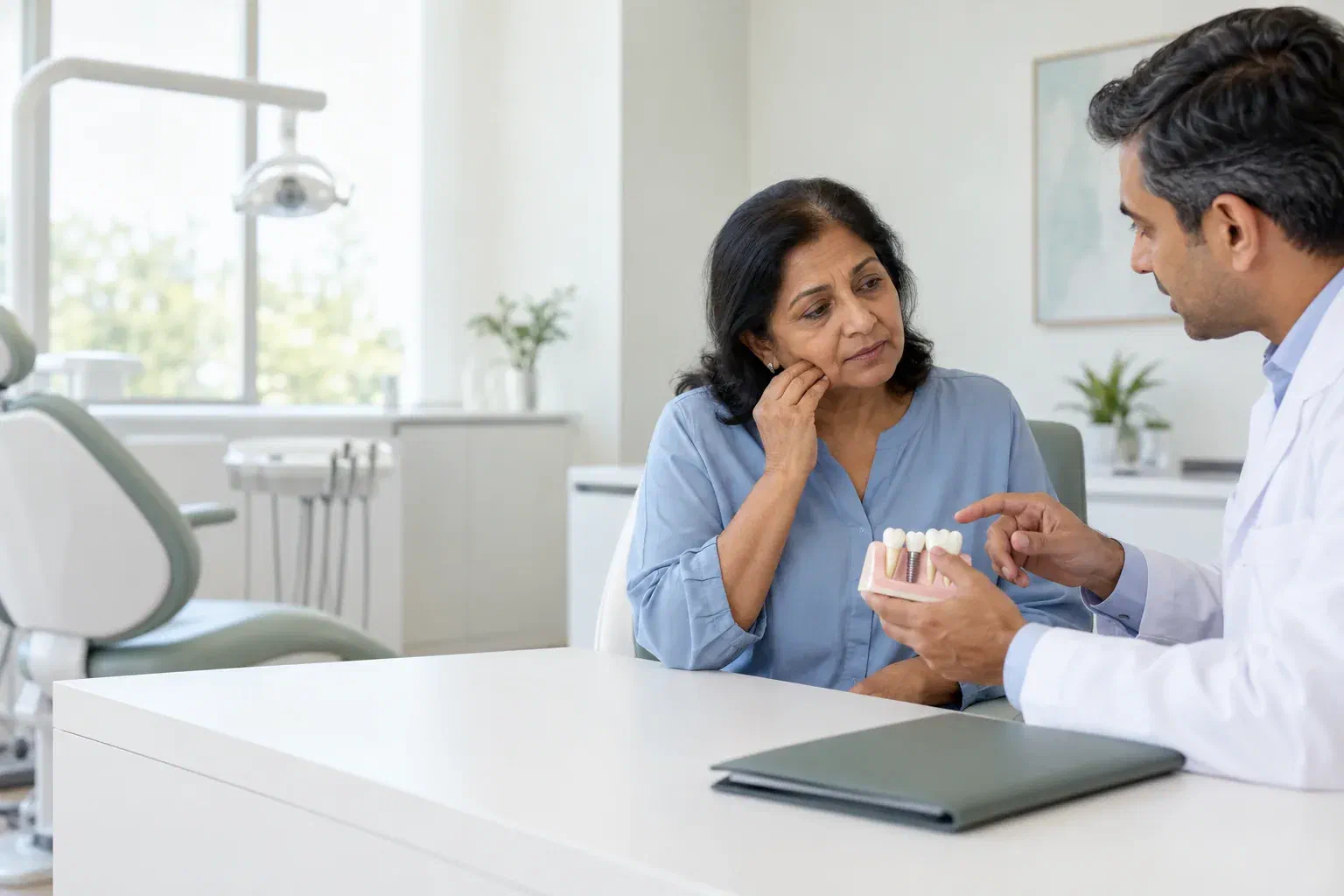
Illustrative consultation about concerns with an existing dental implant
Restorative Dentistry

Replacement of Failing Dental Implants in Oakville

Told your implant is failing, but it feels fine? Coming from Oakville, you can have the finding explained, the X-rays compared, and every option set out before you commit to removal or a new implant.

A diagnosis you did not expect

No pain, yet the X-ray says otherwise.

It is a strange position to be in. The implant tooth chews normally and looks the same, but a dentist has pointed to an image and used the word failing. Before reacting, it helps to know exactly what was seen. Bone loss around an implant, inflamed gum, a worn connection and a loose crown are not the same finding, and they are not treated the same way.

Replacing the implant becomes a consideration only when an assessment shows it should not be kept. Even then, taking it out is one choice and placing another is a second. The underlying cause, the bone and gum left behind, the tooth that will go on top and what you prefer all feed into the decision.

Many people from Oakville come to us wanting a clear explanation more than a quick procedure. We review the area, compare any earlier X-rays you can share, and walk you through what the evidence suggests. If more imaging or a specialist would add something, we say so, and you hear about every alternative before choosing.

Ask us to review the finding
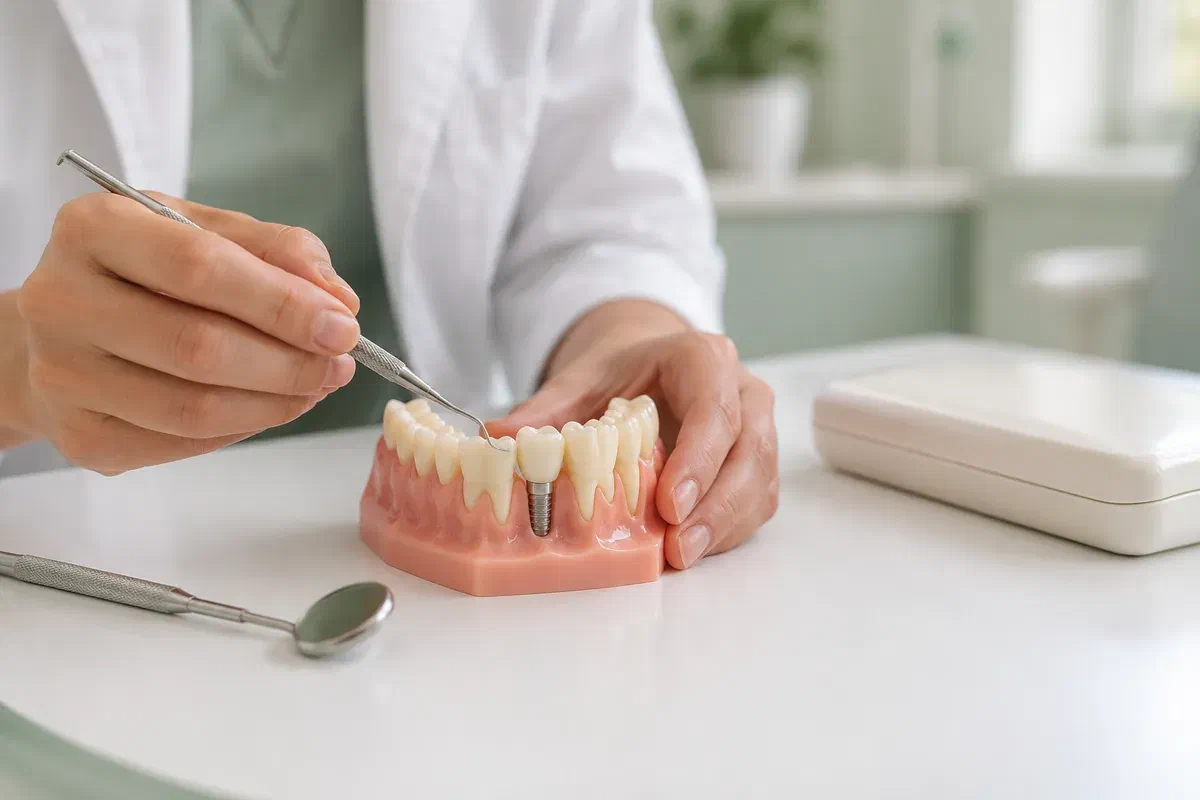
A dentist examining an illustrative jaw teaching model with an implant crown
What brought you in

Bring the concern as it reached you.

Let us know when the implant and its crown were placed and how you learned there might be a problem. Copies of recent and older X-rays are especially useful.

A tooth that feels slightly loose

Looseness can originate in the crown, the joining component or the implant's grip on the bone. Testing it with your tongue or finger will not settle which. Call and describe whether it happened all at once, after an impact, or bit by bit.

Tender or bleeding gum tissue

Inflammation around an implant should be checked even when nothing moves. Mention what you notice while brushing, any ache, and whether there is a discharge or an unpleasant taste. Examination reveals how both gum and bone are faring.

A warning from another office

Often the first sign is a comment at a routine visit. Ask for the specific finding, the images it came from and, where possible, a comparison with older ones. Once you can see what changed, the reasons for suggested treatment become much easier to weigh.

Wear or looseness in the crown does not by itself mean the implant has to be taken out. The affected part needs to be confirmed first.

Planning around the root cause

Fix the reason, not just the implant.

A good assessment should answer one central question: can this implant be kept healthy, or is removal the better course? If a replacement is planned, it needs to deal with what caused the trouble. Without that, a second implant may face the same conditions as the first.

Think about the months in between, too. Before starting, discuss how the space will look, what you will be able to eat and whether a removable tooth is part of the plan. A clear view of the interim stage, any added procedures and the final crown helps you decide whether to pursue another implant.

Patient information: ITI — assessing implant complications and removal

Understanding the finding

Is the problem with the tissues, the hardware, the implant's placement, or a combination? You do not need to master the jargon. You should, however, be able to say which part is affected and what supports that conclusion.

Accounting for bone and gum

The amount and health of the surrounding tissue influence what is possible. Ask whether grafting or a healing pause would be needed and what that does to the timeline. The site deserves as much attention as the implant.

Options you can actually compare

Lay the replacement route beside the alternatives, including maintenance, temporary teeth, fees and the chance of changes after further assessment. That gives you solid ground for a decision.

What the pathway involves

Assess, decide, treat, then reassess.

Several appointments, and sometimes more than one clinician, may be needed. Ask who is responsible at each point and when the plan will be revisited.

  1. Examine and review the records

    We look at your symptoms or lack of them, the crown, the gum, stability and appropriate imaging. Previous X-rays and implant details are valuable. Tell us about medical changes, smoking, clenching, past treatment of the area and how cleaning around it goes.

  2. Consider whether to keep it

    Repairing a component or treating the surrounding tissue may be enough, and we discuss that first. Where removal is advised, you should understand why and what else is possible. A specialist can help with complex surgical or restorative questions.

  3. Remove and manage the space

    If you proceed, the removal, its risks, aftercare and any graft or healing stage are explained in advance. A new implant might be placed later, though doing it at once is not presumed. The temporary arrangement for the gap is agreed beforehand.

  4. Reassess before finishing

    Any new implant and crown are evaluated and followed up in their own right. The plan can change with healing. Ask when you can eat normally on the tooth and how maintenance will be set up for the long term.

Home care through each phase

Follow the advice for where you are now.

Guidance after an assessment, removal, graft or new implant varies. Keep every written instruction and the phone number of the clinician currently responsible for your treatment.

Avoid biting on a moving crown

Until it has been assessed, chew on the other side and leave the implant tooth alone. Do not try to tighten or take off any piece. If something has already detached, keep it clean and dry and bring it to the visit.

Protect the treated area

After a procedure, follow the specific instructions on cleaning, diet and any temporary appliance. Check before wearing an existing denture over the site. If something in the advice is hard to manage, let us know and we can talk it through.

Keep follow-up visits

Reviews check the gum, the parts and the new tooth as treatment progresses. Report new movement, discharge or rising soreness straight away rather than holding on until the next appointment. Mention cleaning difficulties early.

Patient information: Cambridge University Hospitals — implant care and complications

Comparing the routes

Three directions, each with trade-offs.

Ask what each choice aims for and what remains unknown. A past implant does not oblige you to have another.

Where the problem is treatable

Maintain the current implant

In some cases, professional treatment of inflamed tissue around the implant or repair of the crown and parts is appropriate. Success depends on the findings and how the area responds. Ask what will be monitored and what might change the plan.

Where keeping it is unwise

Remove it and assess replacement

An implant that cannot reasonably stay may be removed. Whether a new one can go in depends on the site and the broader plan. Ask about any extra procedures, healing time, a new position and the eventual crown.

Where you decide against another implant

Choose a non-implant option

A bridge, a removable partial denture or another arrangement may be suitable, depending on which teeth are missing and the support available. Discuss what each means for neighbouring teeth, cleaning, appearance and daily comfort.

Patient information: EFP — treatment of peri-implant disease

Questions from Oakville

Clear answers before a big decision.

You can ask for the diagnosis and planned sequence in writing, which helps when care is shared between offices.

(905) 876-4488
Can an implant be failing if it does not hurt?
Yes. Bone loss or inflammation around an implant can progress without pain, which is why routine X-rays and checks matter. A finding without symptoms still deserves explanation, and it may or may not mean the implant needs removal. Assessment clarifies that.
Is it reasonable to get a second opinion on a failing implant?
It is. Asking another dentist to review the findings is a normal step before major treatment. Bring the images and notes you were given. A second look can confirm the diagnosis, offer another perspective, or clarify questions you did not get to ask.
What is peri-implantitis?
It is inflammation around an implant that involves loss of the supporting bone. It is related to, but more advanced than, inflammation limited to the gum. Treatment depends on how far it has progressed, and in some cases the implant can be maintained.
How do I know whether waiting is safe?
Ask directly. Some findings can be monitored for a time, while others are likely to worsen without treatment. The answer depends on the problem and your symptoms. Any swelling, pain or movement in the meantime is a reason to call.
Can a new implant go in the same day the failing one comes out?
In selected cases it may be considered, but it depends on the site, why removal is needed, how much bone is present and the surgical plan. Often a healing or graft stage comes first. Ask what would make same-day placement possible or rule it out for you.
What should a written treatment plan include?
The diagnosis, the reasons for the recommendation, the order of steps, who provides each one, the temporary tooth arrangement, maintenance and fees. Having it on paper makes it easier to compare options and to share with any other clinician involved.
Implant concerns, Oakville to Milton

Understand the finding first.

Book a review at our Bronte Street practice. Bring your X-rays, any notes from the dentist who raised the concern, and your questions, and we will go over the problem, further assessment and your options.

If the implant moves, hurts badly or the area swells, please call instead of using the online form, which is for non-urgent requests.

Visit Milton Dental Clinic
Unit 1, 342 Bronte St. S, Milton, ON L9T 5B7
Get directions Clinic hours
Monday–Thursday
11am–7pm
Friday–Sunday
By appointment only

Areas we serve

  • Milton
  • Oakville
  • Mississauga
  • Georgetown
  • Halton Hills
  • Acton
  • Campbellville
  • Brampton
  • Burlington
  • Puslinch
  • Rockwood
  • Erin
  • Caledon
  • Etobicoke
  • Old Milton
  • Bronte Meadows
  • Timberlea
  • Dorset Park
  • Dempsey
  • Clarke
  • Beaty
  • Coates
  • Harrison
  • Scott
  • Willmott
  • Ford
  • Bowes
  • Cobden
  • Walker
  • Mountain View
  • Milton Heights
  • Hawthorne Village
  • Valley View
  • Fallingbrook
  • Nassagaweya
  • Trafalgar
  • Esquesing
  • Nelson
  • Brookville
  • Moffat
  • Glen Williams
  • Norval
  • Limehouse
  • Stewarttown
  • Ashgrove
  • Hornby
  • Silver Creek
  • Speyside
  • Scotch Block
  • North Oakville
  • River Oaks
  • Glen Abbey
  • West Oak Trails
  • Palermo
  • Bronte Creek
  • College Park
  • Joshua Creek
  • Uptown Core
  • Preserve
  • Iroquois Ridge
  • Lisgar
  • Meadowvale
  • Meadowvale Village
  • Churchill Meadows
  • Erin Mills
  • Central Erin Mills
  • Streetsville
  • East Credit
  • Creditview
  • Heartland
  • Sheridan
  • Mount Pleasant
  • Credit Valley
  • Huttonville
  • Churchville
  • Springbrook
  • Northwest Brampton
  • Bram West
  • Fletcher's Meadow
  • Fletcher's Creek South
  • Alton Village
  • Orchard
  • Millcroft
  • Headon Forest
  • Tansley
  • Brant Hills
  • Tyandaga
  • Kilbride
  • Lowville
  • Aberfoyle
  • Morriston
  • Arkell
  • Hillsburgh
  • Freelton
  • Carlisle
  • Waterdown
  • Flamborough
  • Mountsberg

How can we help?

Milton Dental Clinic

Have a question about your smile? Choose the option that works best for you.

For urgent dental concerns, please call.
Messages are reviewed during clinic hours.