

Illustrative consultation comparing options for several older restorations
Restorative Dentistry

Replacement of Metal Fillings in Milton

Wondering whether one dark-edged filling means the rest are next? A Milton review of your metal fillings looks at each tooth separately, so you can see what needs care, what can wait, and what is simply your choice.

Silver fillings, reviewed close to home in Milton

One filling changed. Does that mean all of them should?

Many people first think about their metal fillings when one of them starts to feel different: a sharp spot under the tongue, floss that shreds, or a dark line along an edge. It is natural to wonder if the others are about to follow. Usually that question is better answered one tooth at a time.

Fillings placed years apart can sit side by side and still be in very different shape. One may have a small fracture or recurrent decay, while its neighbour is sealed and doing its job. A review sorts these out, so that monitoring, repair and replacement are each matched to a specific reason.

Since you are already in Milton, it is easy to start with a single conversation rather than a big commitment. Tell us which tooth caught your attention and anything else you have wondered about, including appearance. We will explain what we find and leave room for you to decide how much to do.

Ask about your metal fillings
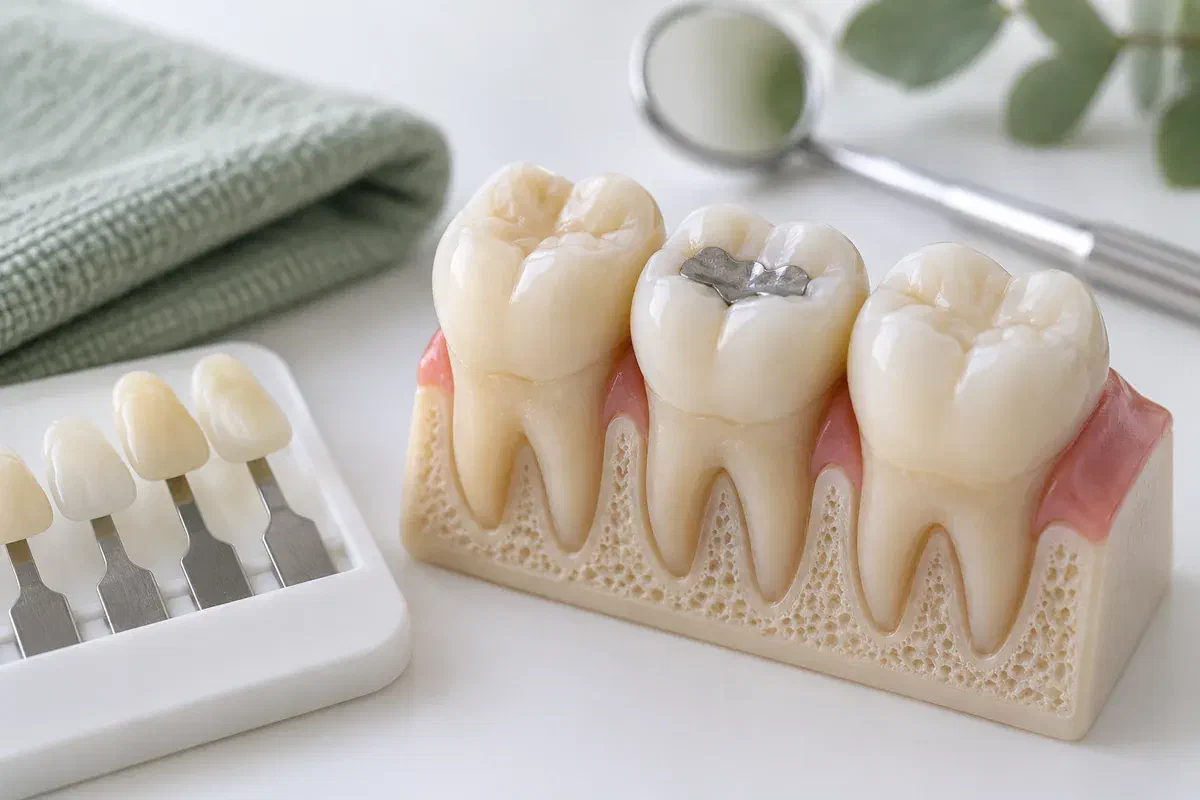
Teaching model of back teeth with a sound silver filling beside shade samples
What brings the question up

Notice something? Start with what you noticed.

The reason you book shapes the conversation. A grey shadow, a rough edge and a tender bite each point to a different kind of check.

Fillings you have had for many years

Some people cannot remember who placed their fillings or when. That is fine. The dentist looks at how each one is holding up today and can review records that are available. Age alone does not settle whether a metal filling has to come out.

The one that shows in photos

Often a single upper or lower filling is the one you see in pictures or the mirror. Naming it keeps the cosmetic part of the discussion focused, rather than assuming every silver surface in your mouth needs a new look.

Pain, catching food or a rough spot

Mention these on their own, apart from appearance. A tooth that aches when you chew or traps food may have a cause that has nothing to do with how dark the filling looks. Linking the symptom to an actual finding comes first.

Intact amalgam fillings are not usually removed just as a health precaution. If you have a medical or material-sensitivity concern, raise it with your dentist and, when it makes sense, your physician as well.

What a good plan gives you

Clear reasons for every tooth on the list.

A plan that covers several fillings is easier to follow when each item has a label. Which teeth show a defect, which ones are being watched, and which changes would be mostly about how your smile looks? You should be able to explain the reason behind each line yourself.

Materials are chosen per tooth as well. A tooth-coloured filling placed directly may be enough in one spot, while a larger or weaker tooth may call for a different kind of restoration. Teeth can look consistent together without being restored in exactly the same way.

Patient information: FDA — choices of restorative materials

Urgency sorted honestly

Ask which findings should be dealt with soon and which can wait without much risk. That helps you plan time and budget while the clinical picture stays clear. Visibility should not be the thing that decides the order.

Realistic shade expectations

A well-chosen shade helps a new filling blend in, though surrounding enamel and existing stains also affect the look. Talk through each visible tooth before choosing how far to go.

Something in writing

You can ask for a plain outline and estimates for each proposed stage. Use it to compare choices, check your coverage or come back with questions. It should still allow for changes if something new is found during treatment.

How the review unfolds

Four steps, with a pause wherever you need one.

Talking about several fillings does not commit you to treating them all. The exam helps settle a sensible scope and a workable order.

  1. Look at the fillings and listen to you

    The dentist checks each restoration, the teeth around it and any symptoms you describe. X-rays may be suggested if they would add something useful. Let us know whether comfort, appearance or an earlier recommendation is what you most want to understand.

  2. Weigh the choices together

    Monitoring, repair and replacement are compared for the teeth involved. Ask about materials, fees and what happens if decay or cracking turns out to be deeper than expected. It helps to hear plainly which items are needed and which are elective.

  3. Set an order that suits you

    Scheduling takes into account how much work is involved, your comfort and how you will chew in the meantime. More than one visit may be needed for several fillings. Ask which area comes first and what to avoid while other teeth wait.

  4. Check the finished work

    Every new restoration is checked for shape and bite before you leave, and you get care instructions. With staged treatment, confirm the next visit and any open decisions. If eating or cleaning becomes harder, tell us before the next stage.

In the days after treatment

Pay attention to each treated tooth on its own.

With several teeth treated, noting where a feeling is and what sets it off helps the team know which area to look at.

Follow the guidance for each stage

Let the numbness fade before chewing, and follow any instructions specific to the material used. A temporary filling and a finished one may need different care, so ask how they differ. Keep the instructions with your next appointment card.

Be specific about any change

Mention a tooth that seems to hit first, discomfort that lingers, or food packing where it did not before. Say which side and when it happens instead of assuming every treated tooth is involved. That detail helps us book the right follow-up.

Keep caring for the fillings left in place

Brush, floss and keep regular checkups for every tooth, including the metal fillings that were judged sound. Choosing to monitor a filling means looking at it again at future visits, not forgetting it once others are done.

How much treatment fits

Sometimes the right plan is the smaller one.

Look at what each path does for the teeth that were flagged. Ask for the trade-offs to be laid out before you settle on the scope.

When there is no reason to remove

Keep and watch sound fillings

A filling that is intact and working can stay and be checked over time. Drilling out a sound filling may remove some healthy tooth along with it. Ask what signs would prompt another look and how today’s condition will be recorded.

When certain teeth have a clear reason

Replace only the teeth that need it

A focused plan can deal with a defect, or an agreed cosmetic concern, without changing every metal filling. Talk about the material and the size of the work for each tooth. Fillings that look alike may not need the same treatment.

When a filling alone will not hold

Move to a stronger restoration

For a tooth with more extensive damage, an onlay, crown or other restoration might be discussed. Ask why it is suggested and how many extra visits or preparation it involves. The decision follows what the tooth needs rather than a wish for a certain colour.

Questions we hear in Milton

Straight answers before you decide.

You should leave knowing which teeth are involved and why. Bring any questions about timing, cost, appearance or past advice.

(905) 876-4488
One of my fillings cracked. Should I worry about the others?
Not automatically. Each filling and tooth is assessed on its own, and a fracture in one does not show that the rest are failing. Ask the dentist to go through them individually so you know which need treatment, which can be watched and which changes would be optional.
How do I know if a metal filling is leaking or has decay under it?
You often cannot tell by looking or by feel. The dentist checks the edges of the filling and may suggest X-rays to look for decay that is not visible. Signs such as sensitivity or food trapping are worth mentioning, but they need an exam to explain them.
Can a new tooth-coloured filling be matched to my front teeth too?
The goal is a shade that suits the tooth being restored, and nearby teeth can differ slightly from each other. Ask how the visible teeth will be assessed together and what might limit the match, such as existing stains or other dental work.
Is it safer to remove silver fillings I have read concerns about?
Talk it through first. The FDA advises against removing intact amalgam fillings without a clinical reason when there is no decay underneath. Taking them out can cost healthy tooth structure and briefly increase mercury vapour exposure. If you have a specific medical concern, it deserves a personal discussion.
Will replacing a filling make the tooth feel different?
A new filling may feel slightly different at first, and some short-lived sensitivity can occur. The bite is checked before you leave. If a tooth still feels high, sore or sensitive after the first days, call so it can be looked at.
Can I treat one side now and decide on the rest later?
Often, yes. Ask which findings need timely care and which choices can wait, and request a written outline to take home. If new symptoms appear in the meantime, contact the clinic rather than relying on the earlier review.

Patient information: FDA — existing amalgam fillings

Metal filling reviews in Milton

Start with the tooth that made you wonder.

Book a visit at our Bronte Street practice to talk about your existing metal fillings and what matters to you. We will go through the findings tooth by tooth so the scope is clear before you choose any treatment.

For strong discomfort or swelling, please phone the clinic. Online requests are best for non-urgent appointments.

Visit Milton Dental Clinic
Unit 1, 342 Bronte St. S, Milton, ON L9T 5B7
Get directions Clinic hours
Monday–Thursday
11am–7pm
Friday–Sunday
By appointment only

Areas we serve

  • Milton
  • Oakville
  • Mississauga
  • Georgetown
  • Halton Hills
  • Acton
  • Campbellville
  • Brampton
  • Burlington
  • Puslinch
  • Rockwood
  • Erin
  • Caledon
  • Etobicoke
  • Old Milton
  • Bronte Meadows
  • Timberlea
  • Dorset Park
  • Dempsey
  • Clarke
  • Beaty
  • Coates
  • Harrison
  • Scott
  • Willmott
  • Ford
  • Bowes
  • Cobden
  • Walker
  • Mountain View
  • Milton Heights
  • Hawthorne Village
  • Valley View
  • Fallingbrook
  • Nassagaweya
  • Trafalgar
  • Esquesing
  • Nelson
  • Brookville
  • Moffat
  • Glen Williams
  • Norval
  • Limehouse
  • Stewarttown
  • Ashgrove
  • Hornby
  • Silver Creek
  • Speyside
  • Scotch Block
  • North Oakville
  • River Oaks
  • Glen Abbey
  • West Oak Trails
  • Palermo
  • Bronte Creek
  • College Park
  • Joshua Creek
  • Uptown Core
  • Preserve
  • Iroquois Ridge
  • Lisgar
  • Meadowvale
  • Meadowvale Village
  • Churchill Meadows
  • Erin Mills
  • Central Erin Mills
  • Streetsville
  • East Credit
  • Creditview
  • Heartland
  • Sheridan
  • Mount Pleasant
  • Credit Valley
  • Huttonville
  • Churchville
  • Springbrook
  • Northwest Brampton
  • Bram West
  • Fletcher's Meadow
  • Fletcher's Creek South
  • Alton Village
  • Orchard
  • Millcroft
  • Headon Forest
  • Tansley
  • Brant Hills
  • Tyandaga
  • Kilbride
  • Lowville
  • Aberfoyle
  • Morriston
  • Arkell
  • Hillsburgh
  • Freelton
  • Carlisle
  • Waterdown
  • Flamborough
  • Mountsberg

How can we help?

Milton Dental Clinic

Have a question about your smile? Choose the option that works best for you.

For urgent dental concerns, please call.
Messages are reviewed during clinic hours.