

Illustrative consultation comparing options for several older restorations
Restorative Dentistry

Replacement of Metal Fillings in Puslinch

A silver filling that keeps getting patched can leave you wondering when to stop repairing it. From Puslinch, you can have it reviewed alongside your other metal fillings and hear whether repair, replacement or waiting fits each one.

Repeat repairs, reviewed for Puslinch

Patched twice already.

Some fillings have a story: a corner chipped a few years back and was bonded, then a small edge was touched up later. Now a dentist mentions it again, and you are left wondering whether one more repair is sensible or whether it is time for a fresh start.

There is no automatic answer. A small, contained repair can be a conservative way to keep a tooth going without removing a sound filling. When problems keep returning, though, or decay or cracking has spread beneath the metal, replacing the filling, or choosing a sturdier restoration, may serve the tooth better.

Making the trip from Puslinch, you will want the other metal fillings looked at at the same time. Tell us which tooth has the repair history, which others you are curious about, and whether appearance matters. We will explain the reasoning for each tooth before you decide anything.

Review a patched or older filling
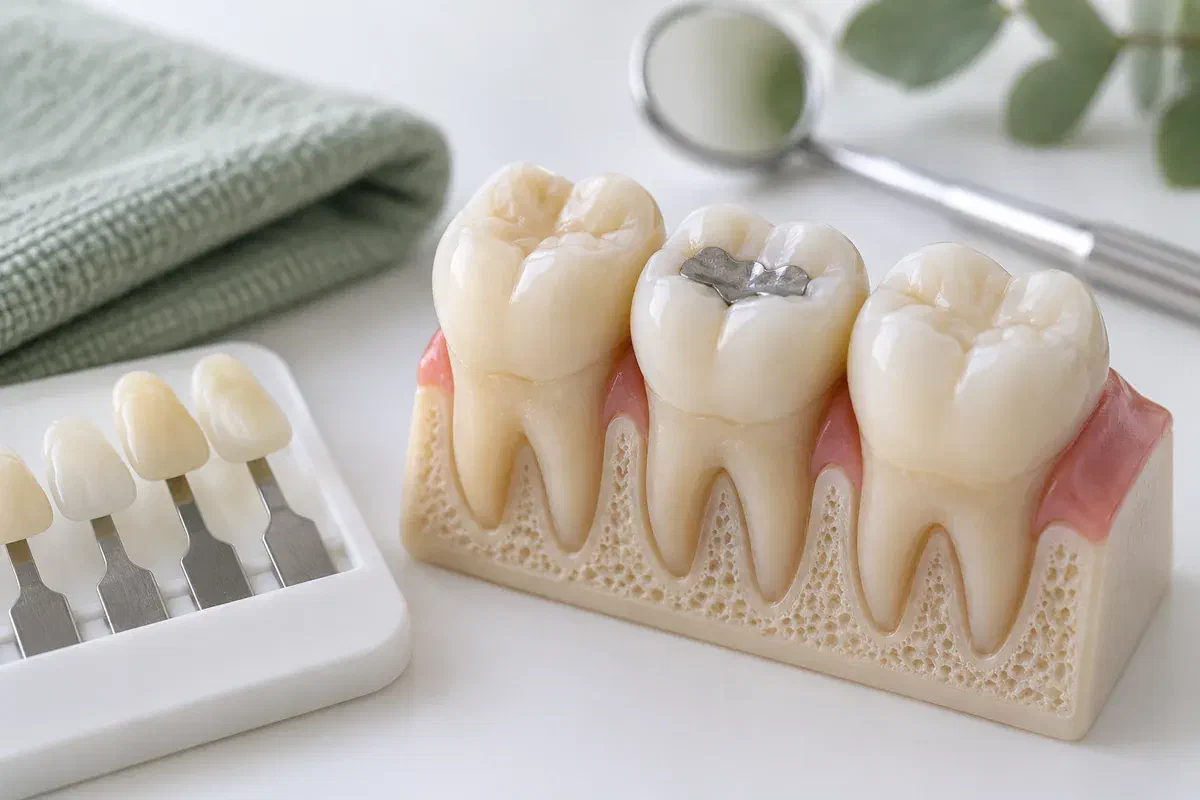
Teaching model of back teeth with a sound silver filling beside shade samples
What a repair history tells us

History, looks and symptoms all count, separately.

The review records what is found at every tooth. How dark a filling looks is not a reason to remove it on its own.

Old fillings with past patches

Your mouth may hold a mix of untouched fillings and ones that were repaired before. The dentist assesses how each one is holding up and reviews whatever history is available. A metal filling does not run out of usefulness on a fixed date.

A repair that shows

A patch in a different material can make one tooth look uneven. Point out the teeth that bother you. That keeps the appearance discussion specific and avoids planning cosmetic work for fillings you rarely see.

Recurring trouble at one tooth

Describe repeat chipping, sensitivity, pain on biting or food packing on its own. Problems that keep coming back may point to a crack or a weakened cusp. A proper diagnosis helps decide whether another repair is worth it.

Intact amalgam is not usually removed as a step toward better health. Bring a medical or material-sensitivity concern to your dentist and, when appropriate, your physician.

Repair or replace, decided properly

Conservative where possible. Thorough where needed.

When a tooth has a repair history, a clear plan matters even more. For each filling, ask whether it has a defect to treat, whether it can be monitored, or whether a change would mostly be cosmetic. Seeing all three side by side shows where another patch makes sense and where it may not.

Materials and designs are chosen tooth by tooth. A direct tooth-coloured filling may suit a modest area, while a tooth that keeps breaking may do better with an onlay or crown that covers the weak parts. Mixed restorations can still look natural.

Patient information: FDA — choices of restorative materials

An order grounded in findings

Learn what should be treated soon and what can wait. That helps you plan around trips and costs while letting the clinical picture, not the most noticeable patch, decide what comes first.

A grounded look at appearance

Picking the right shade helps new work blend, but your enamel and older repairs influence the result. Discuss each visible tooth so you know what change is realistic.

A plan you can take home

Request a written outline with estimates for each stage, including repair versus replacement where both are options. You can compare them, check benefits or return with questions. The outline may change once treatment reveals more.

The path to a decision

How we work out whether to patch again.

Having several fillings reviewed does not commit you to replacing them. The exam helps define a reasonable scope and order.

  1. Assess the repaired tooth and the rest

    The dentist examines the patched filling, every other metal filling and any symptoms. Imaging may be recommended if it would clarify what is under the old work. Let us know whether comfort, appearance or a previous recommendation matters most.

  2. Weigh repair against replacement

    For each tooth, monitoring, repair and replacement are discussed. Ask about materials, fees and what might be found once an old filling is removed. You should be able to tell which steps are necessary and which are elective.

  3. Set a workable schedule

    The plan considers the amount of work, what is comfortable in a single visit and how you will eat afterward. Several teeth may need more than one appointment. Ask which tooth goes first and what precautions apply in between.

  4. Check and confirm

    Each finished restoration is checked for contour and how your teeth come together, and you get care instructions. If more stages remain, confirm the next one. Mention new trouble with eating or cleaning before continuing.

In the weeks that follow

Watch whether the old trouble returns.

With several teeth treated, describing where a sensation is and what triggers it helps the team check the right tooth.

Follow care advice for each stage

Wait until numbness fades before chewing, and follow any guidance for the material used. A temporary may need gentler handling than a finished restoration. Keep the written advice until your next appointment.

Tell us if a familiar problem comes back

Mention chipping, a tooth that hits first, sensitivity that lingers or food catching again. Say which side and when. That helps show whether the repaired tooth or a different one needs a look.

Keep the other fillings in view

Every tooth still needs brushing, flossing and regular exams, including metal fillings left as they are. Monitoring means checking them again over time.

Possible routes

Leave it, patch it, replace it, or protect it?

Compare what each option achieves for the teeth identified. Ask the dentist to explain the trade-offs before choosing.

When removal is not justified

Monitor sound fillings

Where a filling is still sealed and functioning, leaving it alone keeps the surrounding tooth intact. It is simply rechecked at later visits. Find out which signs would reopen the question and how its current state is being noted.

Where a clear finding exists

Replace the fillings that keep failing

A focused plan can deal with a filling that has repeated problems, or an agreed cosmetic change, without replacing every metal filling. Talk through materials and extent for each tooth. Lookalike fillings may need different care.

When repeated repairs are not holding

Give a fragile tooth more coverage

For a tooth that keeps chipping, an onlay or crown might be discussed. Ask why, and what extra preparation or visits it involves. The choice reflects how much support the tooth needs, not just colour.

Puslinch questions about patched fillings

Repair, replace or wait: common questions.

You should leave knowing which teeth are involved and the reason behind each recommendation. Ask about repairs, timing, looks or past advice.

(905) 876-4488
How many times can a filling be repaired?
No fixed number applies. A repair may be reasonable when the problem is small and the rest of the filling is sound. If issues keep recurring or the tooth is weakening, replacement or a stronger restoration may be advised. The dentist will explain the reasoning for your tooth.
Is a repaired filling weaker than a new one?
Not necessarily. A well-placed repair on a sound filling can work well. Its success depends on the size of the defect and the condition of the surrounding tooth. Ask what the dentist expects for the specific tooth.
Why does the same tooth keep chipping?
Possible reasons include a crack, a thin wall of tooth beside a large filling, or heavy biting forces. The dentist may examine the bite and the tooth more closely. Understanding the cause helps decide whether a different restoration would help.
Would taking out silver fillings reduce mercury risk?
It is worth discussing before booking removal. The FDA says intact amalgam fillings that have no decay underneath should not be removed without a clinical reason. Removal can sacrifice healthy tooth and briefly increase mercury vapour exposure. An individual medical concern needs its own discussion.
Can I have estimates for both repairing and replacing?
Yes. Having the two costed side by side is often the clearest way to compare them. Ask that the teeth, surfaces and materials be spelled out for both routes, and whether X-rays or a temporary are billed on their own. If you have benefits, check how your plan views a repair compared with a full replacement.
Can treatment be arranged so I make fewer trips from Puslinch?
Often, yes. Where it is clinically sensible, nearby teeth can be treated in the same visit. Ask which work could be combined and which needs its own appointment. If a tooth becomes painful before the planned date, phone rather than waiting.

Patient information: FDA — existing amalgam fillings

Puslinch metal filling reviews

Find out whether one more patch is the right call.

Arrange a visit at our Bronte Street practice to review a repaired filling and any other metal fillings on your mind. We will explain each tooth’s condition and the options so you can choose your next step.

For significant pain or swelling, call the clinic. Online appointment requests are for non-urgent matters.

Visit Milton Dental Clinic
Unit 1, 342 Bronte St. S, Milton, ON L9T 5B7
Get directions Clinic hours
Monday–Thursday
11am–7pm
Friday–Sunday
By appointment only

Areas we serve

  • Milton
  • Oakville
  • Mississauga
  • Georgetown
  • Halton Hills
  • Acton
  • Campbellville
  • Brampton
  • Burlington
  • Puslinch
  • Rockwood
  • Erin
  • Caledon
  • Etobicoke
  • Old Milton
  • Bronte Meadows
  • Timberlea
  • Dorset Park
  • Dempsey
  • Clarke
  • Beaty
  • Coates
  • Harrison
  • Scott
  • Willmott
  • Ford
  • Bowes
  • Cobden
  • Walker
  • Mountain View
  • Milton Heights
  • Hawthorne Village
  • Valley View
  • Fallingbrook
  • Nassagaweya
  • Trafalgar
  • Esquesing
  • Nelson
  • Brookville
  • Moffat
  • Glen Williams
  • Norval
  • Limehouse
  • Stewarttown
  • Ashgrove
  • Hornby
  • Silver Creek
  • Speyside
  • Scotch Block
  • North Oakville
  • River Oaks
  • Glen Abbey
  • West Oak Trails
  • Palermo
  • Bronte Creek
  • College Park
  • Joshua Creek
  • Uptown Core
  • Preserve
  • Iroquois Ridge
  • Lisgar
  • Meadowvale
  • Meadowvale Village
  • Churchill Meadows
  • Erin Mills
  • Central Erin Mills
  • Streetsville
  • East Credit
  • Creditview
  • Heartland
  • Sheridan
  • Mount Pleasant
  • Credit Valley
  • Huttonville
  • Churchville
  • Springbrook
  • Northwest Brampton
  • Bram West
  • Fletcher's Meadow
  • Fletcher's Creek South
  • Alton Village
  • Orchard
  • Millcroft
  • Headon Forest
  • Tansley
  • Brant Hills
  • Tyandaga
  • Kilbride
  • Lowville
  • Aberfoyle
  • Morriston
  • Arkell
  • Hillsburgh
  • Freelton
  • Carlisle
  • Waterdown
  • Flamborough
  • Mountsberg

How can we help?

Milton Dental Clinic

Have a question about your smile? Choose the option that works best for you.

For urgent dental concerns, please call.
Messages are reviewed during clinic hours.