

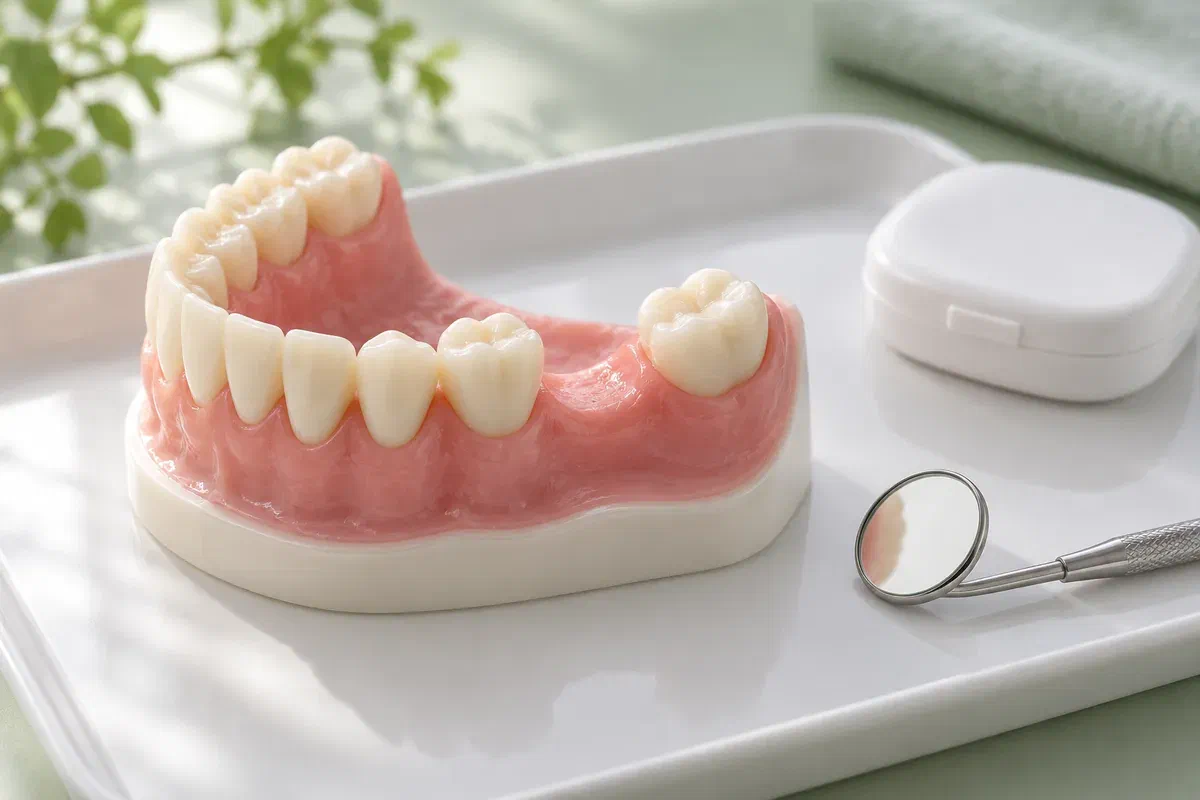
Illustrative consultation about the jaw ridge and a future tooth replacement
Restorative Dentistry

Ridge Augmentation in Brampton

What actually goes into the jaw during a graft, and can you have a say in it? For people coming from Brampton, we explain ridge augmentation materials, why a graft might be suggested, and the options beside it.

Materials, purpose and choice

You are allowed to ask what the graft is made of.

Ridge augmentation adds bone or bone-like material to a part of the jaw that has thinned after a tooth was lost. The ridge supports whatever replaces that tooth. When it lacks width, height or a smooth contour, building it up may help the planned restoration.

Many people want to know about the material before anything else, sometimes for personal, cultural or religious reasons. That question deserves a straight answer. So does the earlier one: why grafting is being suggested at all, since the look of a gap cannot show how much bone sits underneath.

From Brampton or elsewhere, you are welcome to bring both questions to our Bronte Street practice. We begin with the replacement you are considering and the findings at the site, then explain what more assessment, specialist planning or ridge treatment would involve.

Ask about graft options
Illustrative jaw model showing a smooth gum ridge in a missing-tooth space
Reasons a graft comes up

First the why, then the what

Before materials are chosen, the reason for augmentation should be clear. The assessment looks at the ridge, nearby structures and the tooth you want.

Too little bone for an implant

A planned implant needs bone in a position that supports the crown. Nerves, the sinus and nearby roots narrow the choices further. Imaging usually shows whether the ridge is wide and tall enough, which the gum alone cannot reveal.

A contour that would show

A dent in the ridge can make a new tooth look out of place or leave a gap at the gum. Say what you notice in your smile or with a partial. Bone, gum tissue, tooth design, or a combination may be involved.

Earlier treatment at the site

Tell us about past extractions, injuries, grafts or implants nearby. That history, including any materials used before, can inform the plan. It still does not confirm that the site is ready for the next stage.

Ridge augmentation is not part of every implant or replacement. It should answer a specific need in your plan.

What the procedure is for

A graft earns its place by what it enables.

If it is indicated, augmentation is meant to make the next step more workable. That may be placing an implant where the crown belongs or giving the replacement a more natural outline. Ask your clinician to name the specific aim before discussing materials in detail.

There are commitments on your side too: surgery, a healing period, follow-up visits, and possibly further care. Any material, whatever its source, comes with uncertainty about how much bone develops. A responsible plan says so, and it does not promise a future implant outcome.

Patient information: AAP — ridge modification for implant planning

The goal on a model

Ask to see where the replacement tooth would go and how the current ridge falls short. Relating the graft to that final position helps you decide whether it is worthwhile.

The sequence explained

Grafting may be done with implant placement or as a separate earlier stage. Ask which applies and why, so you can plan around work, family and an interim tooth.

A frank talk about sources

Graft and membrane materials can come from different origins depending on the procedure. Share your preferences before treatment is booked. Ask whether an alternative would be suitable and how it would change the plan.

What to expect

Assess, agree, treat and review

Technique and timing depend on the defect and the restoration. Ask who will perform each step and where follow-up will happen.

  1. Examination and history

    The site, imaging, gum health and medical history are reviewed. Mention smoking, medications, earlier grafts, and any healing problems. Share what you hope the replacement will do, and any material preferences you already have.

  2. The proposal and consent

    You will hear about technique, materials and their origins, recovery, fees and alternatives. Ask whether a donor site in your own mouth or a membrane is planned and whether anything might need removing later. Confirm the temporary tooth plan.

  3. The procedure

    If you choose to go ahead, the site is treated using the agreed method and comfort plan. Instructions specific to your procedure are provided. Recovery varies, so follow your own advice closely.

  4. Follow-up and next steps

    Reviews check healing and decide when further assessment or treatment is appropriate. A comfortable gum does not prove that the bone is ready. Ask what the clinician must see before the restoration stage.

Caring for the graft site

Protect the material while your body works with it.

Keep your written instructions and contact details where you can find them. Ask about any activity, cleaning step or appliance that might put pressure on the area.

Temporary teeth, used with care

A removable appliance may need adjusting or leaving out for a time. Do not let it press on the site unless advised that it can. Talk through appearance and eating plans before surgery day.

Gentle cleaning, sensible eating

You will be shown how to clean near the area and the rest of your mouth while it heals. Avoid lifting your lip or prodding to look. Check before changing anything you were told.

Reviews and warning signs

Attend every follow-up, even when comfortable. Contact the treating team about increasing pain, bleeding that returns, discharge, or any material showing through an opening in the gum.

Patient information: Cambridge University Hospitals — bone grafting for implants

Paths to compare

Three ways a plan can go

Ask what is clinically reasonable for your anatomy and goals. Include the finished restoration in the comparison, not only the graft.

When preparation comes first

Grafting ahead of the implant

The ridge heals before an implant is reconsidered. Ask about review points and what would happen if the gain is not enough. Timing depends on the procedure and how you heal.

When the site allows it

Grafting during implant placement

Some cases permit augmentation at the same surgery as the implant. Many defects are unsuitable. Ask what supports it for you and how it changes the temporary tooth and aftercare.

When augmentation is declined

No graft, different replacement

A bridge, removable partial, or another implant approach may be worth weighing. Each needs its own assessment and has limits and maintenance. Compare them before deciding grafting is the only route.

Graft questions from Brampton

Materials, preferences and safety, in plain terms

We can show the site and the proposed material on a model or image. Bring questions about recovery and the finished tooth too.

(905) 876-4488
Can I ask for a graft that does not use animal-derived material?
Yes, you can raise that preference. Depending on the procedure, other material types may be available, though suitability varies by site. Ask what alternatives exist and whether they would change the expected result or the plan.
Is using my own bone better than other materials?
Each option has trade-offs. Your own bone requires a donor site, which adds another area to heal. Other materials avoid that. The choice depends on the defect and procedure, so ask why a particular option is proposed for you.
What is a membrane, and is it always used?
A membrane is a thin barrier sometimes placed over a graft to protect it while it heals. Some are absorbed by the body and others are removed later. Whether one is used depends on the technique.
Are processed donor materials screened?
Graft products used in dentistry are supplied as regulated medical materials that go through processing before use. If you have concerns, ask your clinician what product is planned and what information is available about it.
Could my body react to the graft material?
Reactions are possible with any procedure. Tell the clinician about allergies and past reactions to medications or materials. They can explain what is known about the planned product and which signs to report.
Will the graft material show on future X-rays?
Some graft materials can be visible on imaging for a period, and the treated area is often reviewed with X-rays over time. Keep a note of what was used so future dentists have accurate information.
Ridge care for Brampton

Talk through the material before the surgery.

Meet our Bronte Street team to have the gap examined and your material questions answered in person. We will connect any graft to the replacement you want, describe the options and their origins, and compare them with routes that need no grafting at all.

For a change at an area that has already been treated, follow your treating clinician’s contact advice or call us.

Visit Milton Dental Clinic
Unit 1, 342 Bronte St. S, Milton, ON L9T 5B7
Get directions Clinic hours
Monday–Thursday
11am–7pm
Friday–Sunday
By appointment only

Areas we serve

  • Milton
  • Oakville
  • Mississauga
  • Georgetown
  • Halton Hills
  • Acton
  • Campbellville
  • Brampton
  • Burlington
  • Puslinch
  • Rockwood
  • Erin
  • Caledon
  • Etobicoke
  • Old Milton
  • Bronte Meadows
  • Timberlea
  • Dorset Park
  • Dempsey
  • Clarke
  • Beaty
  • Coates
  • Harrison
  • Scott
  • Willmott
  • Ford
  • Bowes
  • Cobden
  • Walker
  • Mountain View
  • Milton Heights
  • Hawthorne Village
  • Valley View
  • Fallingbrook
  • Nassagaweya
  • Trafalgar
  • Esquesing
  • Nelson
  • Brookville
  • Moffat
  • Glen Williams
  • Norval
  • Limehouse
  • Stewarttown
  • Ashgrove
  • Hornby
  • Silver Creek
  • Speyside
  • Scotch Block
  • North Oakville
  • River Oaks
  • Glen Abbey
  • West Oak Trails
  • Palermo
  • Bronte Creek
  • College Park
  • Joshua Creek
  • Uptown Core
  • Preserve
  • Iroquois Ridge
  • Lisgar
  • Meadowvale
  • Meadowvale Village
  • Churchill Meadows
  • Erin Mills
  • Central Erin Mills
  • Streetsville
  • East Credit
  • Creditview
  • Heartland
  • Sheridan
  • Mount Pleasant
  • Credit Valley
  • Huttonville
  • Churchville
  • Springbrook
  • Northwest Brampton
  • Bram West
  • Fletcher's Meadow
  • Fletcher's Creek South
  • Alton Village
  • Orchard
  • Millcroft
  • Headon Forest
  • Tansley
  • Brant Hills
  • Tyandaga
  • Kilbride
  • Lowville
  • Aberfoyle
  • Morriston
  • Arkell
  • Hillsburgh
  • Freelton
  • Carlisle
  • Waterdown
  • Flamborough
  • Mountsberg

How can we help?

Milton Dental Clinic

Have a question about your smile? Choose the option that works best for you.

For urgent dental concerns, please call.
Messages are reviewed during clinic hours.