

Illustrative consultation about a crown after root canal treatment
Restorative Dentistry

Root Canal Crown Restoration in Burlington

A root-treated tooth no longer warns you with hot or cold, so a weak spot can go unnoticed. If you’re coming from Burlington, plan a restoration that protects the tooth before a problem shows.

A tooth that feels different now

When the warning signals go quiet

Many people notice that a tooth stops reacting to iced drinks after its root canal. That is expected, because the nerve tissue inside has been removed. It also means you cannot count on sensitivity to tell you when the outer tooth is under strain, which is one reason the restoration that follows matters so much.

That restoration has to suit the tooth in front of the dentist. A heavily filled molar that carries much of your chewing is likely to need more protection than a front tooth with most of its enamel intact. Position, remaining cusps, existing fillings, cracks and bite are each considered before a crown or a smaller repair is proposed.

Coming from Burlington, you may have had the root canal close to home or with a specialist. Either way, we can take over the next stage. Let us know what was done and whether the current filling is temporary, and bring any notes. We will then explain the build-up, the final restoration and how the tooth will be monitored.

Plan protection for your treated tooth
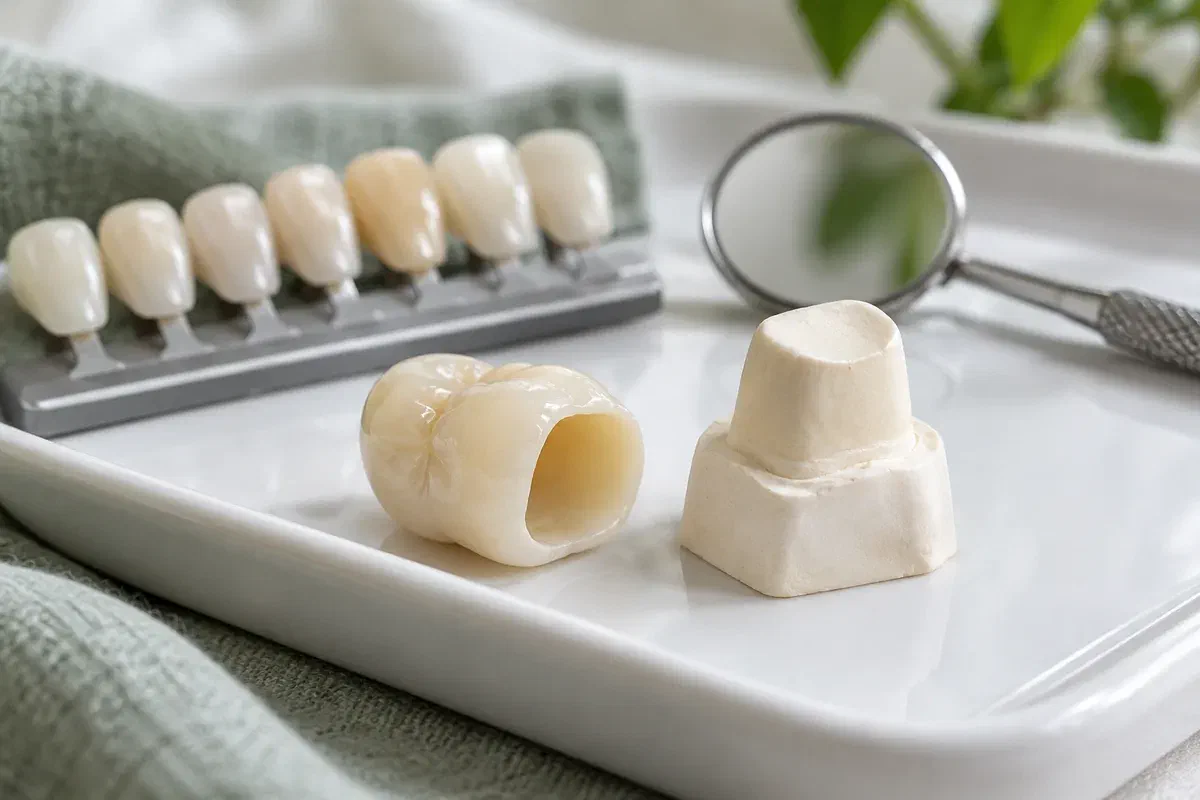
Illustrative ceramic crown and prepared-tooth model beside a shade guide
Reasons not to wait

No pain, but still unprotected

Ask whoever performed the root canal which steps remain. A temporary cover and a final crown come with different do’s and don’ts.

The temporary is doing a short-term job

Interim material keeps the access sealed until the permanent restoration is ready. Find out how long it is expected to hold and which foods could dislodge it. A settled tooth is not automatically ready for crusty bread or nuts.

Thin walls after decay or fracture

Where decay, breakage or old fillings have removed structure, the remaining walls can be fragile. Ask what is left and how a crown would be supported. Designing the core and the crown together avoids surprises.

Treatment split between two offices

If an endodontist treated the canals, ask when to book the restoration and confirm reports are being sent. Note any specialist review on the calendar. That way it is clear who is arranging the crown.

Call us if the temporary cracks, the tooth becomes sore or swelling develops while you wait. Raise any new concern right away instead of saving it for the crown appointment.

What you gain from the final repair

Shape and support, restored with care

For a tooth that needs it, a crown can wrap and reinforce weakened structure while rebuilding a shape you can chew with. The fit at its edges and the seal it forms are just as important. Ask how the proposed design handles your tooth’s particular damage, rather than seeing every crown as interchangeable.

Priorities follow the tooth’s role. A molar faces strong chewing forces, while a visible tooth brings shade and outline into the conversation. Keeping as much natural tooth as practical is part of the same discussion.

Patient information: ADA — the role of a dental crown

Matching protection to weakness

Ask which areas need covering and the reason. You should see how the restoration engages what remains and whether a lighter design could work. Broader coverage is not always the better choice.

Foundation work before the crown

A build-up can supply the shape a crown needs when structure is missing. Posts are reserved for teeth where they help keep that build-up in place. Ask which parts your plan includes and what each does.

A bite that feels right

Your crown is checked against the adjacent and opposing teeth. Mention any high point or snag as you chew. That feedback points to what may need refining.

What to expect

The crown stage, one visit at a time

Your number of appointments depends on the tooth, its foundation and how the crown is produced. Request the whole sequence and an estimate before you start.

  1. Look closely at the tooth

    We examine the treated tooth, its filling, any symptoms and records from your root canal provider. X-rays may be required. If anything about the canals or healing is unclear, more assessment may be suggested before the final crown.

  2. Rebuild and prepare

    Any needed core is placed, and the tooth is shaped to receive the restoration. We talk about material and appearance where they matter. Local anaesthetic and other comfort measures are still part of the visit.

  3. Record and protect

    An impression or digital scan captures the detail for the crown. If a temporary goes on, you receive tips for chewing and cleaning around it. Check the next appointment date and what to do if it loosens.

  4. Fit, adjust and follow up

    We check the fit, the contacts, the appearance and your bite before cementing the crown. Ask how to clean along its margin and when to return. Routine exams keep track of the crown, the gums and the tooth inside.

Keeping the tooth healthy

Small habits that protect a big repair

Follow the instructions given for the temporary and the permanent crown. Because the tooth cannot signal through sensitivity, cleaning and regular checks carry extra weight.

Go easy on the interim crown

Avoid the foods and habits you were warned about, since they can loosen or break a temporary. Phone us if it comes off. Do not glue it back or leave the tooth open without asking first.

Notice anything odd when eating

Once the final crown is in normal use, check that meals feel comfortable. Report a high spot, ongoing tenderness or a change in how your teeth fit together. There is no need to bite hard to test it.

Clean where crown meets tooth

Brush with fluoride toothpaste and use a between-teeth cleaner that suits the area. Let us know if floss snags or reaching is hard. The natural tooth at the edge can still decay, so keep your exam visits.

Possible restorations

Different teeth, different answers

Ask why a particular restoration is suggested and what choosing an alternative would mean for protection, preparation and maintenance.

Extensive structure lost

A complete crown

Full coverage may be advised for a tooth with major loss of structure or other findings that need protection. Discuss the core, the material and the preparation. It is only appropriate when the remaining tooth can support it.

Enough healthy tooth to work with

A conservative restoration

A filling or partial-coverage restoration may suit some teeth. Ask what makes yours a good fit and how it will be protected. A completed root canal is not, by itself, a reason every tooth must be crowned.

Unclear outlook

A pause for more information

Continuing symptoms, a suspected crack or uncertain support may need investigating first. Ask what remains unknown and how the tooth will be protected in the meantime. A crown should not stand in for solving a problem.

Burlington questions

Practical answers about crowns on treated teeth

Your plan should make clear who does each step, when and at what cost. Bring the written instructions from your root canal appointment.

(905) 876-4488
Why doesn’t my tooth feel cold anymore?
After a root canal, the nerve tissue inside the tooth has been removed, so it usually no longer reacts to temperature. The surrounding gum and ligament can still feel pressure. Because of this, it is wise not to wait for pain before arranging the final restoration.
Can a root-treated tooth crack without hurting?
It can. Without the warning of sensitivity, a weakened tooth may fracture without much discomfort at first. This is part of why the dentist assesses whether the tooth needs protective coverage and why regular examinations remain important.
Is a post always placed under the crown?
No. A post is used only when it helps retain the core build-up, often in teeth with little structure left. Many teeth do not need one. Ask whether a post is part of your plan and what it is intended to do.
Do I need to rush the crown, or can it wait a few months?
Follow the timeline your clinicians recommend and avoid leaving the tooth unfinished. Temporary materials are not built for long-term use. If you need to change plans, call us to talk about protecting the tooth and rescheduling.
Will anaesthetic be used when the tooth is prepared?
It may be. The tissues around a treated tooth can still register pressure or discomfort during preparation. The clinician will discuss suitable comfort measures with you. Mention any previous difficulties so the visit can be planned.
Does the dentist who did my root canal need to see it again?
Sometimes. Ask whether a follow-up review of healing is planned, separate from the restoration. The crown does not replace that check. Report any new symptom, even if the crown looks fine.

Patient information: AAE — restoration principles after root canal treatment

From Burlington to Bronte Street

Protect the tooth you saved.

Arrange a visit at our Bronte Street practice to plan the restoration after your root canal. Bring the treatment details with you, and we will examine the tooth and talk through its core, crown and monitoring.

Phone if your temporary is lost or symptoms are increasing. Use online requests for non-urgent appointments.

Visit Milton Dental Clinic
Unit 1, 342 Bronte St. S, Milton, ON L9T 5B7
Get directions Clinic hours
Monday–Thursday
11am–7pm
Friday–Sunday
By appointment only

Areas we serve

  • Milton
  • Oakville
  • Mississauga
  • Georgetown
  • Halton Hills
  • Acton
  • Campbellville
  • Brampton
  • Burlington
  • Puslinch
  • Rockwood
  • Erin
  • Caledon
  • Etobicoke
  • Old Milton
  • Bronte Meadows
  • Timberlea
  • Dorset Park
  • Dempsey
  • Clarke
  • Beaty
  • Coates
  • Harrison
  • Scott
  • Willmott
  • Ford
  • Bowes
  • Cobden
  • Walker
  • Mountain View
  • Milton Heights
  • Hawthorne Village
  • Valley View
  • Fallingbrook
  • Nassagaweya
  • Trafalgar
  • Esquesing
  • Nelson
  • Brookville
  • Moffat
  • Glen Williams
  • Norval
  • Limehouse
  • Stewarttown
  • Ashgrove
  • Hornby
  • Silver Creek
  • Speyside
  • Scotch Block
  • North Oakville
  • River Oaks
  • Glen Abbey
  • West Oak Trails
  • Palermo
  • Bronte Creek
  • College Park
  • Joshua Creek
  • Uptown Core
  • Preserve
  • Iroquois Ridge
  • Lisgar
  • Meadowvale
  • Meadowvale Village
  • Churchill Meadows
  • Erin Mills
  • Central Erin Mills
  • Streetsville
  • East Credit
  • Creditview
  • Heartland
  • Sheridan
  • Mount Pleasant
  • Credit Valley
  • Huttonville
  • Churchville
  • Springbrook
  • Northwest Brampton
  • Bram West
  • Fletcher's Meadow
  • Fletcher's Creek South
  • Alton Village
  • Orchard
  • Millcroft
  • Headon Forest
  • Tansley
  • Brant Hills
  • Tyandaga
  • Kilbride
  • Lowville
  • Aberfoyle
  • Morriston
  • Arkell
  • Hillsburgh
  • Freelton
  • Carlisle
  • Waterdown
  • Flamborough
  • Mountsberg

How can we help?

Milton Dental Clinic

Have a question about your smile? Choose the option that works best for you.

For urgent dental concerns, please call.
Messages are reviewed during clinic hours.