

Illustrative consultation about a crown after root canal treatment
Restorative Dentistry

Root Canal Crown Restoration in Milton

The ache has gone, but the tooth is only partly finished. Close to home in Milton, we can plan the foundation, the crown or other restoration, and a bite that works for daily meals.

After the canals are sealed

The inside is treated. Now the chewing surface needs a plan.

A root canal cleans and seals the space within the tooth, yet the part you bite with is often left weakened or covered only by a temporary filling. What happens next decides how well that tooth copes with years of ordinary chewing. Where much of the original structure is gone, a crown is often the restoration that gives it the cover it needs.

Still, the choice is made tooth by tooth. A molar with thin walls and an old filling is a different case from a front tooth that lost very little during treatment. The dentist looks at where the tooth sits, which cusps survive, any cracks, earlier work, and how your teeth meet before suggesting a crown or a smaller repair.

Many households in Milton juggle school runs, shifts and activities, and the second stage can slip once the pain fades. We can pick up where your root canal left off, even if a specialist or another office did that part. Tell us what was done, bring any notes you were given, and we will map out the foundation, the final restoration and the checks that follow.

Arrange the next stage for your tooth
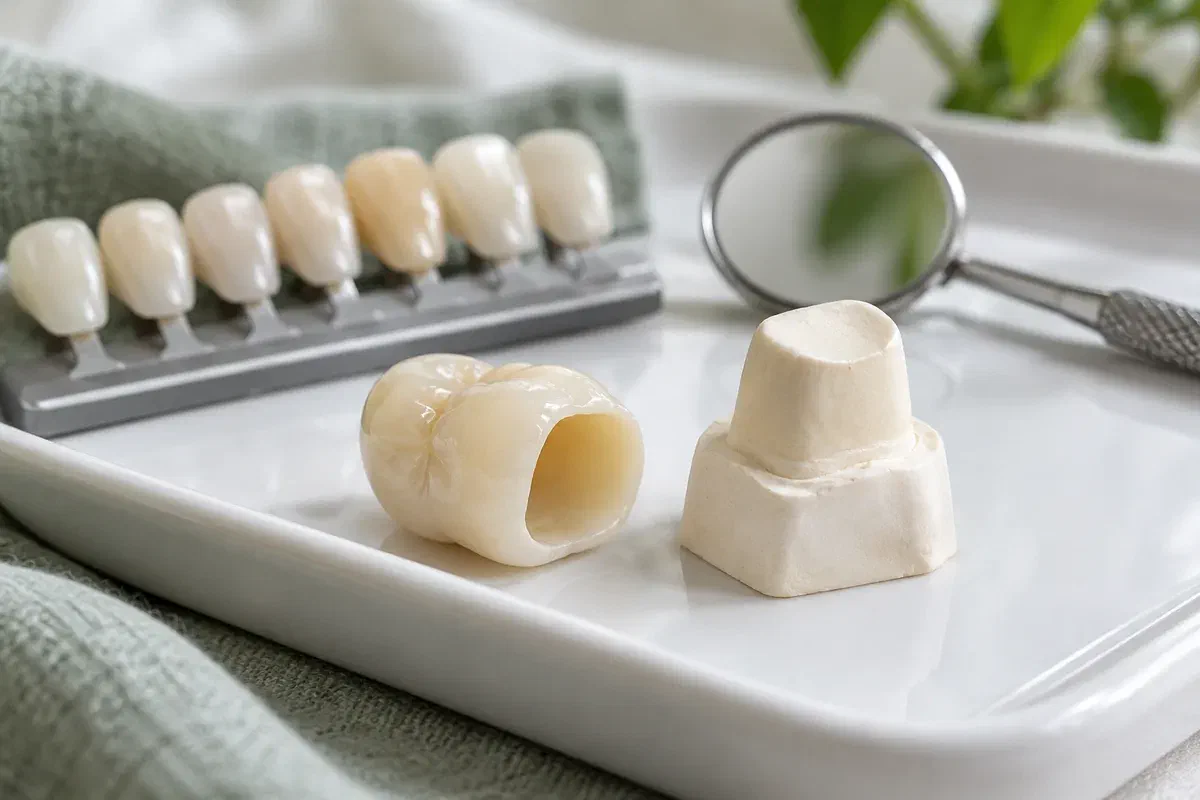
Illustrative ceramic crown and prepared-tooth model beside a shade guide
Signs the tooth is waiting on you

Feeling better is not the same as being finished.

The person who treated the canals can tell you what still needs to happen. Caring for a tooth under a temporary cover is different from living with a completed crown.

You still have the interim filling

That soft or provisional cover was placed to seal the opening for a limited time. Ask how long it is meant to last and which foods to avoid in the meantime. A quiet tooth may still be too fragile for hard or sticky foods.

Much of the tooth was already lost

Old fillings, a fracture or deep decay may have removed walls the tooth relied on. Find out what remains and how a crown would sit on it. Planning the core and the cover at the same time keeps the design sensible.

Two offices are involved

When an endodontist handled the root canal, confirm who books the crown and whether reports have been shared. Mention any recall the specialist wants. Clear handover means the tooth does not fall between appointments.

Call us if the temporary cover cracks or falls out, or if pain or swelling appears while you wait. A new problem should be reported straight away rather than saved for the crown visit.

What the restoration is for

A cover designed around the treated tooth

On a tooth that needs it, a crown can hold weakened walls together and give back a shape that works for biting. It also has to seal well at its edges. Ask how your proposed design deals with the specific damage on your tooth, because no single crown suits every case.

Where the tooth sits changes the priorities. A molar takes heavy chewing load, while a tooth near the front raises questions about shade and outline. The dentist balances those needs against how much natural tooth can be kept.

Patient information: ADA — the role of a dental crown

Coverage that fits the damage

Ask which cusps need protecting and the reason for each. You should see how the crown relates to what is left and whether a smaller option is reasonable. Covering more is not always better.

A core built first where needed

Some teeth need a build-up so the crown has something solid to hold. A post is added only when it is suited to keeping that core in place. Ask which pieces your plan includes and the job of each one.

A bite checked with you

The finished crown is compared against the teeth on either side and the ones it meets. Say so if it feels tall or snags when you chew. What you notice guides any adjustment after it is placed.

How the visits usually unfold

From temporary seal to finished crown

How many appointments you need depends on the tooth, the foundation and the method used to make the crown. Ask for the whole sequence and an estimate before the crown stage starts.

  1. Examine the treated tooth

    We look at the tooth, its current filling, any symptoms and the records from your root canal. X-rays may be taken. If healing or the canal work looks uncertain, further assessment may come before the final crown.

  2. Build the core and shape the tooth

    If a build-up is needed, it is placed, and the tooth is shaped for the chosen restoration. Material and appearance are discussed where they matter. Freezing or other comfort measures are still offered, even on a root-treated tooth.

  3. Take records and fit a temporary

    Impressions or a digital scan capture the shape for the crown. If you leave with a temporary, you get guidance on eating and cleaning around it. Confirm the return date and what to do if it loosens.

  4. Place the crown and plan reviews

    Fit, contacts with neighbouring teeth, appearance and bite are checked before the crown is cemented. Ask how to clean along its edge and when to come back. Regular exams continue to matter for the crown, the gums and the tooth underneath.

Living with the restored tooth

Fold the new crown into your usual routine

Follow the advice for your temporary and for the final crown. A tooth that has had a root canal still needs cleaning, check-ups and a call when something feels different.

Be gentle with the temporary

Skip foods and habits that could pull off or break the interim cover, as advised at your visit. If it comes out, call us. Avoid gluing it yourself or leaving the opening bare without talking to the team.

Notice how meals feel

Once the crown is cleared for normal use, pay attention to your bite at mealtimes. Let us know about a high spot, lasting tenderness or a change in how your teeth close. Grinding or clenching to test it is not a good idea.

Keep the edges clean

Brush with fluoride toothpaste and clean between teeth with a tool that suits the spot. Ask for help if floss shreds or the area is hard to reach. Decay can still start where crown meets tooth, so keep up with your exams.

Which restoration fits

Let the remaining tooth guide the choice.

Ask why a particular restoration is being suggested and how the alternatives compare for protection, preparation and upkeep.

When the structure needs full protection

A crown that covers the whole tooth

Full coverage may be advised when a large amount of tooth is missing or other findings call for it. Talk through the core, the material and the shaping involved. It only makes sense if the tooth left behind can support the crown.

When enough tooth remains

A smaller, more conservative repair

A filling or a partial-coverage restoration may be suitable for some teeth. Ask what makes your tooth a candidate and how it will be protected. Having had a root canal does not, on its own, mean every tooth must be crowned.

When questions remain about the tooth

More investigation first

Ongoing symptoms, a possible crack or doubt about the root support may need checking before a crown is made. Ask what is still unknown and how the tooth is protected while you wait. A crown should not cover up an unresolved problem.

Common questions in Milton

What people ask between root canal and crown

A good plan explains who does what, when each step happens and what each part costs. Bring any written instructions from your root canal appointment.

(905) 876-4488
Is it safe to chew on the tooth before the crown goes on?
Usually it is best to be cautious. A temporary filling and a weakened tooth may not handle hard foods well. Chew on the other side where you can, avoid sticky or very hard foods, and follow the specific instructions you were given until the final restoration is in place.
What is a core build-up, and will I need one?
A build-up replaces missing tooth structure so the crown has a stable base. Whether you need one depends on how much of the tooth remains after decay and treatment. The dentist will explain if it is part of your plan and how it relates to the crown.
My root canal was done by a specialist. Can you place the crown?
Yes, you can book an assessment with us. Let us know where the root canal was completed and ask that office to send records and recommendations. We examine the tooth before confirming the foundation and type of restoration it needs.
Will the crown match my other teeth?
For a visible tooth, shade and shape are discussed during planning. The material chosen affects appearance, strength and how much tooth is reshaped. Ask how the options compare for your tooth and what is realistic for its position.
What happens if I leave the temporary filling in for months?
Temporary materials are not designed to last indefinitely. They can wear, leak or break, and a weakened tooth may fracture. If you cannot keep your planned appointment, call to discuss how the tooth will be protected and when you can be seen.
Can I book the crown visit around a busy Milton schedule?
Our hours run Monday to Thursday from 11 am to 7 pm, with Friday to Sunday by appointment only. Ask how many visits your plan involves so you can arrange them ahead of time and avoid long gaps between stages.

Patient information: AAE — restoration principles after root canal treatment

Crown planning in Milton

Bring the tooth back to full use.

Come to our Bronte Street practice to talk about restoring your tooth after root canal treatment. Bring any records and questions, and we will examine the tooth and explain the core, cover and follow-up it needs.

Call if your temporary falls out or the tooth is getting worse. Online requests are for non-urgent appointments only.

Visit Milton Dental Clinic
Unit 1, 342 Bronte St. S, Milton, ON L9T 5B7
Get directions Clinic hours
Monday–Thursday
11am–7pm
Friday–Sunday
By appointment only

Areas we serve

  • Milton
  • Oakville
  • Mississauga
  • Georgetown
  • Halton Hills
  • Acton
  • Campbellville
  • Brampton
  • Burlington
  • Puslinch
  • Rockwood
  • Erin
  • Caledon
  • Etobicoke
  • Old Milton
  • Bronte Meadows
  • Timberlea
  • Dorset Park
  • Dempsey
  • Clarke
  • Beaty
  • Coates
  • Harrison
  • Scott
  • Willmott
  • Ford
  • Bowes
  • Cobden
  • Walker
  • Mountain View
  • Milton Heights
  • Hawthorne Village
  • Valley View
  • Fallingbrook
  • Nassagaweya
  • Trafalgar
  • Esquesing
  • Nelson
  • Brookville
  • Moffat
  • Glen Williams
  • Norval
  • Limehouse
  • Stewarttown
  • Ashgrove
  • Hornby
  • Silver Creek
  • Speyside
  • Scotch Block
  • North Oakville
  • River Oaks
  • Glen Abbey
  • West Oak Trails
  • Palermo
  • Bronte Creek
  • College Park
  • Joshua Creek
  • Uptown Core
  • Preserve
  • Iroquois Ridge
  • Lisgar
  • Meadowvale
  • Meadowvale Village
  • Churchill Meadows
  • Erin Mills
  • Central Erin Mills
  • Streetsville
  • East Credit
  • Creditview
  • Heartland
  • Sheridan
  • Mount Pleasant
  • Credit Valley
  • Huttonville
  • Churchville
  • Springbrook
  • Northwest Brampton
  • Bram West
  • Fletcher's Meadow
  • Fletcher's Creek South
  • Alton Village
  • Orchard
  • Millcroft
  • Headon Forest
  • Tansley
  • Brant Hills
  • Tyandaga
  • Kilbride
  • Lowville
  • Aberfoyle
  • Morriston
  • Arkell
  • Hillsburgh
  • Freelton
  • Carlisle
  • Waterdown
  • Flamborough
  • Mountsberg

How can we help?

Milton Dental Clinic

Have a question about your smile? Choose the option that works best for you.

For urgent dental concerns, please call.
Messages are reviewed during clinic hours.