

Illustrative consultation about reassessing a previously root-treated tooth
Restorative Dentistry

Root Canal Retreatment in Halton Hills

Retreatment often involves both your dentist and a root canal specialist. For households across Halton Hills, we explain who does what, how records move between offices, and how the final repair fits once the canals have been treated again.

Two clinicians, one tooth

Know who is responsible for each part of the work.

One of the most common sources of confusion with a second root canal is simply keeping track of who is doing what. Your general dentist may assess the tooth and later restore it, while an endodontist, a specialist in root canal treatment, may handle the retreatment in between. Each handover is a point where questions can slip.

Underneath the logistics is a clinical decision. A previously treated tooth may need attention again if healing did not complete, if decay or a broken filling let bacteria back in, or if something else changed. Pain near the tooth can also come from elsewhere. Retreatment is considered when the canals look like the source and the tooth can be restored afterward.

From Georgetown, Acton, Glen Williams or the smaller hamlets of Halton Hills, it helps to have one place that keeps the overall plan together. Tell us what you know about the first treatment. We will examine the tooth, explain what we find, and, if a specialist is appropriate, describe what the referral is for and what comes back to us.

Start with a coordinated assessment
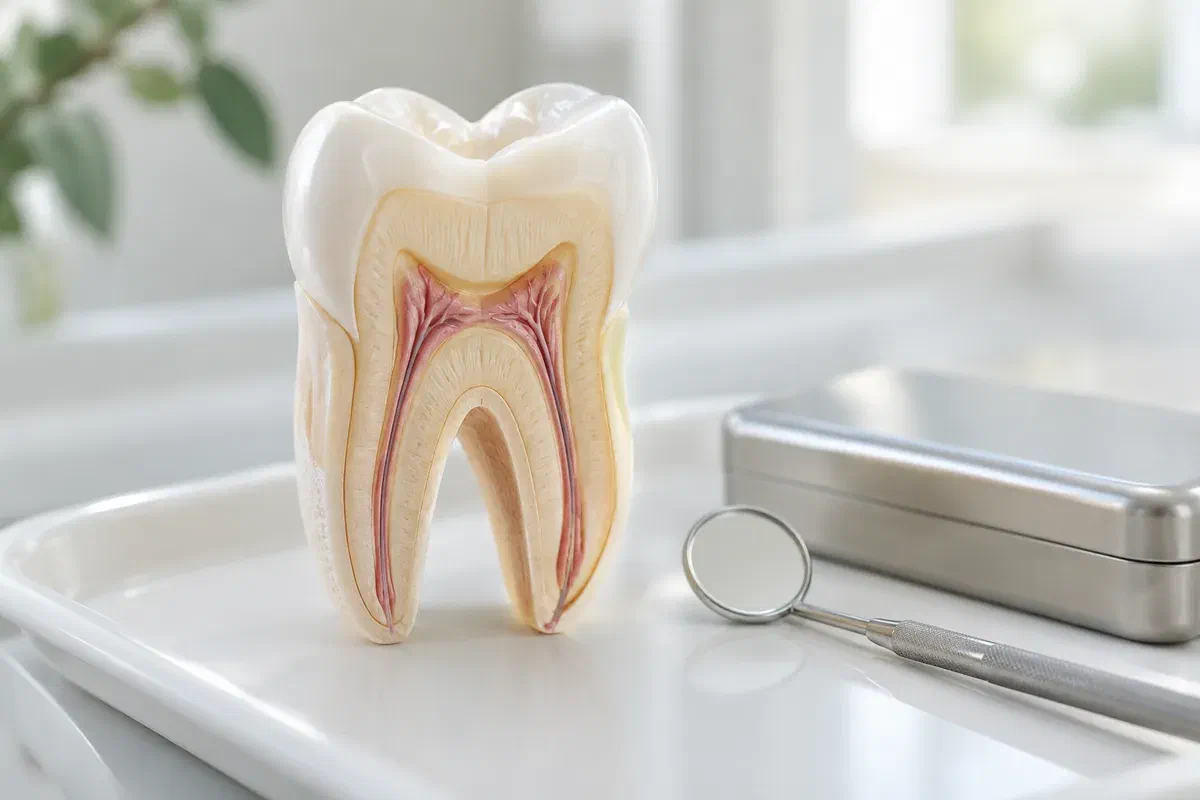
Illustrative cutaway molar teaching model used to explain the root canal space
Signs to raise with us

Mention anything new about the treated tooth.

Describe when the change started and how it differs from the weeks after the original root canal. This background guides the exam; it cannot confirm the diagnosis on its own.

Ache after a long settled period

Perhaps there is soreness when you bite, or a vague pressure around the area. Say whether it is steady or brought on by chewing. Other teeth and the gum are considered before any recommendation for further canal work.

A finding from routine imaging

A checkup X-ray can show a change near the root tip with no symptoms. Ask what was seen and whether older images exist to compare. Observation, more tests, or a specialist review are all possible next steps, and comfort alone does not decide which.

A damaged restoration

A loose crown, broken filling or decay along an edge can affect a tooth treated years ago. Explain when the damage occurred and whether the tooth was left exposed. The restoration and the canals are assessed as a pair.

Keep any planned review, even if the tooth feels better. Should pain build, swelling start, or a gum bump keep coming back before then, call us so the timing can be reconsidered.

Why coordination matters

Treatment works best when every step connects.

For a suitable tooth, retreatment offers a second opportunity to resolve a problem in the canal system. You should hear why the findings point toward it and what might limit the outcome. Keeping a natural tooth is worthwhile, and that goal depends on the canal work and the restoration being planned as one.

Make sure the discussion covers the current crown or filling, any post, the remaining tooth, and the earlier treatment history. Ask what would be removed to gain access and who would replace it. When both clinicians share the same picture, comparing retreatment with other options becomes much clearer.

Patient information: AAE — understanding endodontic retreatment

A shared reason for treating

Ask what the retreatment is intended to address and which questions are still open. Both the referring dentist and the specialist should be working toward the same aim. Discomfort on its own is not a defined purpose.

A referral with a clear question

When a specialist is suggested, ask what the visit is meant to answer: whether retreatment is feasible, whether surgery should be considered, or whether the tooth can be kept. Ask how the report will return to the dentist planning your restoration.

One plan for the final repair

Agree on the seal and protective restoration before the canal work begins. Ask about the number of visits, who will do them, and the costs involved. The tooth needs one connected plan, not two separate ones.

Who does what, and when

A handover plan for your tooth

Every tooth is different, so visit numbers and order vary. Confirm who leads each stage and how the tooth is protected between offices.

  1. Initial assessment with us

    Bring any records and describe your symptoms. Examination and suitable imaging assess the tooth and nearby bone. If further tests or a specialist view are needed, we explain why and what they should clarify.

  2. Specialist review if recommended

    The endodontist assesses whether retreatment suits the tooth, the likely difficulties, and the alternatives. Ask about access through or removal of the crown, the estimate, and what would happen if findings change during treatment.

  3. Retreatment of the canals

    If you proceed, the old root filling is taken out where required so each canal can be checked, disinfected and sealed again. The area is isolated and comfort is managed. Some teeth need two or more sessions.

  4. Back to us for the restoration

    The final crown or filling is placed by the agreed clinician, followed by reviews. Ask who will monitor healing. Follow-up assesses symptoms, function and healing over time, not just how the tooth feels in the first days.

Between offices

Look after the temporary until it is replaced.

Ask whoever treated you that day for care advice matching the work done. A temporary seal, a completed restoration, and an unfinished stage each need different precautions.

Chew gently on that side

Wait for the numbness to wear off before eating, then follow advice on how much to use the tooth. Avoid hard foods. If a temporary loosens, call the office that placed it rather than waiting for your next appointment.

Know who to call about symptoms

Report increasing soreness, a bite that feels high, or swelling to the treating clinician. Note when it started and what triggers it. Follow the pain advice you were given, and check before using medication that may conflict with your health history.

Keep both offices’ appointments

Restoration visits and healing reviews may be with different teams. Ask how records will travel between them and who answers questions in the meantime. A finished crown does not replace a review of the root treatment.

Options to weigh

Retreatment is one of several paths.

Ask why each reasonable choice fits or does not fit your tooth. A sound recommendation looks at the inside of the roots and the tooth’s ability to keep working afterward.

Reopening the original access

Nonsurgical retreatment

The canals are reached through the top of the tooth and treated again. Existing crowns or posts may complicate this. Ask what the clinician expects to correct and how the access will be sealed and protected.

A specialist’s alternative approach

Endodontic surgical assessment

For selected teeth, an endodontist may consider treating the root tip through the gum. Surgery and retreatment suit different circumstances and are sometimes combined. Ask why a surgical opinion is being sought rather than assuming it is the next step.

When retention is not realistic

Removal and a replacement discussion

Some teeth are too compromised to keep with reasonable confidence. Discuss why, what removal would involve, and possible replacements. Ask for the full sequence and upkeep of each option so you can compare them fairly.

Questions about referrals

Sorting out the specialist side

Ask for the diagnosis and the order of treatment to be explained before deciding. If you receive estimates from more than one office, check what each one covers.

(905) 876-4488
What is an endodontist?
An endodontist is a dentist with additional training focused on the inside of the tooth and root canal treatment. Complex retreatments are often referred to an endodontist. Your general dentist usually remains involved in assessing and restoring the tooth.
Do I have to see a specialist for retreatment?
Not always. It depends on how complex the tooth appears and what the assessment shows. Ask why a referral is or is not being suggested, and what the specialist visit would add to the decision.
How do records get shared between offices?
With your consent, clinics exchange relevant records such as images and treatment notes. Ask each office how and when this happens, and who will contact you once reports are received.
Who places the final crown after a specialist retreatment?
Often the general dentist, though arrangements vary. Ask before treatment starts who will do the final repair and how soon after the canal work it should happen. Check that the estimate reflects both stages.
My existing crown is quite new. Will it be removed?
Not necessarily. Some teeth can be retreated through an opening in the crown, which is then sealed. Others need the crown removed for access or because of a problem beneath it. Ask which approach is planned and why.
Can appointments be arranged with travel from Halton Hills in mind?
Ask for an outline of the likely visits with each office at the start. Knowing the sequence helps you plan time away from work or school, and some steps may be grouped when clinically reasonable.
Halton Hills retreatment planning

One starting point for a multi-office plan

Book an assessment with our Bronte Street team for a tooth that has had a root canal. Bring any records, and we will explain the findings, whether referral to a specialist makes sense, and how the restoration will be coordinated afterward.

Phone the clinic about growing pain or swelling instead of waiting on a reply to an online request.

Visit Milton Dental Clinic
Unit 1, 342 Bronte St. S, Milton, ON L9T 5B7
Get directions Clinic hours
Monday–Thursday
11am–7pm
Friday–Sunday
By appointment only

Areas we serve

  • Milton
  • Oakville
  • Mississauga
  • Georgetown
  • Halton Hills
  • Acton
  • Campbellville
  • Brampton
  • Burlington
  • Puslinch
  • Rockwood
  • Erin
  • Caledon
  • Etobicoke
  • Old Milton
  • Bronte Meadows
  • Timberlea
  • Dorset Park
  • Dempsey
  • Clarke
  • Beaty
  • Coates
  • Harrison
  • Scott
  • Willmott
  • Ford
  • Bowes
  • Cobden
  • Walker
  • Mountain View
  • Milton Heights
  • Hawthorne Village
  • Valley View
  • Fallingbrook
  • Nassagaweya
  • Trafalgar
  • Esquesing
  • Nelson
  • Brookville
  • Moffat
  • Glen Williams
  • Norval
  • Limehouse
  • Stewarttown
  • Ashgrove
  • Hornby
  • Silver Creek
  • Speyside
  • Scotch Block
  • North Oakville
  • River Oaks
  • Glen Abbey
  • West Oak Trails
  • Palermo
  • Bronte Creek
  • College Park
  • Joshua Creek
  • Uptown Core
  • Preserve
  • Iroquois Ridge
  • Lisgar
  • Meadowvale
  • Meadowvale Village
  • Churchill Meadows
  • Erin Mills
  • Central Erin Mills
  • Streetsville
  • East Credit
  • Creditview
  • Heartland
  • Sheridan
  • Mount Pleasant
  • Credit Valley
  • Huttonville
  • Churchville
  • Springbrook
  • Northwest Brampton
  • Bram West
  • Fletcher's Meadow
  • Fletcher's Creek South
  • Alton Village
  • Orchard
  • Millcroft
  • Headon Forest
  • Tansley
  • Brant Hills
  • Tyandaga
  • Kilbride
  • Lowville
  • Aberfoyle
  • Morriston
  • Arkell
  • Hillsburgh
  • Freelton
  • Carlisle
  • Waterdown
  • Flamborough
  • Mountsberg

How can we help?

Milton Dental Clinic

Have a question about your smile? Choose the option that works best for you.

For urgent dental concerns, please call.
Messages are reviewed during clinic hours.