

Illustrative consultation with a patient bringing records for another dental opinion
Restorative Dentistry

Root Canal Second Opinions in Campbellville

Is there room to think before a root canal, or should it happen soon? From Campbellville, book a second opinion in Milton to understand the findings, the timing that is reasonable for your tooth, and how to plan the next visits.

Deciding on your own timeline

How long can this tooth wait?

When a root canal is recommended, one of the first practical questions is timing. Do you need to book this week, or is there room to think, compare and fit appointments around the rest of life? The answer depends on what is happening in the tooth, and a second opinion is a good place to get a clear sense of it.

You may hear the same recommendation again, a suggestion for extra testing, or another reasonable option. We don’t set out to overturn anyone’s advice. The value is in understanding the evidence, the uncertainty, and how urgent or flexible each path really is for you.

Life in a rural hamlet like Campbellville often means grouping errands and appointments, so knowing the timeline helps you plan. Bring whatever plan and records you have. We will examine the tooth, explain what we see, and tell you when an endodontist should be involved. No technical vocabulary is needed to ask, “How soon?”

Ask how much time your tooth allows
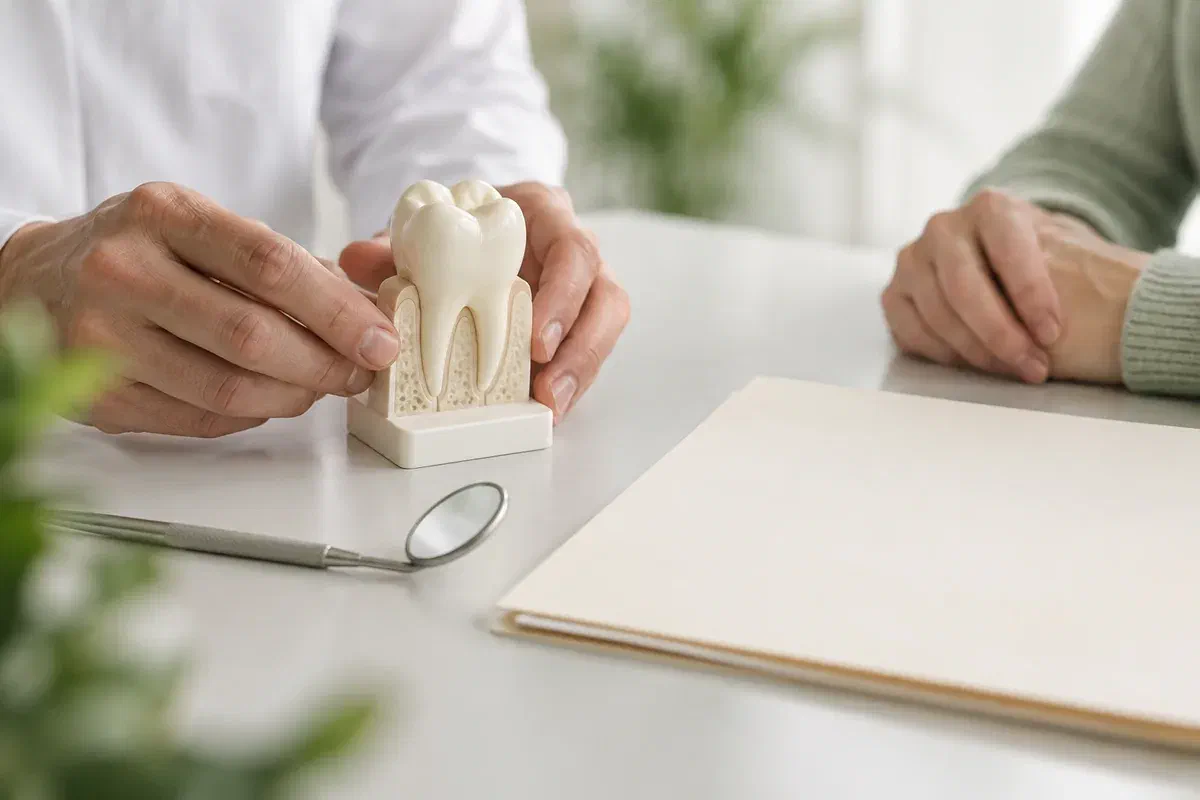
Illustrative review of a tooth model and a plain records folder at a consultation
What you might be weighing

Urgent, soon, or watch and wait?

Your main question guides the visit. Tell us if it is the diagnosis, the procedure, how the plan fits together, or a symptom you can’t explain.

You don’t know how serious it is

Being told a tooth needs a root canal doesn’t always come with a sense of urgency, or lack of it. Ask what is affecting the nerve or root area and what the examination showed. Understanding the problem is the first step to understanding the timing.

Different plans, different timelines

A root canal now, monitoring, or extraction can each change how many visits you need and when. Bring all the plans you have. They may differ because they include different stages, not only because of disagreement.

An old root canal is acting up

If a previously treated tooth is now flagged for retreatment or removal, share its history. Remaining structure, the restoration and the cause of symptoms all affect both the advice and its urgency. Specialist review may help in harder cases.

Some signs mean the tooth can’t wait: worsening pain, swelling in the face, or a recent injury. Call promptly and describe them, rather than holding off for a second-opinion appointment.

What the consultation gives you

A timeline you understand, not just a date.

A useful review sorts what is certain from what is still open. Ask which findings are clear, which involve judgement, and which new information could change the advice. That tells you how much flexibility you really have, and what would shorten it.

It also shows the full sequence. A root canal is often followed by a build-up or crown, and removing a tooth usually raises a separate replacement question. Knowing every step lets you plan visits, maintenance and costs over the coming months, not only the next appointment.

Patient information: AAE — seeking informed choices before irreversible care

Your schedule taken seriously

Let us know if seasonal work, family commitments, the number of trips, anxiety or cost will shape your choices. These priorities don’t change the findings, but they help us plan care that is both reasonable and realistic.

The alternatives, side by side

Ask what each option would achieve, what it can’t do, and how timing affects it. If an option isn’t suitable, ask why. You should know whether it is ruled out clinically or simply carries different compromises.

A clear owner for the next step

Before leaving, confirm who will arrange a referral, send records or book treatment. If your regular dentist will carry on, ask how our opinion will reach them. Nothing should be left hanging.

Your appointment

Understand the tooth, then plan the calendar.

When booking, say it is a second opinion and mention any timing pressures. The review may include examination and testing as well as discussion.

  1. Tell us what was proposed

    Share the tooth involved, the recommended treatment and any reports or X-rays. Let us know whether treatment has started or an appointment is already set. We can explain how to move records securely between offices.

  2. Describe the symptoms and their pattern

    Explain what you feel, how often, and whether it is getting better, worse or staying the same. Include medications, health conditions and earlier care of the tooth. Changes over time are especially useful when judging urgency.

  3. Examine and test the tooth

    The dentist looks at the records and examines the tooth with appropriate tests. New imaging may be suggested if it would help answer a question. Ask what each check adds and whether a specialist should be consulted.

  4. Set the next step and its timing

    You hear whether the exam backs the first advice, favours another approach, or calls for more testing, along with a realistic sense of how soon each would need to happen. Ask what waiting could mean. We confirm what comes next and how our opinion will be passed on.

Once you’re back home

Use the time you have wisely.

Many second-opinion visits finish with advice rather than treatment. Keep the information, know the warning signs, and plan your next appointment while it is fresh.

Compare plans on equal terms

Check whether each estimate covers assessment, root canal treatment, temporary protection and the lasting restoration. When extraction is offered, see whether replacement is quoted separately. Unequal scope can make one route look faster.

Know who handles problems meanwhile

If another office started treatment, confirm who to call about a temporary filling or new symptoms. A second opinion doesn’t transfer responsibility on its own. Keep both offices informed of any agreed change.

Write down your decision window

Note the timing the dentist suggested and the symptoms that would mean calling sooner. Keep it somewhere the rest of the household can see, especially if someone else drives you in. If the schedule conflicts with work or travel, raise it early so appointments can be grouped or adjusted.

What you may be told

Act now, choose differently, or learn more first.

The review is an assessment, with no guaranteed treatment or outcome. Ask what the conclusion is based on and how confident it can be.

When the plan is supported

Go ahead with root canal care

The findings may confirm that a root canal is a sound way to keep the tooth, sometimes with a clear sense of how soon. Ask about comfort, the restoration afterwards and whether your usual dentist will be involved. Knowing the timing can make the plan easier to organise.

When another approach fits

Follow a different route

The assessment may suggest an alternative or a different sequence. Ask which finding changes the advice and what each option means for the tooth. The recommendation should be explained, not presented as one opinion against another.

When the answer isn’t clear yet

Look further before deciding

Some teeth need more investigation before anyone can recommend treatment confidently. Endodontists are dentists with specialist training focused on the inside of the tooth and its roots. Ask what a referral should settle and how to manage the tooth until then.

Patient information: AAE — the role of an endodontist

Campbellville timing questions

About waiting, deciding and planning visits.

Bring the dates you are working around, plus your most important questions. It helps us give practical advice.

(905) 876-4488
How quickly does a root canal usually need to be done?
It varies. Some teeth need prompt treatment, especially with pain or swelling, while others allow time to plan. Ask the dentist what the findings suggest for your tooth and which signs would mean acting sooner.
What could happen if I put off treatment for too long?
Depending on the problem, delay may allow infection or damage to progress, which can affect what options remain. A tooth that could be saved now might be harder to restore later. Ask how waiting might change things for your particular tooth, and what a sensible check-in point would be if you do take time.
Can I take antibiotics instead of having a root canal?
Antibiotics may sometimes be used for spreading infection, but they don’t usually resolve a problem inside the tooth on their own. Ask the dentist what is appropriate for you and why.
Is one X-ray from my previous office enough for you to judge the urgency?
An image helps, but examination, testing and your description of symptoms all contribute. The dentist will tell you whether more information is needed to give a useful answer.
Living in Campbellville, can I combine appointments to save trips?
Mention it when you book. Sometimes steps can be planned together, but some need time in between. Sending records beforehand helps the team plan the visit efficiently.
If I already started treatment elsewhere, can I still pause to get an opinion?
Talk to the treating office before pausing. A partly treated tooth needs protection and a plan. Tell us exactly what stage was reached so we can advise on timing.
Root canal second opinions near Campbellville

Know your timing, then make your choice.

Book a second-opinion visit with our team on Bronte Street in Milton. Share the plan and your questions, including any dates you are working around, and we will assess the tooth and discuss a reasonable next step.

If symptoms are getting worse or treatment has already begun, please call when booking so we understand how soon to see you.

Visit Milton Dental Clinic
Unit 1, 342 Bronte St. S, Milton, ON L9T 5B7
Get directions Clinic hours
Monday–Thursday
11am–7pm
Friday–Sunday
By appointment only

Areas we serve

  • Milton
  • Oakville
  • Mississauga
  • Georgetown
  • Halton Hills
  • Acton
  • Campbellville
  • Brampton
  • Burlington
  • Puslinch
  • Rockwood
  • Erin
  • Caledon
  • Etobicoke
  • Old Milton
  • Bronte Meadows
  • Timberlea
  • Dorset Park
  • Dempsey
  • Clarke
  • Beaty
  • Coates
  • Harrison
  • Scott
  • Willmott
  • Ford
  • Bowes
  • Cobden
  • Walker
  • Mountain View
  • Milton Heights
  • Hawthorne Village
  • Valley View
  • Fallingbrook
  • Nassagaweya
  • Trafalgar
  • Esquesing
  • Nelson
  • Brookville
  • Moffat
  • Glen Williams
  • Norval
  • Limehouse
  • Stewarttown
  • Ashgrove
  • Hornby
  • Silver Creek
  • Speyside
  • Scotch Block
  • North Oakville
  • River Oaks
  • Glen Abbey
  • West Oak Trails
  • Palermo
  • Bronte Creek
  • College Park
  • Joshua Creek
  • Uptown Core
  • Preserve
  • Iroquois Ridge
  • Lisgar
  • Meadowvale
  • Meadowvale Village
  • Churchill Meadows
  • Erin Mills
  • Central Erin Mills
  • Streetsville
  • East Credit
  • Creditview
  • Heartland
  • Sheridan
  • Mount Pleasant
  • Credit Valley
  • Huttonville
  • Churchville
  • Springbrook
  • Northwest Brampton
  • Bram West
  • Fletcher's Meadow
  • Fletcher's Creek South
  • Alton Village
  • Orchard
  • Millcroft
  • Headon Forest
  • Tansley
  • Brant Hills
  • Tyandaga
  • Kilbride
  • Lowville
  • Aberfoyle
  • Morriston
  • Arkell
  • Hillsburgh
  • Freelton
  • Carlisle
  • Waterdown
  • Flamborough
  • Mountsberg

How can we help?

Milton Dental Clinic

Have a question about your smile? Choose the option that works best for you.

For urgent dental concerns, please call.
Messages are reviewed during clinic hours.