

Illustrative consultation with a patient bringing records for another dental opinion
Restorative Dentistry

Root Canal Second Opinions in Rockwood

Not sure what to ask, or how to tell whether a root canal recommendation is well explained? From Rockwood, come prepared to a second-opinion visit in Milton and leave with answers you can actually use.

Coming prepared

What does a good explanation sound like?

Most people aren’t sure what to ask about a root canal until after the appointment is over. A useful test is simple: can you explain to a friend what is wrong with the tooth, why this treatment was chosen, and what the alternatives were? If not, a second opinion is a reasonable next step.

Expect a fresh, independent look rather than a guaranteed change of plan. You might hear that the original recommendation holds, that one more test would help, or that a different approach is also sensible. Whatever the outcome, the goal is that you understand the evidence, its limits, and what each option involves.

From Rockwood, a little preparation makes the trip worthwhile. Bring the written plan, any records you can get, and a short list of questions. The dentist looks at the tooth itself, puts the findings into ordinary words, and says when an endodontist would add something. A question as plain as “What happens if I do nothing?” is a good one.

Bring your questions for a second look
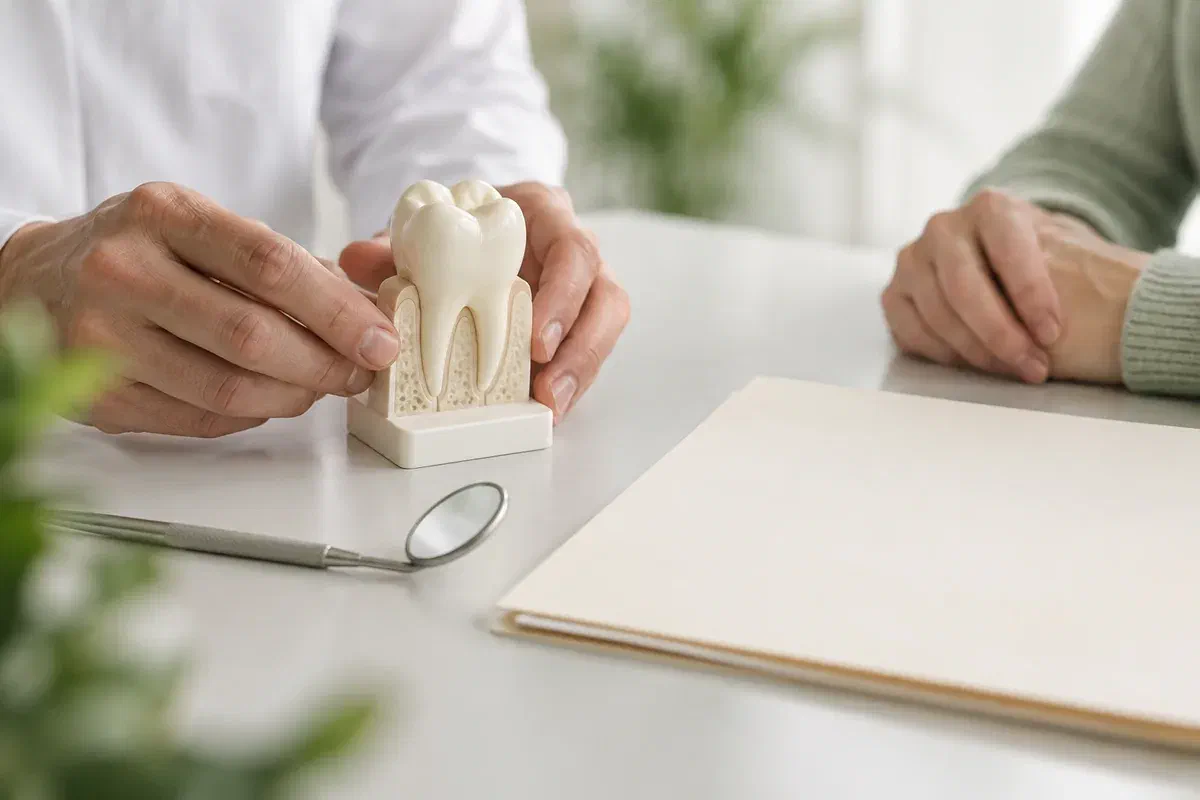
Illustrative review of a tooth model and a plain records folder at a consultation
Questions worth asking

Start with the one you couldn’t answer yourself.

Pick the area you understand least. That might be the diagnosis, the procedure, how the stages connect, or a symptom that still puzzles you.

“What exactly is wrong?”

A good answer names the problem, such as an inflamed or infected nerve or a change near the root, and links it to what the exam showed. If you can’t say what the problem is, ask again. Treatment should follow from a clear finding.

“How do these plans compare?”

Root canal care, a crown and extraction each come with different visits and upkeep. Bring every plan you have. Sometimes the difference is simply that one lists the full sequence and another doesn’t, rather than a real clinical disagreement.

“Why is this treated tooth a problem again?”

If retreatment or removal of an already treated tooth is proposed, ask what has changed. Share the history and current symptoms. The remaining tooth, its restoration and the cause of the problem all count, and a specialist’s view may help in harder cases.

Some situations need care first and questions later: pain that keeps escalating, swelling of the face or jaw, or a freshly injured tooth. Tell us about these when you call.

What you should leave with

Answers you could repeat at the kitchen table.

The best sign of a useful consultation is that you can tell the certain parts from the uncertain ones. Ask which findings are clear, what is being inferred, and what could change the recommendation. Even if some doubt remains, you will know exactly where it lies.

A good explanation also covers what comes after. Most root-treated teeth still need a build-up, a crown or both, and an extraction tends to lead to a decision about replacement. Asking about the complete route helps you compare visits, ongoing care and cost, not just the first step.

Patient information: AAE — seeking informed choices before irreversible care

A conversation that includes you

Mention what matters most to you, whether that is saving the tooth, managing nerves, arranging visits around work or understanding cost. Those priorities don’t replace the findings, but they help focus the discussion on choices that suit you.

Alternatives with reasons

For each option, ask what it would achieve and what it wouldn’t. If one is not advised, ask why. Listen for whether it is clinically unsuitable or just a different trade-off. Both are fair answers, but they mean different things.

A practical finish

Before you go, find out who will send records, make any referral or book treatment. If you are returning to your own dentist, ask how the findings will reach them. You should be able to say what happens next.

How the appointment unfolds

Your questions guide the visit.

Say you are booking a second opinion, and feel free to send your list of questions in advance. The visit may include examination and tests, not only a review of past images.

  1. Bring the plan and paperwork

    Note the tooth, the treatment proposed and the office that suggested it. Share any X-rays or reports. Mention if treatment has begun or another appointment is booked. We can help you request records securely.

  2. Explain the tooth in your words

    Describe what you feel and when, what triggers it, and whether it has changed. Add medications, health conditions and past work on the tooth. Those details help us understand both the tooth and the earlier advice.

  3. Examination with explanation

    The dentist reviews records and examines the tooth, using tests that suit the question and explaining what each one checks. If extra imaging would help, you will be told why. Ask whether a specialist should be involved.

  4. Answer your list together

    Item by item, we work down your list and say plainly whether the exam backs the first recommendation, favours something else, or leaves a gap that needs filling. Ask about timing and the effect of waiting. You leave knowing the next step and how our opinion will be shared.

Back home

Check your list one more time.

Often you leave with a recommendation rather than treatment. Keep the notes you made, and be sure of the basic care the tooth needs in the meantime.

Make sure the plans compare fairly

See whether each estimate covers assessment, the root canal, any interim seal and the permanent crown or filling. Where extraction is one option, check whether a replacement is a separate cost. Matching the scope first avoids misleading comparisons.

Note who to contact in the meantime

If another office began treatment, ask who you should ring if the temporary comes loose or new pain starts. Our opinion does not automatically shift that responsibility. Let both offices know if you change arrangements.

Write down the timing you were given

How long you can take depends on the tooth and findings. Note the warning signs that mean calling sooner. If the suggested timing doesn’t work for you, raise it so the next step can be planned sensibly.

Possible answers

Yes, no, or not yet.

We provide an assessment, not a guarantee of any particular treatment. Ask what our conclusion depends on and how sure we can be.

When the findings support it

Yes: go ahead with the root canal

We may agree that root canal treatment makes sense for keeping the tooth. Comfort during treatment, the crown or filling afterwards and the role of your usual dentist are all fair topics. Sometimes hearing the reasoning a second time is what makes the decision feel settled.

When a different approach fits

No: another route is better

The assessment may point toward an alternative treatment or a different sequence. Ask which finding changed the advice and what each option would mean for the tooth. A good recommendation always comes with its reasons.

When the question is still open

Not yet: more information first

Some teeth and symptoms need further testing before anyone can advise confidently. An endodontist is a dentist who limits their practice to root canal diagnosis and treatment. Ask what the referral should clarify and how to care for the tooth in the meantime.

Patient information: AAE — the role of an endodontist

Rockwood second-opinion questions

Before you agree to a root canal.

Write your questions down and bring them. Having them on paper makes it easier to get the answers you came for.

(905) 876-4488
What are the most important questions to ask about a root canal recommendation?
Ask what is wrong, how sure the dentist is, what the alternatives are, what happens if you wait, and what the full plan includes. Those five usually cover the essentials, but add anything that matters to you.
What happens if I decide to do nothing about the tooth?
That depends on the problem. Some conditions can worsen over time, while others may be monitored. Ask the dentist to explain the likely course for your tooth and what signs to watch for.
Is it all right to take notes or record the explanation?
Taking notes is a good idea. If you would like to record the discussion, ask at the start of the visit. Bringing someone with you to help remember details can also be useful.
How can I tell if the explanation I was given was complete?
A complete explanation usually names the problem, explains how it was found, describes the alternatives, and covers the full treatment sequence. If any of those pieces are missing, it is reasonable to ask.
What should I bring if I’m not sure which tooth is involved?
Bring any written plan or estimate and the name of the office that made it. Point to the area and describe the symptoms. The team can help track down the records, so you don’t need to know tooth numbers.
Making the trip from Rockwood, should I send anything ahead?
Sending records and your list of questions before the appointment helps the dentist prepare. Mention any symptoms when you book so the visit can be planned appropriately.
Root canal second opinions for Rockwood

Bring your list. Leave with answers.

Come in to the Bronte Street clinic with the recommendation, your records and the questions you want answered, and the dentist will examine the tooth and help you weigh an appropriate next step.

Please call when booking if treatment has already begun or the tooth is getting worse, so the team can gauge the timing.

Visit Milton Dental Clinic
Unit 1, 342 Bronte St. S, Milton, ON L9T 5B7
Get directions Clinic hours
Monday–Thursday
11am–7pm
Friday–Sunday
By appointment only

Areas we serve

  • Milton
  • Oakville
  • Mississauga
  • Georgetown
  • Halton Hills
  • Acton
  • Campbellville
  • Brampton
  • Burlington
  • Puslinch
  • Rockwood
  • Erin
  • Caledon
  • Etobicoke
  • Old Milton
  • Bronte Meadows
  • Timberlea
  • Dorset Park
  • Dempsey
  • Clarke
  • Beaty
  • Coates
  • Harrison
  • Scott
  • Willmott
  • Ford
  • Bowes
  • Cobden
  • Walker
  • Mountain View
  • Milton Heights
  • Hawthorne Village
  • Valley View
  • Fallingbrook
  • Nassagaweya
  • Trafalgar
  • Esquesing
  • Nelson
  • Brookville
  • Moffat
  • Glen Williams
  • Norval
  • Limehouse
  • Stewarttown
  • Ashgrove
  • Hornby
  • Silver Creek
  • Speyside
  • Scotch Block
  • North Oakville
  • River Oaks
  • Glen Abbey
  • West Oak Trails
  • Palermo
  • Bronte Creek
  • College Park
  • Joshua Creek
  • Uptown Core
  • Preserve
  • Iroquois Ridge
  • Lisgar
  • Meadowvale
  • Meadowvale Village
  • Churchill Meadows
  • Erin Mills
  • Central Erin Mills
  • Streetsville
  • East Credit
  • Creditview
  • Heartland
  • Sheridan
  • Mount Pleasant
  • Credit Valley
  • Huttonville
  • Churchville
  • Springbrook
  • Northwest Brampton
  • Bram West
  • Fletcher's Meadow
  • Fletcher's Creek South
  • Alton Village
  • Orchard
  • Millcroft
  • Headon Forest
  • Tansley
  • Brant Hills
  • Tyandaga
  • Kilbride
  • Lowville
  • Aberfoyle
  • Morriston
  • Arkell
  • Hillsburgh
  • Freelton
  • Carlisle
  • Waterdown
  • Flamborough
  • Mountsberg

How can we help?

Milton Dental Clinic

Have a question about your smile? Choose the option that works best for you.

For urgent dental concerns, please call.
Messages are reviewed during clinic hours.