

Illustrative consultation about a removable denture and repair arrangements
Restorative Dentistry

Same-Day Denture Repairs in Mississauga

A partial denture with a snapped clasp, or a full denture split down the middle, needs a different conversation. From Mississauga, call us to describe the appliance, ask about prompt repair options and learn what we will need to check.

Partials, full dentures and everything between

The kind of denture shapes the kind of repair.

Not every broken denture is the same problem. A partial that hooks around your natural teeth relies on clasps and a framework, while a full denture depends on the acrylic base resting evenly on your gums. When one of these fails, eating, speaking and simply feeling ready to go out can all be affected. Knowing which type you have is a good start toward the right repair.

Certain repairs, such as rejoining a clean acrylic crack, may be manageable quickly. Others, like a fractured metal clasp, a damaged framework or a denture that was already loose, can need impressions, lab work or a different plan altogether. The condition of the surrounding material and your own teeth also matters. For that reason, a same-day result is something we try to confirm after looking, not something we can offer from a description.

Before making the trip from western neighbourhoods such as Meadowvale or Churchill Meadows, please call our Bronte Street practice. Let us know whether the appliance is full, partial or implant-retained, what broke and whether any teeth or gums feel sore. The team can then discuss assessment, what to bring and how to manage meanwhile.

Book an assessment for a broken denture
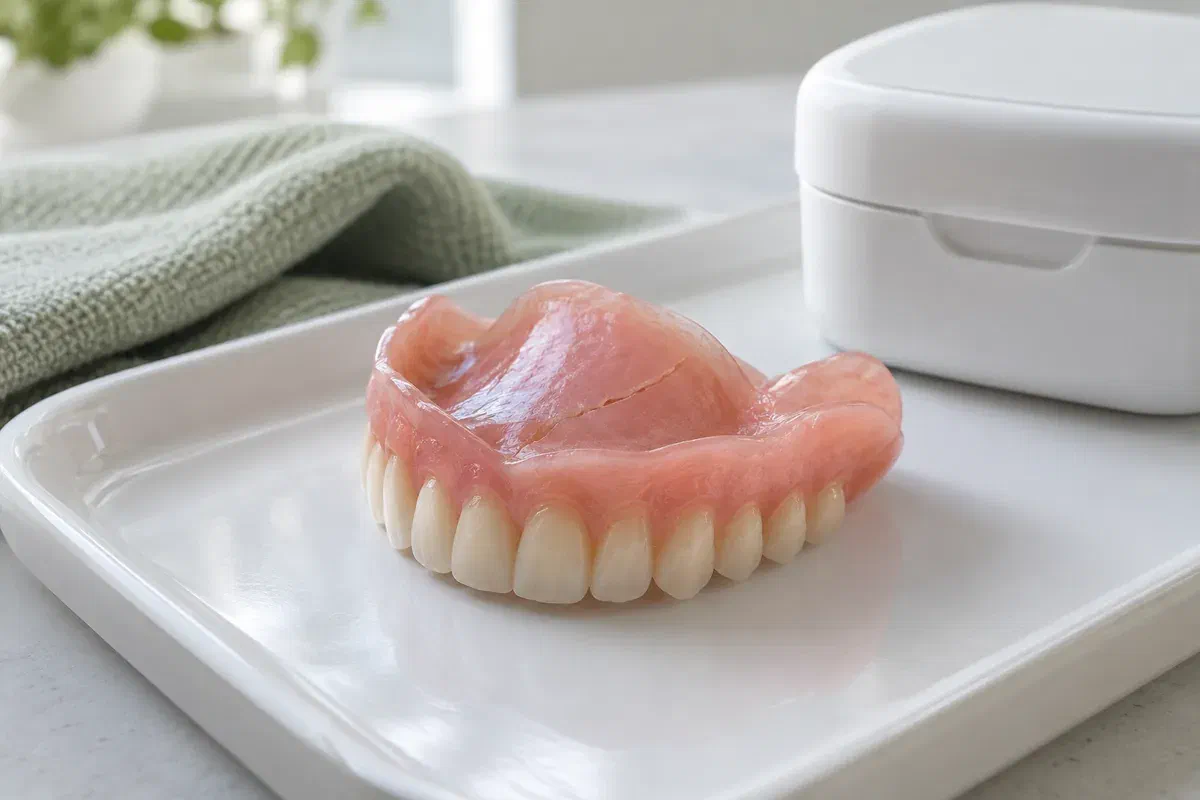
Illustrative upper denture with a fine fracture in its pink acrylic base
Describing the damage

Which part gave way?

Technical terms are not needed. Tell us what you can see and how the denture had been fitting, and we can prepare for the right kind of assessment.

The acrylic is cracked or in pieces

Describe whether the pink plastic has a fine line, has broken in two, or is missing a section. Keep all the parts in a firm box. Avoid bending them or holding the denture together in your mouth to see whether it still works.

A clasp, tooth or attachment is broken

On a partial, clasps grip your natural teeth, so a broken one can leave the denture unstable. Keep any fragment, and mention metal frameworks or implant clips. Do not wear a denture with a part that could come free while you chew.

There were problems before the break

Mention looseness, rocking, food trapping or sore spots that came first, and any earlier repairs. A repair can rejoin the material without solving a fit issue. That history helps decide whether repair on its own is the right answer.

Please do not bend clasps back with pliers, glue the pieces or file sharp edges. These can affect your natural teeth, alter the fit and make a professional repair more difficult.

What a timely repair offers

Keeping your current denture working, where that is sensible.

When the damage can be repaired well, keeping the denture you have can shorten the disruption and avoid an immediate replacement. For partial wearers, a stable appliance also helps protect the natural teeth it rests against. Ask whether the repair is a long-term solution or a bridge to other care.

Fast does not always mean right. The clinician reviews the break, the denture’s fit on your gums and any natural teeth, and your bite. A clasp that keeps failing, worn teeth or a loose fit may suggest a different approach, and you should understand any limits that will remain after the work.

Patient information: ADA — professional adjustment and repair of partial dentures

A description of the proposed work

Ask exactly what is damaged and how it will be repaired. Fixing a clasp, reattaching a tooth and mending a base are different tasks, with different timing and estimates. A clear explanation helps you weigh your options.

Arrangements that work for you

Confirm when to leave the denture, whether a fitting appointment follows and how it will be returned. Mention transport, language or scheduling needs. A shared plan is more reliable than assuming it will be done while you wait.

A look at the natural teeth too

For partial dentures, ask whether the supporting teeth are healthy and stable. Problems there can affect how the denture performs. The assessment can separate today’s repair from care that helps the whole arrangement last.

Getting the repair done

A call, an exam, a decision and a final fit.

How long a repair takes depends on the damage and the work involved. The team will explain what can be confirmed before the visit and what has to wait for the clinician.

  1. Explain the denture and the break

    Say whether it is a full or partial denture, what broke and whether there is pain, swelling or a cut. Mention implants or earlier repairs. Ask about available times and how to bring the appliance, rather than counting on a same-day finish.

  2. Assessment of appliance and teeth

    Bring all the pieces and any records you have. The clinician checks the damage, the fit and the gums, along with any natural teeth that support a partial. Impressions may be needed to plan the repair properly.

  3. Confirm the repair plan

    Talk through whether repair suits the denture, what it involves, the estimate and any limits. Framework or clasp work may require lab time. Agree on how you will manage while it is away and how you will be contacted.

  4. Fit check before you leave

    The repaired denture should be checked for comfort, stability and bite, and on a partial, for how the clasps sit. Ask how to wear and clean it again. Confirm any further care before you go.

Back in your mouth

It should click into place easily, not with pressure.

Follow the guidance for your denture and the specific repair. If a clasp feels tight or a new sore spot appears, call the clinician rather than adjusting it yourself.

Return to everyday use gradually

Ask whether any foods should be avoided at first. Notice how the denture feels as you speak and eat. If it will not seat fully or causes pain, get advice instead of biting down to push it in.

Clean around clasps and teeth

Use a cleanser suitable for the acrylic and any metal parts, and keep cleaning your natural teeth carefully. Work over a towel or basin of water. Ask about storage, and avoid hot water that could warp the base.

Attend the follow-up

Natural teeth that hold a partial still need their regular dental checks, and the denture needs reviewing too. Come back for any suggested adjustment, and say so if soreness or looseness lingers. A reline or replacement, if mentioned, deserves a date to reconsider.

Patient information: CDA — caring for dentures

Possible ways forward

Matching the fix to the appliance.

Clasps, frameworks and acrylic each have their own repair limits. Find out whether the plan covers only the broken part or also the way the appliance sits.

When the appliance is still sound

Repairing the current denture

A suitable crack, detached tooth or broken clasp may be repaired while keeping the denture. The clinician will explain any limits. Same-day completion depends on the type of repair and on clinic and lab availability.

When fit was already a concern

Repair plus adjustment or reline

If the partial rocked on its clasps or the full denture rubbed, mending the break may not be enough. An adjustment or reline answers a different problem from the fracture itself, so ask whether the clinician would do both at once or one after the other.

When repair would not be enough

Replacing the denture

An extensively damaged or frequently repaired denture, or one that no longer suits your mouth, may need replacing. Ask about interim options and realistic timing. A short-term repair might help bridge the gap if you understand that purpose.

Partial and full denture repair questions

Answers that depend on the appliance.

A phone call gives us a starting point. A dependable recommendation generally needs an examination of the denture and your mouth.

(905) 876-4488
Is repairing a partial denture different from repairing a full one?
Often, yes. Partials can involve metal frameworks and clasps that grip natural teeth, which may need lab work. Full dentures rely on the acrylic base. The clinician will explain what your repair involves after looking at it.
Can a broken metal clasp be fixed, or does the whole partial need replacing?
Many clasps can be repaired or replaced on the existing denture, but it depends on the design and the condition of the framework. Bring the denture and any broken piece so the clinician can advise.
Will wearing a partial with a broken clasp harm my natural teeth?
A loose partial can move against the teeth it rests on and may irritate the gums. It is usually best to leave it out until it has been assessed. Ask the team when you call.
My full denture split in half. Can that be rejoined?
A clean split can often be repaired, depending on the material and how the pieces fit together. Keep both halves in a sturdy container and avoid gluing them. The clinician will check whether a repair will give a reliable fit.
Does fixing a crack make a rocking denture more stable?
Generally not. A repair restores the broken area; it does not reshape the fit. Mention the rocking and when it started. Adjustment, relining or replacement may be suggested in addition to the repair.
I am in Mississauga. How can I avoid an extra trip for the repair?
Call before coming in so the team can explain what to bring and whether the denture may need to stay for lab work. Ask about the likely timing so you can plan the drop-off and the fitting visit together.
Arranging a repair from Mississauga

Tell us about your denture, and we will plan from there.

Start with a phone call to our Bronte Street practice. Tell us whether it is a partial or full denture and what broke, and we will talk through appointment times, the pieces to bring and the checks a clasp or base repair usually needs.

Ringing before you set out is best. Turnaround is decided once the denture has been examined, so an online request is not a promise of a same-day repair.

Visit Milton Dental Clinic
Unit 1, 342 Bronte St. S, Milton, ON L9T 5B7
Get directions Clinic hours
Monday–Thursday
11am–7pm
Friday–Sunday
By appointment only

Areas we serve

  • Milton
  • Oakville
  • Mississauga
  • Georgetown
  • Halton Hills
  • Acton
  • Campbellville
  • Brampton
  • Burlington
  • Puslinch
  • Rockwood
  • Erin
  • Caledon
  • Etobicoke
  • Old Milton
  • Bronte Meadows
  • Timberlea
  • Dorset Park
  • Dempsey
  • Clarke
  • Beaty
  • Coates
  • Harrison
  • Scott
  • Willmott
  • Ford
  • Bowes
  • Cobden
  • Walker
  • Mountain View
  • Milton Heights
  • Hawthorne Village
  • Valley View
  • Fallingbrook
  • Nassagaweya
  • Trafalgar
  • Esquesing
  • Nelson
  • Brookville
  • Moffat
  • Glen Williams
  • Norval
  • Limehouse
  • Stewarttown
  • Ashgrove
  • Hornby
  • Silver Creek
  • Speyside
  • Scotch Block
  • North Oakville
  • River Oaks
  • Glen Abbey
  • West Oak Trails
  • Palermo
  • Bronte Creek
  • College Park
  • Joshua Creek
  • Uptown Core
  • Preserve
  • Iroquois Ridge
  • Lisgar
  • Meadowvale
  • Meadowvale Village
  • Churchill Meadows
  • Erin Mills
  • Central Erin Mills
  • Streetsville
  • East Credit
  • Creditview
  • Heartland
  • Sheridan
  • Mount Pleasant
  • Credit Valley
  • Huttonville
  • Churchville
  • Springbrook
  • Northwest Brampton
  • Bram West
  • Fletcher's Meadow
  • Fletcher's Creek South
  • Alton Village
  • Orchard
  • Millcroft
  • Headon Forest
  • Tansley
  • Brant Hills
  • Tyandaga
  • Kilbride
  • Lowville
  • Aberfoyle
  • Morriston
  • Arkell
  • Hillsburgh
  • Freelton
  • Carlisle
  • Waterdown
  • Flamborough
  • Mountsberg

How can we help?

Milton Dental Clinic

Have a question about your smile? Choose the option that works best for you.

For urgent dental concerns, please call.
Messages are reviewed during clinic hours.