

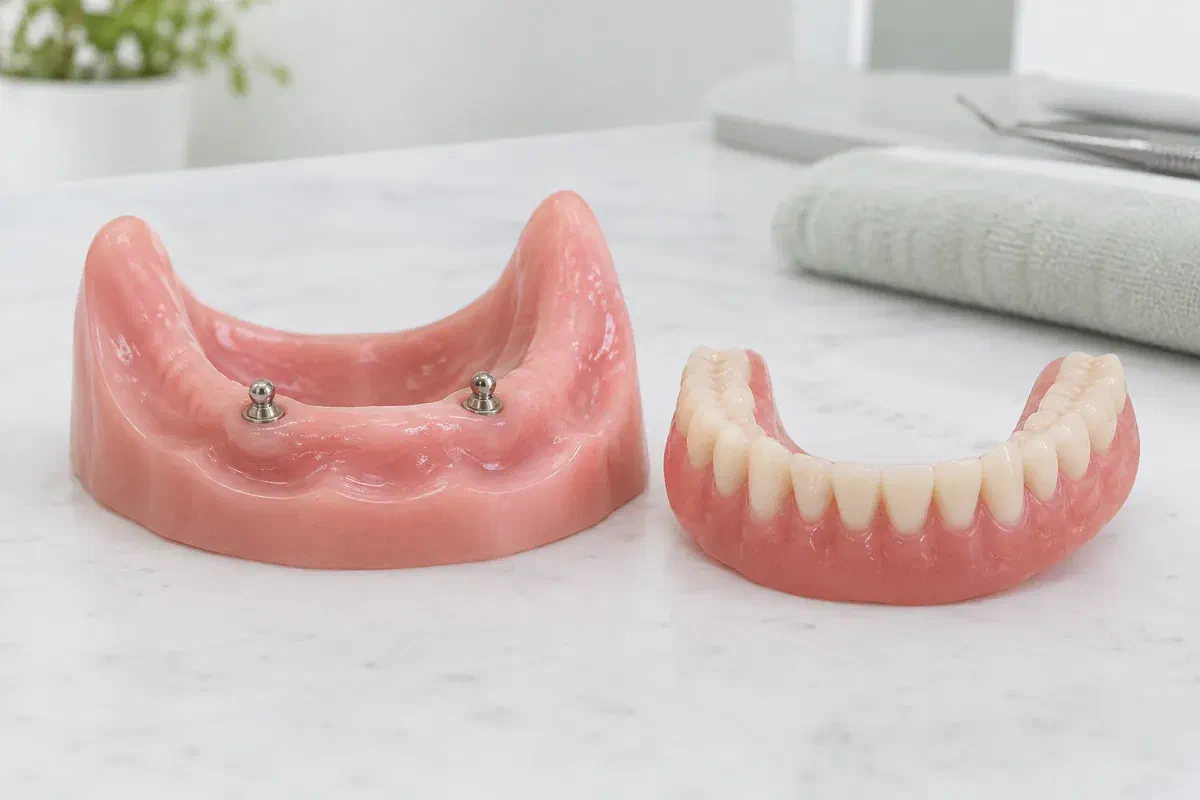
Illustrative discussion of a removable implant-retained denture
Restorative Dentistry

Snap-In Dentures

Explore a removable denture that connects to implant attachments. Discuss snap-in dentures in Milton, from suitability and everyday handling to the cleaning, adjustments, and maintenance that keep the plan practical.

A closer look at snap-in dentures

A more secure connection, with a removable daily routine.

Snap-in denture is a familiar name for a removable denture that connects to implant attachments. The attachments help retain the appliance, while you can still take it out as instructed for cleaning and overnight care. The exact support and connection depend on the design chosen for your mouth.

This is different from a fixed implant bridge that you cannot remove yourself. It also differs from an ordinary denture that does not connect to implants. Understanding those distinctions matters when you compare comfort, handling, cleaning access, cost, and the treatment needed before you can use the finished teeth.

At Milton Dental Clinic, the discussion starts with your current denture experience and what you would like to improve. We can review your mouth, explain further implant assessment, and consider whether a removable attachment-based approach is appropriate. Bring an existing appliance so the conversation can include its fit and the practical routine you already know.

Discuss a removable implant denture
Illustrative lower-jaw model with attachment heads beside a removable overdenture
What brings people to the conversation

Describe the moments when your current teeth feel limiting.

A loose denture can have several contributing factors. Explain your experience so the assessment can consider both the appliance and the tissues supporting it.

Movement during meals or conversation

Tell us when the denture lifts, rocks, or makes you hesitate during ordinary activities. Mention whether adjustments have helped before. Implant attachments may be one option, but the team first needs to understand the current fit and whether another improvement would be suitable.

Interest in more retention without fixed teeth

You may prefer an appliance you can remove for cleaning, or want to compare that arrangement with a fixed bridge. Discuss how you feel about both approaches. Removability is an important part of the design, not an incidental feature to discover after treatment.

Questions about managing the appliance

Tell the team about hand strength, dexterity, vision, or help you receive with daily care. Attaching, removing, and cleaning the denture must be manageable. A plan should account for these practical needs as well as the appearance of the replacement teeth.

An attachment system does not make every denture problem an implant problem. If you already have implants and the appliance becomes loose, both the denture components and the implants need appropriate assessment.

Understanding the proposed improvement

Consider stability together with maintenance.

For suitable patients, implant attachments can improve retention compared with an unsupported removable denture. The intended benefit should be discussed in relation to the activities that matter to you. Ask what movement is normal for the proposed design and what changes you can reasonably expect.

The connection also creates maintenance responsibilities. Attachment components can wear, and the denture base and teeth still need review. The tissues around implants require daily cleaning and professional monitoring. A useful plan includes these ongoing needs rather than treating the fitting appointment as the end of care.

Patient information: Leeds Teaching Hospitals — removable implant overdentures

Retention planned for the mouth

The number, position, and suitability of implants are determined through assessment. Upper and lower jaws can have different requirements. Ask why the recommended arrangement fits your anatomy and restoration rather than assuming every snap-in denture uses the same number of implants.

Access for cleaning

Removing the denture provides access to its underside and the implant attachments. Ask for a demonstration of the tools and movements you would need. Easy access is only useful if the routine is something you can carry out consistently.

An appliance you understand

Ask to see how the proposed connection works on a model. Discuss how it feels to seat and remove the denture and which parts may need replacement over time. That explanation can help you compare the daily experience with other options.

Planning and fitting the denture

Build the plan around the teeth, attachments, and daily use.

Treatment may involve several stages and clinicians. Ask for the sequence, expected intervals, and interim denture arrangements before deciding.

  1. Review the existing situation

    The dentist assesses your mouth, current appliance, medical history, and goals. Relevant imaging and further implant planning may be needed. Mention smoking, previous implant care, and any difficulty cleaning or handling your present denture.

  2. Agree on the restorative design

    Discuss implant suitability, the proposed attachment arrangement, appearance, and maintenance. Ask whether the current denture could be adapted or a new one is needed. Confirm the surgical, restorative, and follow-up costs included in the plan.

  3. Complete the required treatment stages

    If implants are required, placement and healing are planned before the attachments are used as intended. Existing implants need evaluation too. The clinician explains when the denture can be connected and what you should wear or avoid during the interim period.

  4. Fit the appliance and practise the routine

    The denture is checked for fit, retention, bite, and appearance. Practise insertion and removal with guidance rather than leaving unsure of the technique. Review the cleaning method, overnight instructions, and appointments for early adjustments and ongoing maintenance.

Living with attachment-retained teeth

Care for the denture and the connections beneath it.

The routine should reflect your specific attachment system and materials. Ask for written instructions and a demonstration you can repeat before going home.

Use the taught insertion and removal technique

Seat the appliance as shown and avoid forcing a denture that will not connect normally. Do not bite down hard to overcome resistance. Contact the clinic if removal becomes difficult or a connection feels different, especially after a recent adjustment.

Clean both sides of the arrangement

Remove the denture as instructed and clean its fitting surface, teeth, and attachment areas with suitable products. Clean around the implant connections in your mouth using the demonstrated tools. Ask before using a cleanser that could affect metal or other components.

Arrange review when retention changes

An attachment insert may wear, but a loose denture can have other causes. Report movement, soreness, bleeding, or a damaged component rather than replacing parts yourself. Keep the recommended reviews for the appliance and the health of the implant sites.

Comparing full-arch replacement choices

Choose the daily experience as well as the treatment.

Ask how each suitable option would be cleaned, maintained, and repaired. The appearance of the teeth is only one part of the comparison.

When an implant-free approach is preferred

A conventional removable denture

A new or adjusted conventional denture may be appropriate without implant surgery. Discuss the expected fit and limitations for your mouth. It still needs maintenance, but its treatment pathway and components differ from an implant-retained appliance.

When attachments suit the goals and anatomy

A removable implant overdenture

This approach adds implant retention while allowing you to remove the denture. Different attachment designs have different requirements. Compare the proposed stability, handling, cleaning, and likely maintenance rather than relying only on the phrase snap-in.

When a non-removable design is appropriate

A fixed implant restoration

A fixed bridge remains in place during daily care and needs access for cleaning underneath. Its implant, space, and maintenance requirements differ. Ask whether it is suitable and how the full treatment commitment compares with a removable design.

Patient information: ITI — fixed and removable implant replacement considerations

Questions about snap-in dentures

Understand the connection before choosing the appliance.

A model can help explain what stays in your mouth and what comes out. Ask the clinician to show both the wearing and cleaning routines.

(905) 876-4488
Are snap-in dentures permanently fixed to the implants?
No. The term usually describes an overdenture that you can remove from its implant attachments. A fixed implant bridge is a different design. Confirm exactly which type is being proposed, because removal, cleaning access, and maintenance are important differences.
Can my current denture be changed into a snap-in denture?
Sometimes an existing appliance can be adapted, but that depends on its condition, fit, available space, and the implant plan. A new denture may be more appropriate. Bring the current appliance so the clinician can assess it rather than making assumptions from its age alone.
Does every snap-in denture need two implants?
No. Implant number and arrangement depend on the jaw, anatomy, attachment design, and restorative needs. A common example shown on a model does not prescribe your treatment. Ask why the proposed configuration is suitable for your particular upper or lower arch.
Why might a snap-in denture become less retentive over time?
Attachment parts can wear, and changes in the denture or supporting tissues can also affect stability. The cause needs assessment before a component is replaced. Tell the team whether the change was gradual or sudden and whether there is any discomfort or movement at an implant.
Will I still remove a snap-in denture at night?
Follow the wearing instructions given for your appliance; removable overdentures are generally taken out for cleaning and overnight rest. Ask if there are temporary instructions after treatment. The implant connections also need their own cleaning routine while the denture is out.
What should the estimate include for ongoing snap-in denture care?
Ask about examinations, hygiene visits, attachment maintenance, denture adjustments, and possible repairs or relines. These needs vary with the design and use. Understanding the ongoing costs alongside the initial implant and denture stages helps you compare complete treatment plans.
Snap-in denture consultations in Milton

Let’s discuss a connection that fits your everyday life.

Arrange an assessment at our Bronte Street practice to explore a removable implant denture. Bring your current appliance and questions about retention, cleaning, handling, and the stages needed to reach the proposed result.

If an existing implant denture suddenly loosens or becomes painful, call and describe the change when arranging your visit.

Visit Milton Dental Clinic
Unit 1, 342 Bronte St. S, Milton, ON L9T 5B7
Get directions Clinic hours
Monday–Thursday
11am–7pm
Friday–Sunday
By appointment only

How can we help?

Milton Dental Clinic

Have a question about your smile? Choose the option that works best for you.

For urgent dental concerns, please call.
Messages are reviewed during clinic hours.