

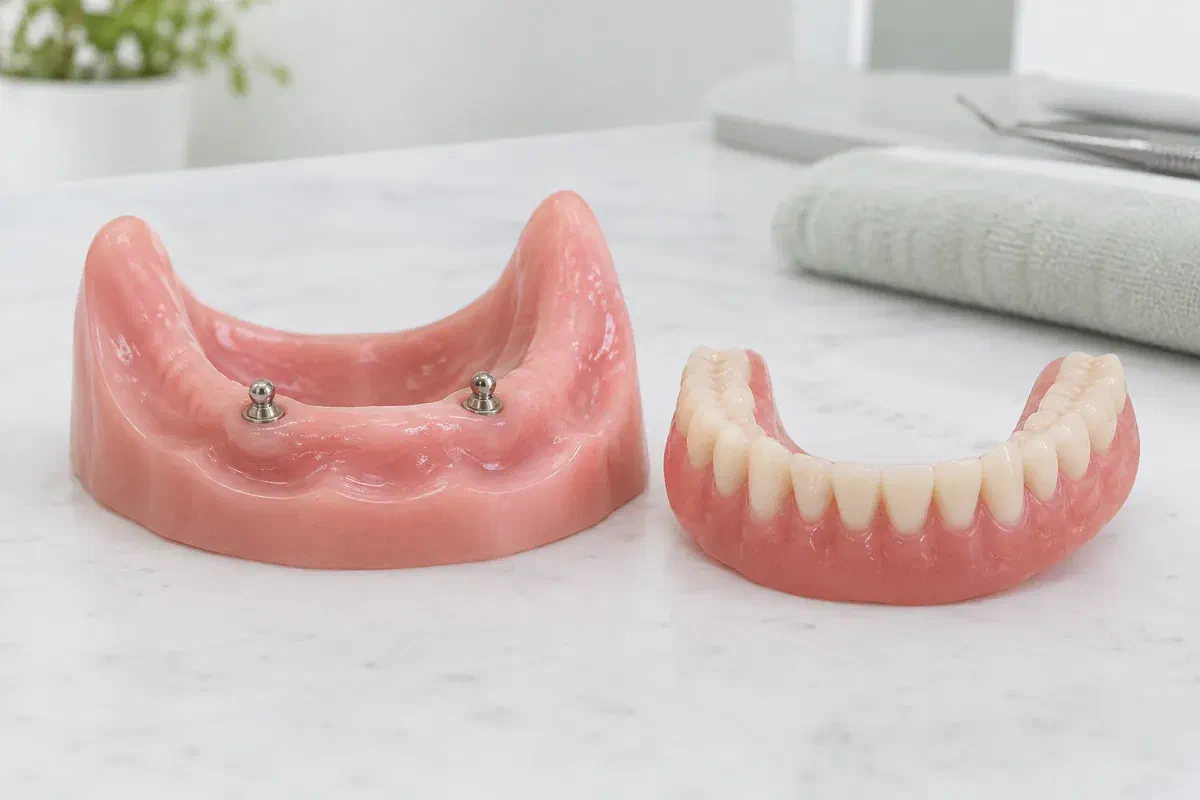
Illustrative discussion of a removable implant-retained denture
Restorative Dentistry

Snap-In Dentures in Campbellville

Has the click on your implant denture gone soft, or are you only starting to consider one? From Campbellville, talk with us about removable snap-in dentures: how the attachments hold, when to call before driving in, and what maintenance keeps them working.

New to it, or already wearing one

That reassuring click, and what it depends on.

Some people reach us because they are curious about implants. Others already have a snap-in denture and have noticed the connection is not as firm as it was. Either way, it helps to know what is going on. The appliance is removable and seats onto attachments fixed to dental implants, which provide much of its hold.

Those attachments separate it from two other designs. A conventional denture has no implants and depends on the gums, while a fixed implant bridge remains in the mouth and is not taken out at home. Each comes with its own cleaning access, comfort, cost and route through treatment.

For households around Campbellville, where trips into town are often planned around other errands, we try to make each visit count. We listen to how your denture behaves, examine your mouth, and explain whether implant assessment or a check of existing implants is the right step. Bring the appliance you wear.

Book an implant denture assessment
Illustrative lower-jaw model with attachment heads beside a removable overdenture
What people notice first

Something feels different.

Changes in how a denture holds can come from several sources. A careful description helps the team decide whether the appliance, the gums, the attachments or the implants need attention.

Wobble at meals or while talking

Explain when it happens and whether it began gradually or suddenly. If you have a conventional denture, mention relines and how long they helped. If you already have attachments, say when the hold first seemed weaker.

Wanting grip without fixed teeth

You may like being able to take the teeth out to clean, or you may be weighing a fixed bridge instead. Share that preference early, since it shapes both the implant plan and the routine you will live with.

Handling it on your own

Mention grip strength, eyesight or help you get from family. Living outside town can make it more important that you are confident seating, releasing and cleaning the denture without needing to come in.

A looser feel is not always about worn parts. When implants support a denture that has begun to move, both the attachment components and the implants themselves need examining before anything is swapped.

What attachments offer

Retention you can count on, with care.

When the mouth is suitable, implant attachments can help a removable denture hold more firmly than gum support alone. Think about what you would like to do with less worry, such as eating at a gathering or working outdoors. Ask what movement remains normal.

Attachments need looking after. Inserts wear with use, the denture teeth and base need periodic review, and the gums around each implant need daily cleaning and regular professional checks. Plan your reviews ahead, perhaps alongside other errands, so they do not slip.

Patient information: Leeds Teaching Hospitals — removable implant overdentures

An arrangement made for you

Assessment determines how many implants are suitable and where. Upper and lower jaws can be quite different. Ask the clinician to explain the reasoning instead of assuming every snap-in denture uses one standard layout.

Room to clean thoroughly

Because the denture comes out, you can reach the attachments in your mouth and the underside of the appliance. Ask for a demonstration of brushes and technique. Easy access only matters if you keep up the routine.

Knowing when something has changed

Ask to see and try the attachment on a model, and learn how a healthy connection should feel. Find out which parts wear. Familiarity helps you spot a change early and describe it clearly when you call.

How we plan treatment

Clear stages, sensibly grouped.

Several appointments and sometimes more than one clinician are involved. Ask for the order of steps, likely intervals and interim arrangements, and whether any visits can be combined.

  1. Assess the mouth and the appliance

    The dentist examines your gums, any existing implants, your denture, health history and goals. Imaging may be arranged. Mention smoking, previous implant work, when you first noticed a change and any handling difficulty.

  2. Decide on repair, adaptation or new design

    For an existing snap-in denture, this may mean replacing parts or adjusting the fit. For a new plan, implant suitability, attachment type, appearance and maintenance are discussed, along with the surgical, restorative and follow-up costs.

  3. Complete any implant stages

    Where new implants are needed, placement and healing are planned before the attachments are relied upon. Existing implants are evaluated. The clinician explains when connection can happen and what to wear in between.

  4. Fit and practise

    The denture is checked for fit, retention, bite and appearance. You practise seating and removing it with guidance, then review cleaning, overnight care and early follow-up appointments before heading home.

Everyday care

Habits that protect the connection.

Instructions depend on your attachment system and materials. Keep a written copy at home so you can refer back to it.

Use your fingers, not your bite

Seat the denture with the hand technique you learned. Biting down to force it can damage components. If it will not engage normally or becomes hard to remove, call the clinic before trying anything else.

Clean the denture and around each implant

Out of the mouth, brush the denture teeth, its underside and the attachment housings using suitable products. Then clean gently around the implant heads with the aids you were shown. Ask before using a new soak.

Call before you drive in

If the hold changes, a quick call lets us advise whether you need to come in and what to bring. Report movement, soreness, bleeding or damage, and avoid replacing parts yourself. Keep your regular reviews.

Comparing approaches

Which routine fits rural life best?

For each suitable option, ask how it is cleaned, maintained and repaired, and how often it is likely to need a visit. The appearance of the teeth is only part of it.

No implant surgery

Conventional denture

A new or refitted denture may be appropriate. Ask what fit and limitations to expect for your mouth. It still needs care and periodic relines, but it has fewer components than an implant-retained appliance.

Implant hold, still removable

Snap-in overdenture

Implants add retention while the denture still comes out. Attachment systems differ in what they require. Compare the proposed system’s hold, ease of handling, cleaning and expected servicing, not just its name.

Stays in place

Fixed implant bridge

A fixed bridge is not removed at home and needs special cleaning beneath it. It has different implant, space and maintenance requirements. Ask whether it is suitable and how the full commitment compares.

Patient information: ITI — fixed and removable implant replacement considerations

Questions from Campbellville

When the hold changes, and other concerns.

Looking at a model often makes it easier to describe what you are feeling. Ask the team to show how a healthy connection should engage.

(905) 876-4488
My snap-in denture used to click firmly. Why does it feel weaker now?
Worn inserts are a common reason, but changes in the gums, the denture base or the implants can also affect hold. The cause should be checked before parts are replaced. Note whether the change was gradual or sudden.
Can I change the inserts myself?
It is best to have inserts changed at the clinic. The team can check the fit, the denture and the implants at the same time, and make sure the correct replacement part is used for your system. Fitting the wrong insert, or seating one incorrectly, could affect how the denture connects.
My implants were placed elsewhere. Can you still help?
Often, yes. Bring any records you have about the implant system and attachments. The team will assess the denture and implants and explain whether parts, adjustments or other treatment are appropriate.
Should I stop wearing the denture if it feels loose?
Call for advice. In some cases you may be asked to wear it carefully, while in others it is better to rest the area. If an implant feels mobile or there is pain or swelling, avoid loading it.
What should I bring to the appointment?
Bring the denture, any spare parts or paperwork you have, a medication list and notes on when the change started. If you have an older denture you used before this one, bring that too. These details help make the visit more productive and can reduce the chance of needing an extra trip just to gather information.
Can routine reviews be timed with other appointments?
Where it is clinically appropriate, the team can try to coordinate review and hygiene visits. Ask when booking, and let us know if several family members need appointments around the same time.
From Campbellville to Bronte Street

One well-planned visit to start.

Book an assessment to talk about a new or existing implant denture. Bring the appliance, any implant records and your questions about hold, cleaning, handling and what treatment may involve.

If your implant denture has suddenly become loose or painful, call first and describe what happened so we can advise before you set out.

Visit Milton Dental Clinic
Unit 1, 342 Bronte St. S, Milton, ON L9T 5B7
Get directions Clinic hours
Monday–Thursday
11am–7pm
Friday–Sunday
By appointment only

Areas we serve

  • Milton
  • Oakville
  • Mississauga
  • Georgetown
  • Halton Hills
  • Acton
  • Campbellville
  • Brampton
  • Burlington
  • Puslinch
  • Rockwood
  • Erin
  • Caledon
  • Etobicoke
  • Old Milton
  • Bronte Meadows
  • Timberlea
  • Dorset Park
  • Dempsey
  • Clarke
  • Beaty
  • Coates
  • Harrison
  • Scott
  • Willmott
  • Ford
  • Bowes
  • Cobden
  • Walker
  • Mountain View
  • Milton Heights
  • Hawthorne Village
  • Valley View
  • Fallingbrook
  • Nassagaweya
  • Trafalgar
  • Esquesing
  • Nelson
  • Brookville
  • Moffat
  • Glen Williams
  • Norval
  • Limehouse
  • Stewarttown
  • Ashgrove
  • Hornby
  • Silver Creek
  • Speyside
  • Scotch Block
  • North Oakville
  • River Oaks
  • Glen Abbey
  • West Oak Trails
  • Palermo
  • Bronte Creek
  • College Park
  • Joshua Creek
  • Uptown Core
  • Preserve
  • Iroquois Ridge
  • Lisgar
  • Meadowvale
  • Meadowvale Village
  • Churchill Meadows
  • Erin Mills
  • Central Erin Mills
  • Streetsville
  • East Credit
  • Creditview
  • Heartland
  • Sheridan
  • Mount Pleasant
  • Credit Valley
  • Huttonville
  • Churchville
  • Springbrook
  • Northwest Brampton
  • Bram West
  • Fletcher's Meadow
  • Fletcher's Creek South
  • Alton Village
  • Orchard
  • Millcroft
  • Headon Forest
  • Tansley
  • Brant Hills
  • Tyandaga
  • Kilbride
  • Lowville
  • Aberfoyle
  • Morriston
  • Arkell
  • Hillsburgh
  • Freelton
  • Carlisle
  • Waterdown
  • Flamborough
  • Mountsberg

How can we help?

Milton Dental Clinic

Have a question about your smile? Choose the option that works best for you.

For urgent dental concerns, please call.
Messages are reviewed during clinic hours.