

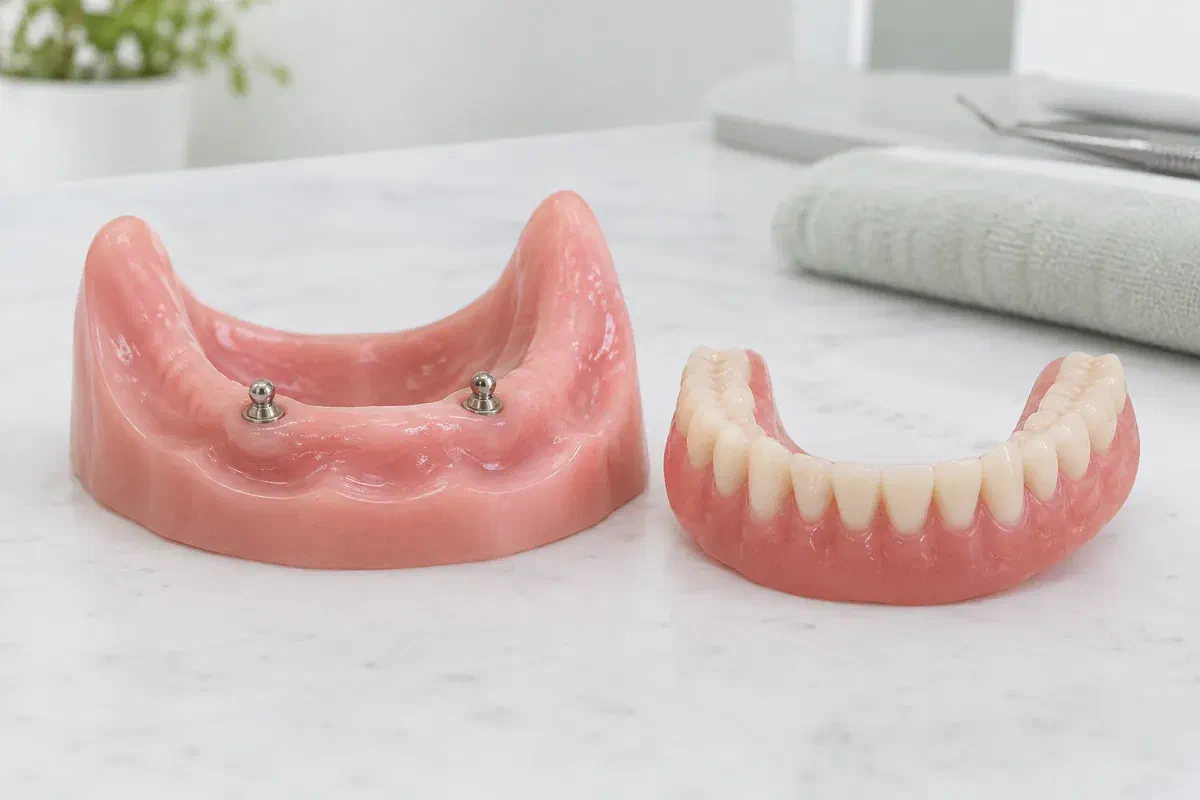
Illustrative discussion of a removable implant-retained denture
Restorative Dentistry

Snap-In Dentures in Puslinch

A snap-in denture has to feel right in your fingers as well as your mouth. For people in Puslinch, we explain how removable implant-retained dentures are seated and released, who they may suit, and what cleaning and maintenance follow.

A hands-on kind of appliance

Try the release before you choose the design.

Here is something brochures rarely mention: every snap-in denture has to be pulled free of its attachments, usually more than once a day. It is a removable appliance that seats onto connectors linked to dental implants. The firmer the hold, the more deliberate that release becomes, so how it feels in your hands matters.

Compare that with the other paths. A conventional denture lifts off the gums with little resistance because there are no implants involved. A fixed implant bridge is never removed at home at all. Handling, cleaning, comfort, cost and the number of treatment stages differ widely across the three.

Coming from Puslinch, you can expect a first visit that is part conversation, part demonstration. We ask what your present teeth or denture make awkward, examine your mouth, and explain whether further implant assessment would be useful. If you wear a denture, bring it, and tell us honestly how easy it is to manage.

See how a snap-in denture handles
Illustrative lower-jaw model with attachment heads beside a removable overdenture
Questions worth raising

Is your denture holding you back?

Loose dentures can have a number of causes. Being specific helps the team weigh the appliance, the gums and whether an attachment design would genuinely help.

Teeth that move when they should not

Maybe it tips when you bite into something firm or shifts while you are working outdoors and talking. Note the situations, and whether adjustments have ever lasted. A refit may be considered before implant attachments.

Hold, but with the freedom to remove

Some people want security yet still like to take their teeth out to clean properly. Others prefer the idea of teeth that stay. Make your preference known early, since it determines the whole approach.

Grip, reach and fine control

Arthritis, a past hand injury, tremor or reduced feeling in the fingertips can make releasing attachments harder. Mention these, and any help you have. The design should match your hands, not only your smile.

Implants do not solve every loose denture. If you already have implants and the denture is starting to move, the attachment parts and the implants both need to be properly assessed.

The trade-off, plainly

More hold usually means a firmer release.

In suitable cases, implant attachments can help a removable denture resist movement better than one resting on the gums. Think about which daily moments you want to feel steadier. Ask what movement is normal and how firmly the proposed attachments hold.

Retention and maintenance travel together. Inserts wear, the denture still needs regular review, and the gums around each implant need daily cleaning and professional monitoring. Some attachment systems offer different levels of hold, which may be worth discussing if handling is a concern.

Patient information: Leeds Teaching Hospitals — removable implant overdentures

Implants planned around your jaw

The count and position of implants depend on your anatomy and the restoration. Upper and lower arches may differ. Ask the clinician to explain the reasoning rather than assuming every snap-in denture follows a standard pattern.

Access you can manage

Once out, the denture’s underside and the attachments in your mouth are easy to reach. Ask for a demonstration of the brushes, including options with larger handles. Access helps only if you can use it consistently.

A connection you have tested

Ask to seat and release a denture on a model yourself, ideally more than once. Learn which parts wear and are replaced. That practical experience is one of the best ways to judge whether the design suits you.

The treatment sequence

Plan, place, heal, fit.

Treatment often involves several visits and more than one clinician. Ask for the order of stages, approximate intervals and what you will wear in between before you decide.

  1. Assessment, including your hands

    The dentist reviews your mouth, current denture, medical history and goals, and asks about dexterity. Imaging may be arranged if implants are being considered. Mention smoking, past implant treatment and handling difficulties.

  2. Choosing an attachment that fits you

    Implant suitability, attachment type, retention level, appearance and maintenance are discussed. You will learn whether your current denture can be modified or replaced, and what the surgical, restorative and review stages cost.

  3. Implant placement and healing

    Any new implants go in first and are given time to heal before the attachments carry their full role. Existing implants are evaluated. The clinician explains the interim arrangement and when connection can happen.

  4. Fitting and repeated practice

    Fit, hold, bite and appearance are checked. You practise seating and releasing the denture with guidance, as many times as needed. Cleaning, overnight care and early adjustment visits are reviewed before you leave.

At home, each day

Gentle technique protects the parts.

The routine depends on your attachment system and materials. Ask for written steps, and practise them in the chair until you are confident.

Release with the right grip

Use the fingertip or thumbnail position you were taught, and lift evenly rather than twisting. Never bite the denture into place. If removal becomes painful or unusually hard, call before forcing it.

Clean the appliance and the implant areas

Brush the denture teeth, underside and attachment housings with suitable products. Then clean gently around each implant in your mouth using the aids shown. Ask before using any new soak, since some may affect metal parts.

Tell us when handling changes

A denture that is suddenly much easier or harder to release is worth reporting. Inserts wear, but tissue or denture changes can also be involved. Avoid swapping parts yourself, and keep regular reviews.

Other ways forward

Handling differs as much as appearance.

For each suitable choice, ask how it is cleaned, maintained and repaired, and how it feels to handle. Looks are only one part of the decision.

Easiest to remove, no implants

A conventional denture

A new or relined denture may suit you without surgery. Ask what fit and limitations to expect. Care is still needed, but there are no attachments to release and fewer components than an implant-retained appliance.

Removable, with attachment hold

An implant overdenture

Implants add retention while the denture comes out. Attachment systems vary in their requirements and in how firmly they hold. Compare stability, ease of release, cleaning and upkeep for the proposed system.

Nothing to remove at home

A fixed implant bridge

A fixed bridge stays in and needs special cleaning tools underneath. Implant, space and maintenance needs differ. Ask whether it suits you and how the cleaning effort compares with a removable design.

Patient information: ITI — fixed and removable implant replacement considerations

Puslinch FAQs

Handling, grip and everyday use.

Trying the release on a model can tell you more than a description. Ask the team to let you practise before making a decision.

(905) 876-4488
Is a snap-in denture hard to take out?
It takes more effort than a conventional denture, because the attachments are designed to hold. Most people learn a technique that works for them. If removal is difficult, the team can review your method or the attachment design.
Can the attachment hold be made lighter?
With some systems, different inserts provide different levels of retention. Whether that is suitable depends on your attachment design and situation, because lighter hold can also mean the denture moves more during meals. Ask the clinician if handling is a concern, and describe exactly which part of the release feels hardest.
What if I have arthritis in my hands?
Mention it at the first visit. The team can consider attachment options and techniques that may be easier to manage, and discuss whether a helper should learn the routine. The plan should suit your hands.
Are there cleaning brushes that are easier to hold?
Yes, there are brushes and aids with larger or adapted handles. Ask the team which suit your attachments and gums, and practise with them before deciding which to use at home.
What if the denture snaps in on one side but not the other?
Do not bite down to force it. Take it out, check for debris, and try again with the technique you were shown. If it still will not seat evenly, call the clinic for advice, and mention whether anything was dropped, bent or recently adjusted. Uneven seating can have a simple cause, but it is worth checking.
Can I practise handling before the final denture is made?
Ask whether a model or demonstration denture is available during planning. Practising early can help you and the clinician decide whether a particular attachment design is practical for you.
Visiting from Puslinch

Feel the connection for yourself.

Come to our Bronte Street practice to explore whether a removable implant denture could suit you. Bring the denture you wear now and questions about grip, release, cleaning and the stages ahead.

If an implant denture you already wear has suddenly become loose or sore, describe the change on the phone so we can plan the visit.

Visit Milton Dental Clinic
Unit 1, 342 Bronte St. S, Milton, ON L9T 5B7
Get directions Clinic hours
Monday–Thursday
11am–7pm
Friday–Sunday
By appointment only

Areas we serve

  • Milton
  • Oakville
  • Mississauga
  • Georgetown
  • Halton Hills
  • Acton
  • Campbellville
  • Brampton
  • Burlington
  • Puslinch
  • Rockwood
  • Erin
  • Caledon
  • Etobicoke
  • Old Milton
  • Bronte Meadows
  • Timberlea
  • Dorset Park
  • Dempsey
  • Clarke
  • Beaty
  • Coates
  • Harrison
  • Scott
  • Willmott
  • Ford
  • Bowes
  • Cobden
  • Walker
  • Mountain View
  • Milton Heights
  • Hawthorne Village
  • Valley View
  • Fallingbrook
  • Nassagaweya
  • Trafalgar
  • Esquesing
  • Nelson
  • Brookville
  • Moffat
  • Glen Williams
  • Norval
  • Limehouse
  • Stewarttown
  • Ashgrove
  • Hornby
  • Silver Creek
  • Speyside
  • Scotch Block
  • North Oakville
  • River Oaks
  • Glen Abbey
  • West Oak Trails
  • Palermo
  • Bronte Creek
  • College Park
  • Joshua Creek
  • Uptown Core
  • Preserve
  • Iroquois Ridge
  • Lisgar
  • Meadowvale
  • Meadowvale Village
  • Churchill Meadows
  • Erin Mills
  • Central Erin Mills
  • Streetsville
  • East Credit
  • Creditview
  • Heartland
  • Sheridan
  • Mount Pleasant
  • Credit Valley
  • Huttonville
  • Churchville
  • Springbrook
  • Northwest Brampton
  • Bram West
  • Fletcher's Meadow
  • Fletcher's Creek South
  • Alton Village
  • Orchard
  • Millcroft
  • Headon Forest
  • Tansley
  • Brant Hills
  • Tyandaga
  • Kilbride
  • Lowville
  • Aberfoyle
  • Morriston
  • Arkell
  • Hillsburgh
  • Freelton
  • Carlisle
  • Waterdown
  • Flamborough
  • Mountsberg

How can we help?

Milton Dental Clinic

Have a question about your smile? Choose the option that works best for you.

For urgent dental concerns, please call.
Messages are reviewed during clinic hours.